Ford F-100 (1953-1956): History, Engines and How to Spot the Years
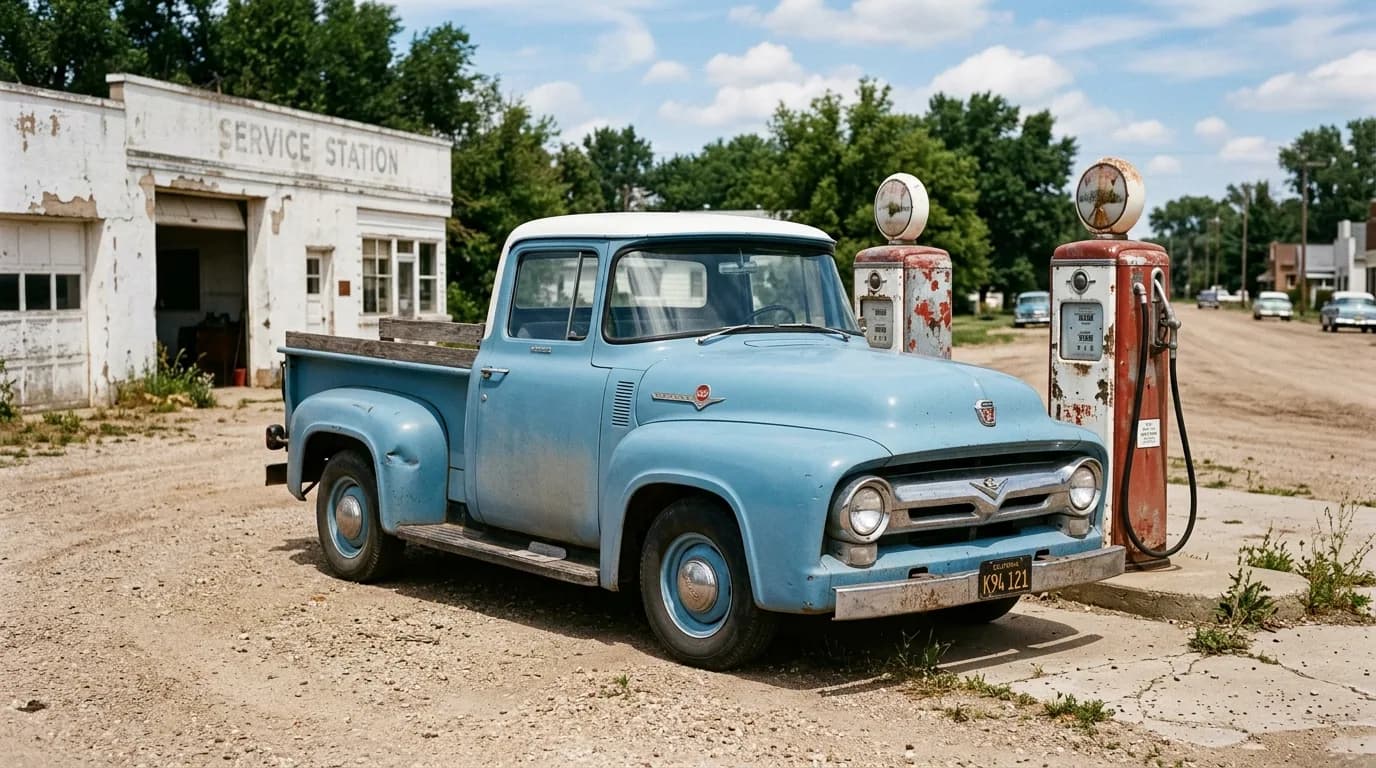
Every F-150 on the road today wears a naming scheme Ford started in 1953. That was the year Ford's half-ton F-1 became the F-100, and the three-digit F-series names have stuck ever since. The AI render above sets an F-100 at a service station that looks like it's been serving the same stretch of highway for decades, pumps and all, a fitting scene for a generation built for exactly this kind of small-town, working-truck duty.
Why It's Called the F-100
Ford's half-ton pickup had been badged simply F-1 since 1948, but for the 1953 model year, the year Ford also marked its 50th anniversary, the company overhauled its truck lineup's naming convention. The single-digit F-1 through F-8 designations gave way to three-digit numbers, and the half-ton became the F-100, with the F-250 and F-350 filling in above it. That naming change stuck: the three-digit F-series names Ford still uses, right through the modern F-150, trace back to this 1953 relaunch. Ford marketed the new lineup as the "Triple Economy" trucks, emphasizing economy of purchase, operation, and maintenance, and the same three-digit numbering scheme covered the whole range that year, from the F-100 half-ton up through the heavy-duty F-350.
A Grille That Changed Almost Every Year
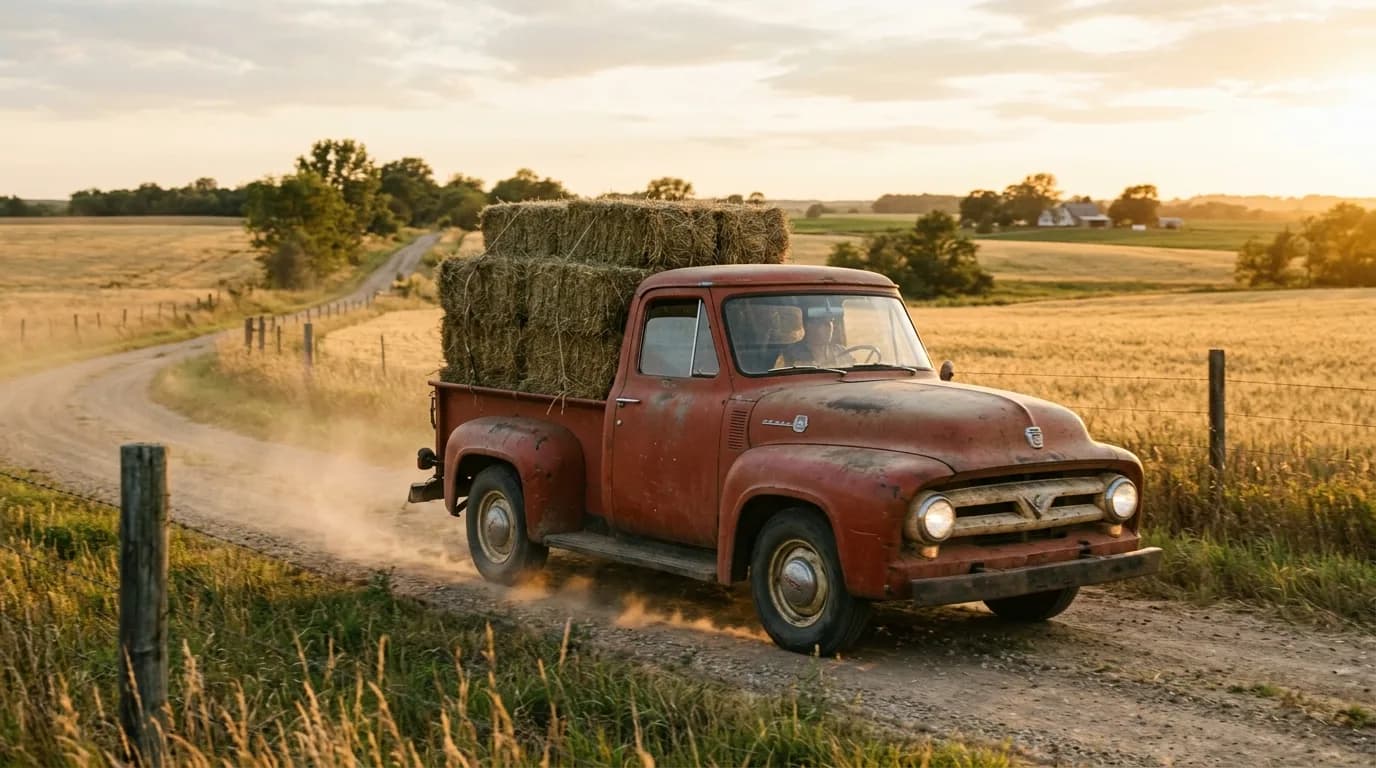
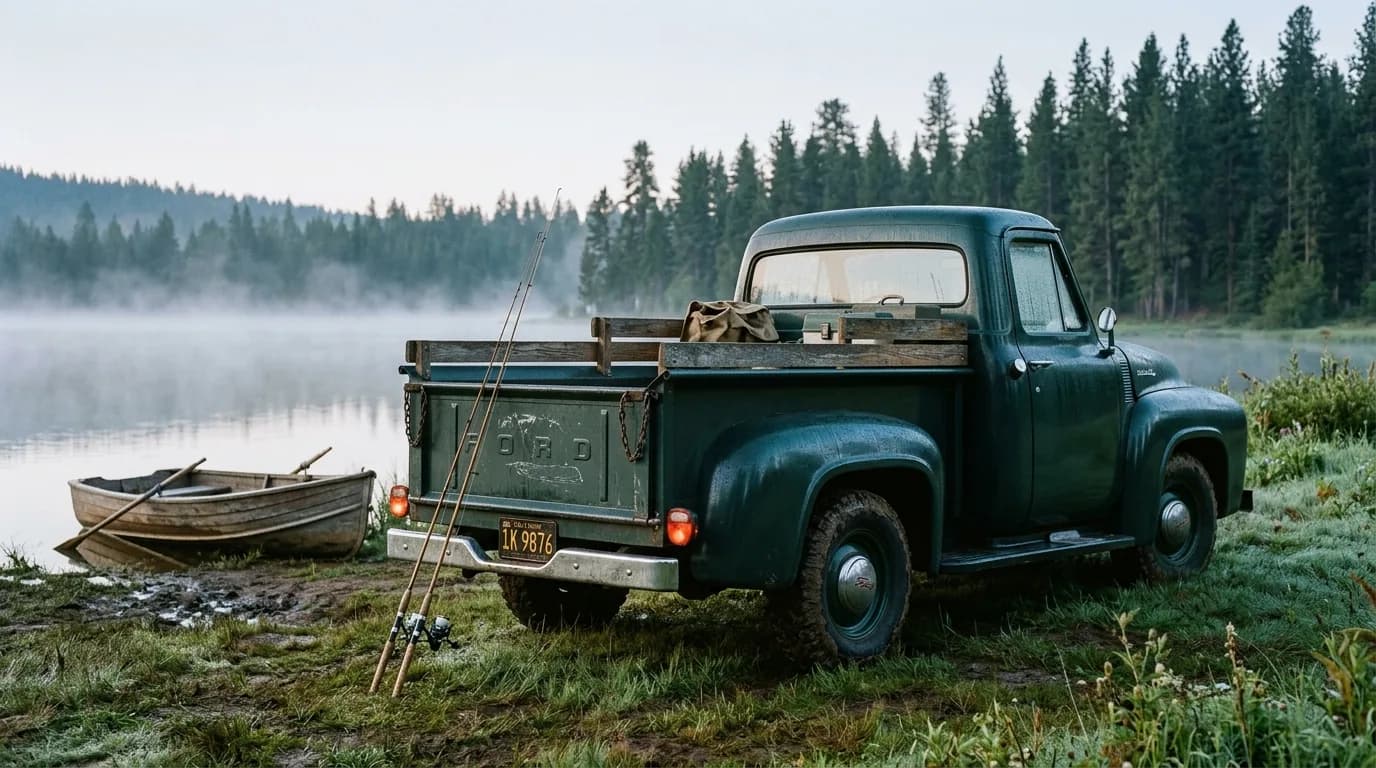
Unlike a lot of 1950s trucks that kept one grille design for several seasons, the F-100 got a new grille treatment nearly every year of this generation, which makes it one of the easier trucks to date at a glance. The 1953 trucks wore a simple two-bar grille. For 1954, Ford revised it to a single slanted bar running between the headlights. The 1955 model brought a double-bar grille back, with a notch in the center bar to make room for a V8 emblem on V8-equipped trucks. Through all of these changes, the cab, doors, hood, and front fenders carried over largely unchanged, with a flat, two-piece windshield split by a narrow center post, the look seen on the trucks pictured here.
The Big Change: 1956's Wraparound Windshield
Ford saved the biggest update for last. The 1956 F-100 got a genuinely new cab: a wraparound, one-piece windshield replaced the old flat two-piece glass, along with new doors, a redesigned dashboard, and an optional wraparound rear window now known among collectors as the "Big Window" cab, built on only about 6,200 of the 1956 trucks. Seat belts also became a factory option for the first time in 1956, an early step toward the safety features buyers now take for granted. Because the wraparound windshield is so distinctive, it's the fastest way to separate a 1956 F-100 from the 1953-1955 trucks that came before it; if the glass is flat and split by a center post, it's an earlier truck.
From Flathead to Y-Block
Engine choices moved fast during this generation too. The 1953 F-100 came standard with a 101-horsepower inline six, with a flathead V8 rated at about 106 horsepower as the truck's last year offering that old-style engine. For 1954, Ford dropped the flathead in favor of its new overhead-valve Y-block V8, rated at 130 horsepower, alongside an upgraded 115-horsepower six; both carried into 1955. That switch from flathead to overhead-valve architecture mirrored what was happening across the industry in the mid-1950s, as manufacturers chased more power without simply enlarging an older design. The 1956 model year brought another bump, to a 137-horsepower six and a 172-horsepower Y-block V8. A three-speed manual was standard the whole generation, with a four-speed manual and Ford's new three-speed Ford-O-Matic automatic, introduced for 1953, available as options for buyers who didn't want to work a clutch all day.
A Truck Built to Work
The second-generation F-100 rode on a 110-inch wheelbase with an overall length of about 189 inches, and it introduced a deeper, 20-inch cargo bed, a real improvement for farmers and tradesmen loading feed sacks or tools. Ford also introduced the Custom Cab trim for 1955, adding more chrome and interior trim for buyers who wanted a truck that looked as good parked at church as it did hauling hay, while the base trim stayed simple and inexpensive for anyone who just needed a work truck. That combination, a rugged half-ton that could be dressed up or kept plain, and a name that Ford never went back on, is a big part of why this generation of F-100 still shows up at truck shows and swap meets today, whether it's the flat-windshield look of 1953-1955 or the wraparound-glass 1956 that closed out the generation.
Specs
- Model years
- 1953-1956 (second-generation F-Series, F-100 half-ton)
- Name change
- F-1 became F-100 for 1953, alongside Ford's 50th-anniversary lineup relaunch
- Grille
- Two-bar (1953), single slanted bar (1954), double-bar with V8 notch (1955), revised again for 1956
- Windshield
- Flat, split two-piece glass (1953-1955); one-piece wraparound windshield (1956 only)
- Engines
- Inline six (101-137 hp across the years); flathead V8 (1953 only); Y-block V8 (1954-1956, 130-172 hp)
- Transmission
- 3-speed manual standard; 4-speed manual or 3-speed Ford-O-Matic automatic optional
- Wheelbase
- 110 in (F-100); 20-inch-deep cargo bed introduced this generation
- Trim
- Custom Cab introduced for 1955; factory seat belts optional starting 1956
Get the Look
As an Amazon Associate we earn from qualifying purchases.
A shelf-size version of the second-generation F-100 shape.
Check price at AmazonBackground reading on the F-1 to F-100 transition and what came after.
Check price at AmazonFor keeping any year's grille bright, whatever the bar count.
Check price at AmazonFAQ
- Why did the Ford F-1 become the F-100?
- Ford overhauled its truck naming convention for the 1953 model year, switching from single-digit names (F-1 through F-8) to three-digit ones. The half-ton F-1 became the F-100, a name Ford's half-ton trucks still carry today.
- How can you tell a 1956 F-100 from earlier years?
- The windshield is the giveaway. 1953-1955 trucks have a flat, two-piece windshield split by a center post. The 1956 F-100 got a new cab with a one-piece wraparound windshield and new doors.
- When did the Ford F-100 get a V8 option?
- A flathead V8 rated at about 106 horsepower was optional starting in 1953, its last year in the F-100. Ford replaced it with a new overhead-valve Y-block V8, rated at 130 horsepower, for the 1954 model year.
- What years make up the second-generation Ford F-100?
- The 1953 through 1956 model years, running on a shared cab and frame with a different grille nearly every year and a major cab redesign for the final 1956 model.