1966 Pontiac GTO: The Loophole That Became the Goat
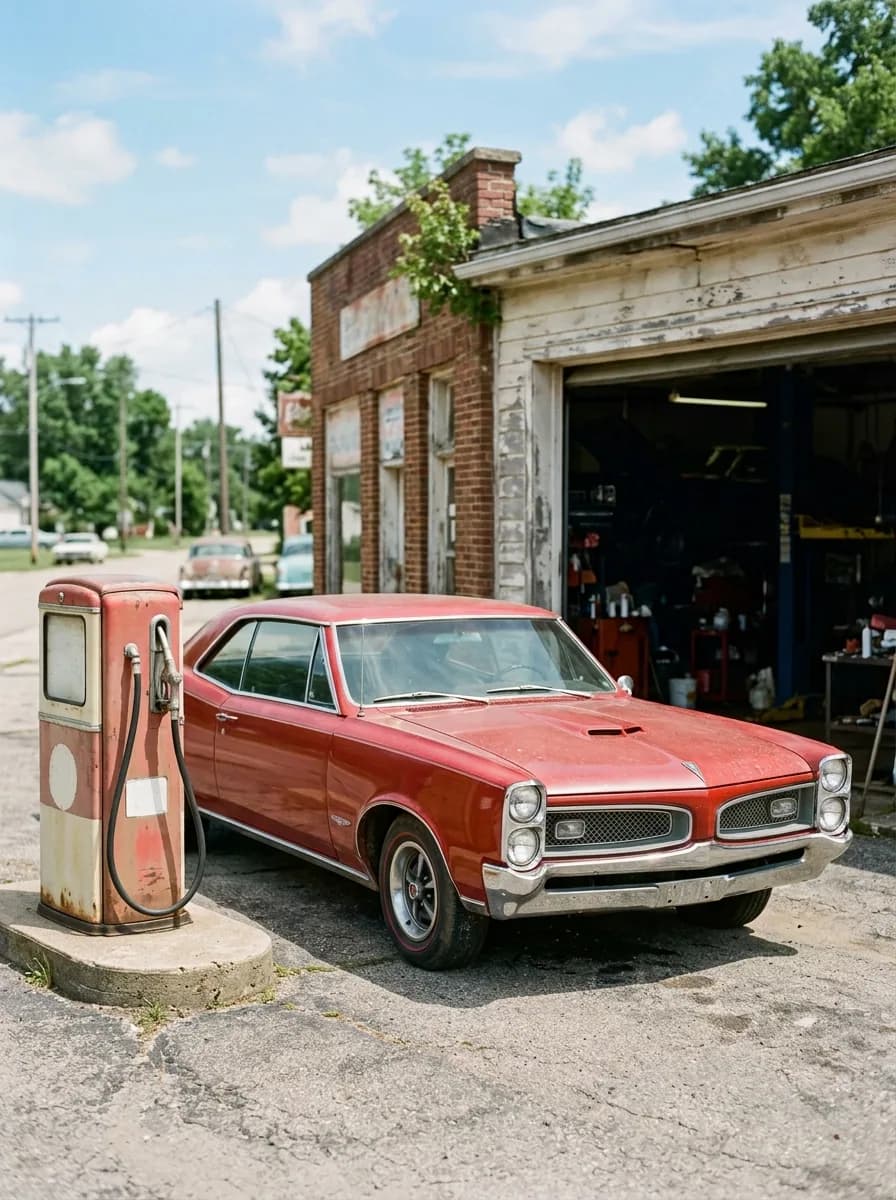
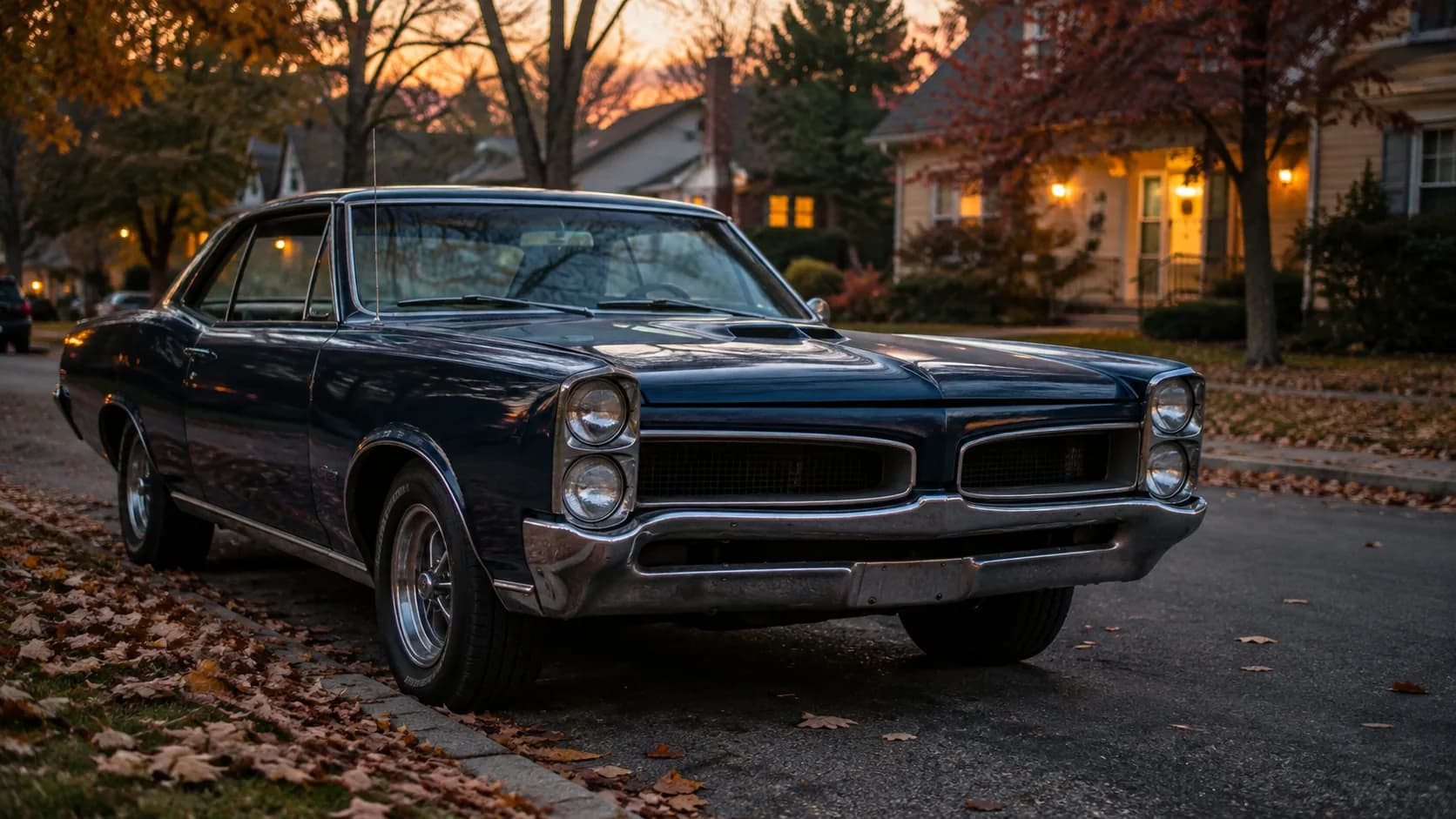
General Motors planners guessed the GTO option would draw maybe 5,000 buyers; by 1966 Pontiac was building 96,946 of them in a single model year. The AI-generated scene above parks a red GTO at a faded small-town filling station, where it would have looked equally at home in 1966 or last Tuesday, because for one wild model year the GTO was the machine every gearhead in America wanted parked next to the pumps.
Born as a Loophole
General Motors had a corporate rule in the early 1960s: no intermediate-sized car could carry an engine larger than 330 cubic inches. Pontiac chief engineer John DeLorean and his engineers Bill Collins and Russ Gee noticed that the division's 389 cubic-inch V8 bolted into the compact Tempest LeMans without any real modification. Rather than fight GM's policy head-on, Pontiac general manager Elliott "Pete" Estes signed off on a workaround: offer the 389 as a dealer-ordered option package on the Tempest LeMans for 1964, badged GTO after Ferrari's own Gran Turismo Omologato racers. GM's planners guessed the option would draw maybe 5,000 buyers. Pontiac sold 32,450 in that first year alone.
From Option Sheet to Own Model
The GTO package carried into 1965 on a restyled Tempest body and found an even bigger audience — 75,352 sold. By then it was obvious the GTO wasn't a niche add-on; it was the reason people were walking into Pontiac showrooms. For 1966, Pontiac cut the cord entirely and gave the GTO its own model line, separate from the Tempest order form, with fresh sheet metal and a front end unique to the '66 and '67 cars: dual headlights stacked vertically in each fender instead of side by side, a look no other Pontiac wore before or after.
389 Cubic Inches, Two Ways
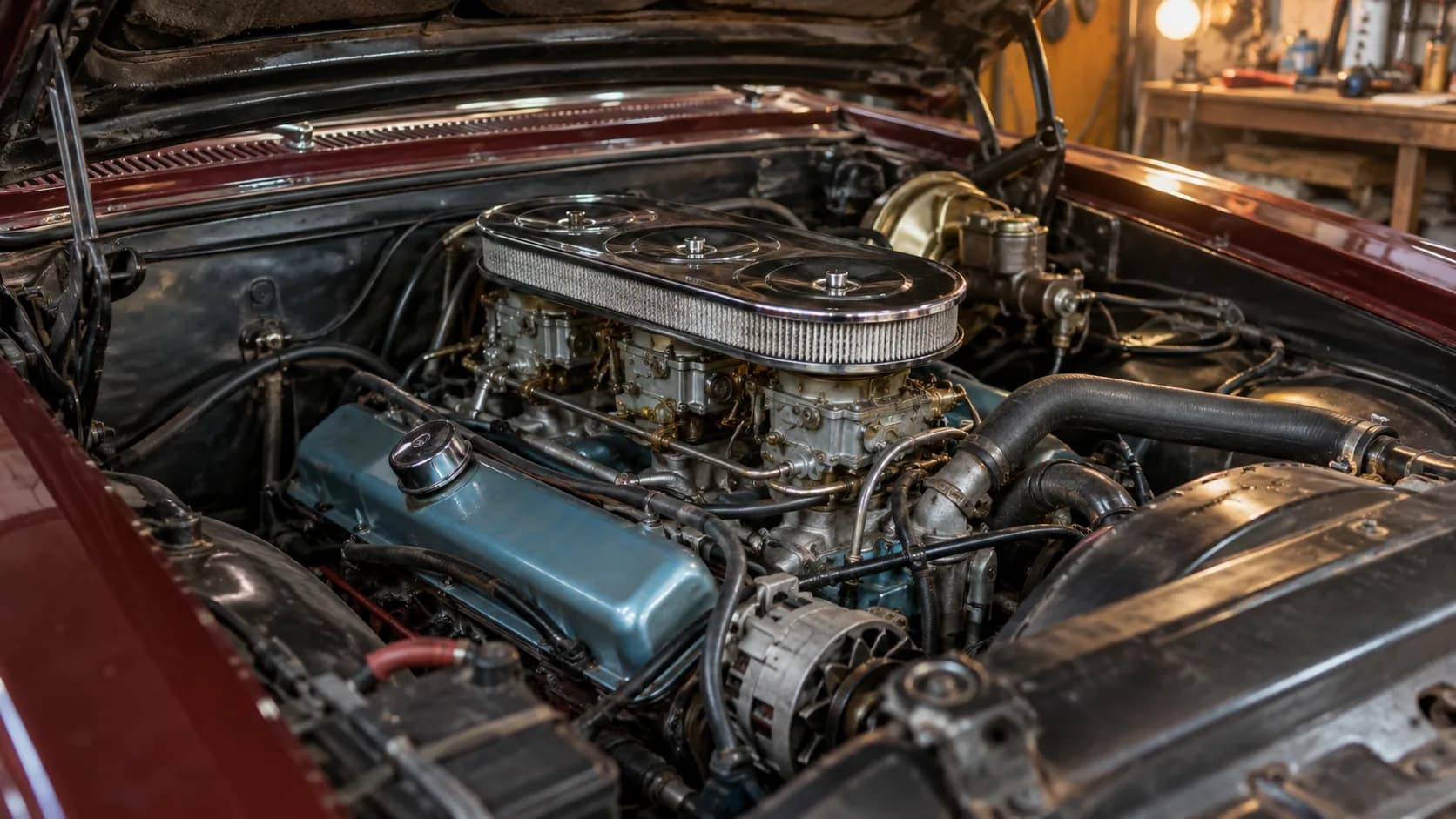
Every 1966 GTO left the factory with a 389 cubic-inch V8. In base form, with a single four-barrel Carter carburetor, it made 335 horsepower. Buyers who checked the Tri-Power box got triple two-barrel Rochester carburetors instead — a small center carb for everyday driving and two outer carbs that opened under hard throttle — for a factory rating of 360 horsepower. Pontiac built 19,045 GTOs with Tri-Power that year, out of a total 1966 production run that dwarfed anything the model had done before or would do again.
The Goat Gets Its Name
Pontiac's own ad campaign pitched the car as the "GTO Tiger," and the agency behind that push — MacManus, John & Adams, with Pontiac account man Jim Wangers driving much of the youth-focused marketing — had built the GTO's image around that big-cat theme from the start. Buyers on the street had other ideas. The GTO abbreviation got turned into a word — add an A to G-T-O and you get GOAT — and Wangers himself later described the nickname taking hold that way, as wordplay rather than a marketing decision. It stuck as a term of affection rather than an insult. GM brass reportedly weren't thrilled about their flagship performance car being nicknamed after a barnyard animal, but "the Goat" outlived every official slogan Pontiac tried to attach to it.
A Record Year
1966 turned out to be the high-water mark for GTO production: 96,946 units, a number the model never matched again even as Pontiac kept the GTO alive into the early 1970s. The sales numbers didn't go unnoticed in Detroit — Chevrolet answered with the Chevelle SS 396, Plymouth countered with the Road Runner and GTX, and Ford leaned harder into the Fairlane and Torino GT, all chasing the same formula the GTO had proven: drop a big engine into a mid-size body and sell it to buyers who wanted a fast car more than a big one. For one year, before that competition fully caught up, the GTO simply owned the category it had invented.
Buying One Today
A genuine 1966 Tri-Power car is a different proposition from a base four-barrel GTO, and the two get mixed up often enough that documentation matters more than the seller's word. A PHS (Pontiac Historic Services) report ties a specific VIN to its original engine, transmission, and options, which is the most reliable way to confirm Tri-Power originality — plenty of cars have had the triple-carb setup added later, since the parts were shared across other Pontiac lines and aren't hard to source. Beyond paperwork, check the usual A-body trouble spots: trunk floors, lower quarter panels, and the frame rails where they meet the floor pan, all common rust points on cars that have spent decades outside. None of that diminishes what the '66 GTO represents — the year a loophole-born option package became a car every other Detroit brand felt obligated to copy.
Specs
- Model year GTO became its own series
- 1966
- Base engine
- 389 cu in V8, 335 hp
- Tri-Power option
- 389 cu in V8, triple 2-bbl carbs, 360 hp
- Tri-Power cars built (1966)
- 19,045
- 1966 model year production
- 96,946 — the GTO's best-selling year
- First GTO offered (as Tempest option)
- 1964, 32,450 sold
FAQ
- What years was the GTO a Tempest option before becoming its own model?
- 1964 and 1965. Pontiac sold the GTO as a dealer-ordered option package on the Tempest LeMans those two years before spinning it off into its own model line for 1966.
- How much horsepower did the 1966 GTO Tri-Power make?
- 360 horsepower, from the same 389 cubic-inch V8 used in the base car but fed by three two-barrel Rochester carburetors instead of one four-barrel.
- Why is the Pontiac GTO nicknamed 'the Goat'?
- It grew out of street wordplay on the GTO initials rather than any official marketing — Pontiac's own campaign called the car the 'GTO Tiger.' The nickname stuck anyway.
- How many 1966 GTOs were built?
- 96,946, which remains the highest single-year production total the GTO ever reached.
Know someone who drove one? Share this guide
Get the Look
As an Amazon Associate we earn from qualifying purchases.
- 1966 Pontiac GTO 1:24 Diecast Model Car — A shelf-scale stand-in for the real thing, in the same Tri-Power spirit.
- Pontiac GTO History Book — Deeper reading on the DeLorean-era Pontiac story.
- Vintage-Style Pontiac GTO Garage Sign — Tin-sign decor for a home garage or man cave.
Sources
- supercars.net — 1966-pontiac-gto
- hagerty.com — 15-gto-facts-america-original-muscle-car
- hagerty.com — the-gto-origin-story
- journal.classiccars.com — 1964-pontiac-gto-muscle-craze
- ateupwithmotor.com — pontiac-gto
- gtoforum.com — history-of-the-gto-goat-name-origin-and-tiger-theme.16850
- en.wikipedia.org — William_T._Collins_Jr.
- autopolis.wordpress.com — the-curious-rise-and-fall-of-the-stacked-headlight