Plymouth Road Runner 1968-1970: History, Engines and Values
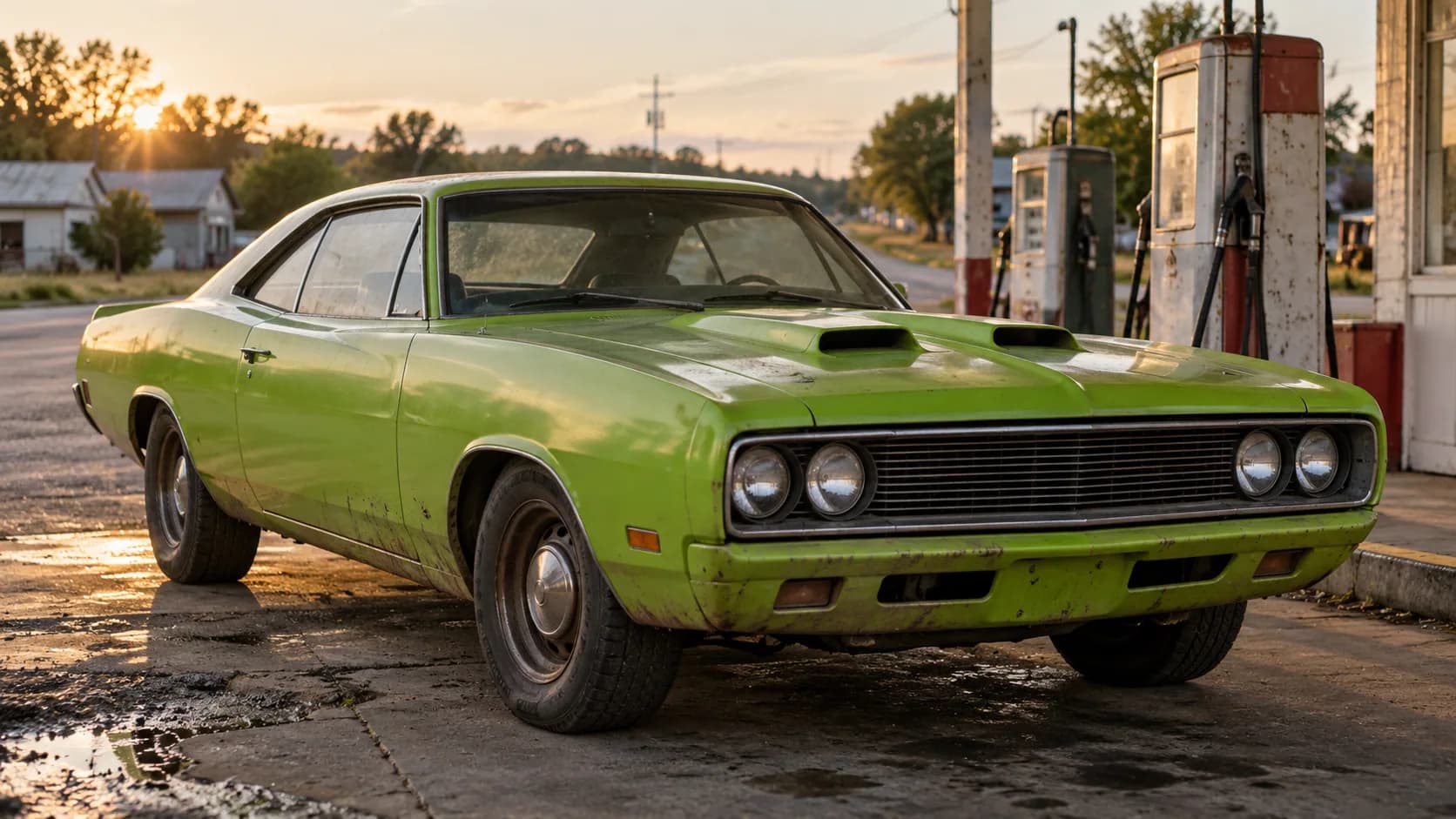
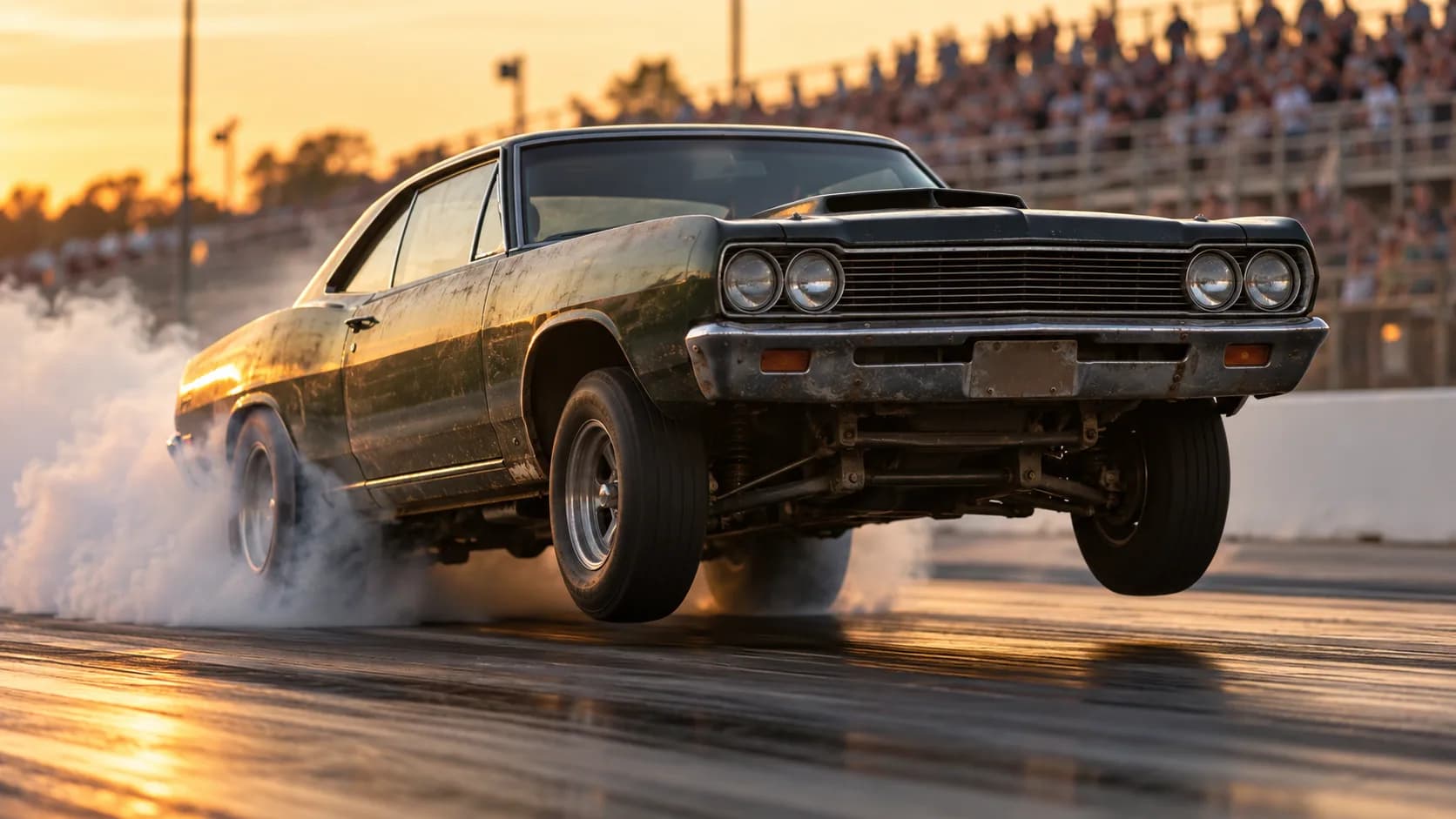
A big-block, a four-speed, a bench seat and a horn that went "beep-beep": in 1968 that recipe cost less than most muscle cars with half the attitude. The AI render above, a faded lime-green Mopar-style hardtop with twin hood scoops parked by old gas pumps at sundown, is an image rather than a photograph of a real car, but the idea it plays on is real. Plymouth's Road Runner proved that a stripped-down intermediate with a serious engine could outsell expectations, and the 1968 to 1970 cars are the ones collectors chase today.
A Muscle Car Built to a Price
By the late 1960s, the hottest intermediates had drifted upmarket, piling on trim, options and cost. Plymouth went the other way. The Road Runner was built on the plain Belvedere body rather than the dressier Sport Satellite that underpinned the GTX, and early cars came with a vinyl bench seat and no carpeting. The base price for the 1968 coupe was about $2,900. Early cars were two-door pillared coupes, with a two-door hardtop added later in the model year.
Plymouth expected to sell about 20,000 the first year. It sold around 45,000, enough to rank third among muscle cars behind the Pontiac GTO and the Chevelle SS 396. For 1969 the line grew to include a convertible, and domestic production reached 81,125, plus 3,295 cars for Canada and export markets. Motor Trend named the Road Runner its Car of the Year for 1969. Sales fell by more than half for 1970, to about 41,000.
The Cartoon, the License and the Horn
The name came from the Warner Bros. cartoon, and Plymouth did it properly. It paid $50,000 for the rights to the Road Runner name and likeness, and the cartoon bird appeared in the car's decals. The finishing touch was a special "beep-beep" horn that cost $10,000 to develop. It is the detail people remember first, and it made the car's personality plain to anyone standing near it at a stoplight.
Engines: 383, 440 Six Barrel and 426 Hemi
The standard engine was a 383 cubic-inch V8 with a single Carter four-barrel, rated at 335 horsepower at 5,200 rpm and 425 lb-ft of torque at 3,400 rpm. Cars ordered with air conditioning got a 330-horsepower version. A four-speed manual was standard in 1968, with the three-speed TorqueFlite automatic optional. Early four-speed cars used Inland shifters before Hurst units replaced them during the model year.
The one option that changed everything was the 426 Hemi, with two Carter AFB four-barrels, rated at 425 horsepower at 5,000 rpm and 490 lb-ft at 4,000 rpm. It cost about $714 extra in 1968, and by 1970 the Hemi option listed at $841.05.
In the middle of 1969 Plymouth added the 440 Six Barrel package, coded A12. Three Holley two-barrel carburetors on an aluminum Edelbrock intake gave 390 horsepower at 4,700 rpm and 490 lb-ft at 3,200 rpm. About 1,432 were built for 1969. The A12 cars were all business: a black fiberglass hood with a functional scoop, 15x6-inch steel wheels without hubcaps, and a Dana 60 rear axle with 4.10 gears. For 1970 the Six Barrel stayed on the options list at $249.55, now on a factory cast-iron intake, although some early 1970 cars used leftover aluminum ones. That year a heavy-duty three-speed manual became the standard gearbox, with the four-speed moved to the options list.
Air Grabber and the 1970 Superbird
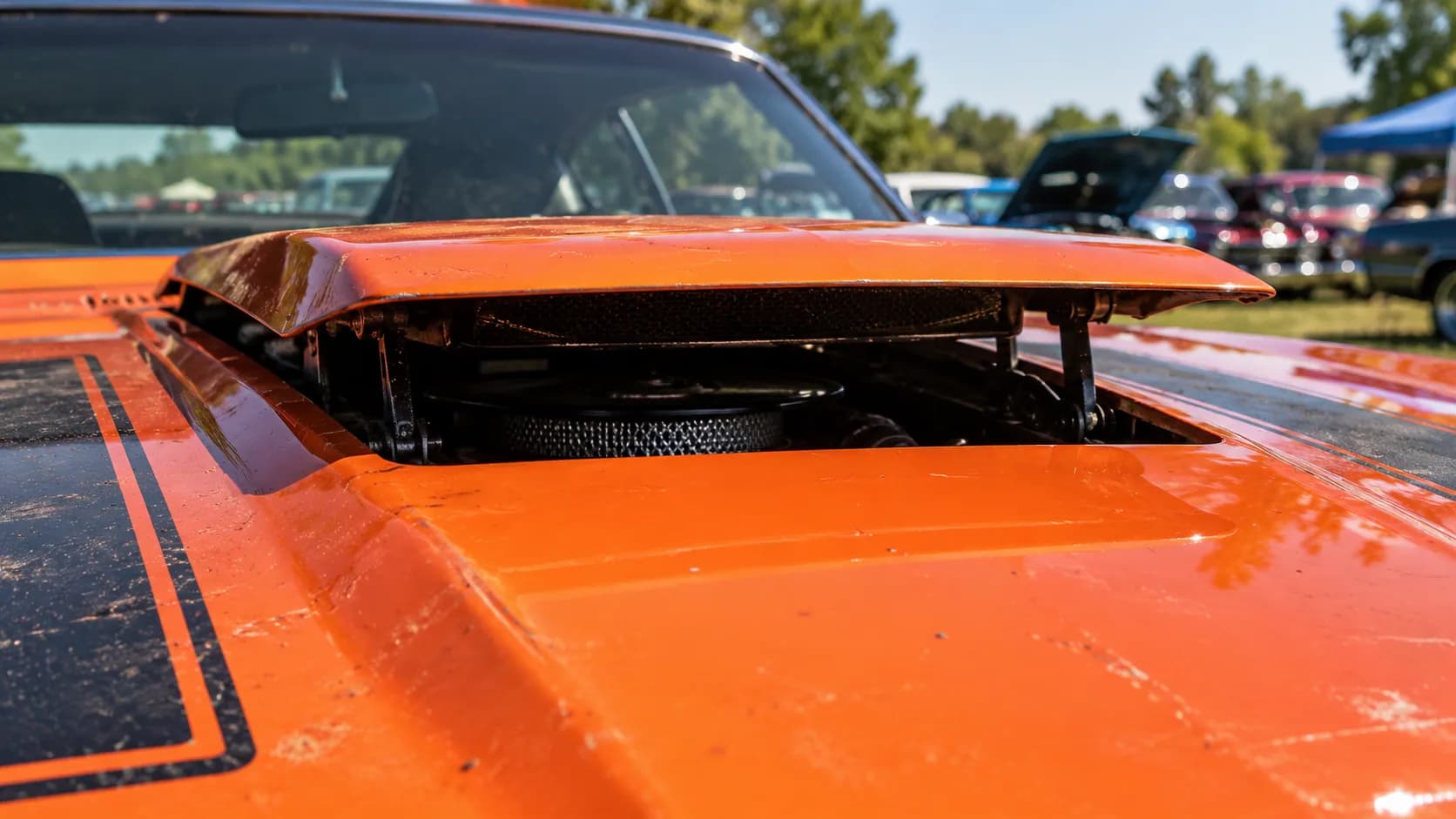
There was no fresh-air induction on 1968 Plymouth B-bodies, even on Hemi cars. For 1969 Plymouth introduced the Air Grabber, a cable-operated system that fed outside air from the hood openings into a black under-hood box. The dash lever was labeled "Carb Air", and the four-barrel air cleaner carried a "Coyote Duster" decal.
For 1970 the system was redesigned. A dash switch sent engine vacuum to an actuator that raised a scoop that otherwise sat flush with the hood, showing off orange and white shark-teeth decals as it opened. When the key was switched off, a vacuum-release solenoid let the scoop drop back flush.
1970 also brought the Road Runner's most extreme relative, the winged Superbird, built to qualify Plymouth's aero car for NASCAR. Plymouth built 1,935 for the U.S. market, 135 of them with the Hemi. That car has its own story, covered in our Charger Daytona and Superbird guide.
How to Tell 1968, 1969 and 1970 Apart
The 1968 is the cleanest of the three, with no fresh-air hood and no side marker lights. The 1969 got a revised grille and taillights, side marker lights, optional bucket seats and new Road Runner decals, and it was the first year for the convertible. The 1970 is the most changed: a new grille, hood, front fenders, quarter panels and rear styling, along with non-functional scoops in the rear quarters and new high-back bucket seats with built-in headrests.
The VIN helps confirm what the body says. Road Runner VINs begin with RM, followed by a body code such as 21 for the pillared coupe or 23 for the hardtop. The fifth character is the engine code, and the sixth is the model year: 8 for 1968, 9 for 1969 and 0 for 1970. A 1969 A12 Six Barrel car should carry an M in the fifth position. Because clones are common, check the fender tag and any build sheet as well, and see our Mopar fender tag decoder before you buy.
What They Are Worth Today
Prices swing widely with engine, originality and paperwork. At Mecum's Indianapolis sale in May 2025, a 1970 Road Runner hardtop with a manual transmission sold for $110,000, while a 1970 Road Runner at Barrett-Jackson Palm Beach in April 2025 sold for $49,500. Hemi cars live in a different bracket: a 1969 Road Runner with the 426 Hemi, a four-speed and a 3.54-geared Dana rear axle brought $275,000 at Mecum Indy in May 2025.
Rarity drives those numbers. For 1970, Plymouth built only about 152 Hemi Road Runners, including just three convertibles. The 1970 convertible itself was a short run, with sources putting it at 824 or 834 cars. Any car presented as an original Hemi or A12 deserves documentation before it gets a Hemi or A12 price.
Specs
- Production (first generation)
- 1968-1970
- Base
- Plymouth Belvedere (B-body)
- Standard engine
- 383 V8, 335 hp, 425 lb-ft
- 440 Six Barrel (A12, from mid-1969)
- 390 hp, 490 lb-ft, three Holley two-barrels
- 426 Hemi option
- 425 hp, 490 lb-ft, two Carter four-barrels
- Production
- About 45,000 (1968); 81,125 U.S. plus 3,295 export (1969); about 41,000 (1970)
- Body styles
- Coupe, hardtop; convertible 1969-1970
- Award
- Motor Trend Car of the Year, 1969
FAQ
- What engine came in the 1969 Plymouth Road Runner?
- The standard engine was a 383 V8 rated at 335 hp. Options were the 426 Hemi at 425 hp and, from mid-1969, the 440 Six Barrel (A12) at 390 hp.
- How many Plymouth Road Runners were made in 1969?
- Domestic production was 81,125 across all body styles, plus 3,295 cars for Canada and export markets. It was the Road Runner's best year.
- Why is it called the Road Runner?
- Plymouth paid Warner Bros. $50,000 to use the cartoon character's name and likeness, and spent $10,000 developing the car's beep-beep horn.
- How can you tell if a Plymouth Road Runner is real?
- A genuine 1968-1970 Road Runner VIN starts with RM, and the sixth character gives the year (8, 9 or 0). Confirm the engine code, fender tag and build sheet, since clones are common.
Know someone who drove one? Share this guide
Get the Look
As an Amazon Associate we earn from qualifying purchases.
- Plymouth Road Runner diecast model car — A 1968-1970 Road Runner for the shelf in 1:24 or 1:18 scale.
- Plymouth Road Runner history book — Background on the Road Runner and Mopar's B-body muscle years.
- Road Runner beep beep horn — The sound that defined the car.
Sources
- en.wikipedia.org — Plymouth_Road_Runner
- oldride.com — 1968_plymouth_road_runner
- ultimatemusclecar.com — 1970-plymouth-road-runner-engine-options-and-specifications
- moparconnectionmagazine.com — the-ultimate-stoplight-intimidator-air-grabber-fresh-air-induction
- musclecarfan.com — plymouth-built-just-152-hemi-road-runners-in-1970-only-16-skipped-the-clutch-pedal
- vanguardmotorsales.com — 1968-plymouth-road-runner
- coyoteclassics.com — 1970-plymouth-road-runner
- classic.com — 1970-plymouth-road-runner-hardtop-4oGyPq4
- classic.com — 1970-plymouth-road-runner-n3eZmEp
- classic.com — 1969-plymouth-road-runner-nmm3wjn
- moparconnectionmagazine.com — gallery-the-mopars-of-mecums-indy-2025-auction
- oldcarsweekly.com — 1968-road-runner