Winged Warriors: The Dodge Charger Daytona and Plymouth Superbird
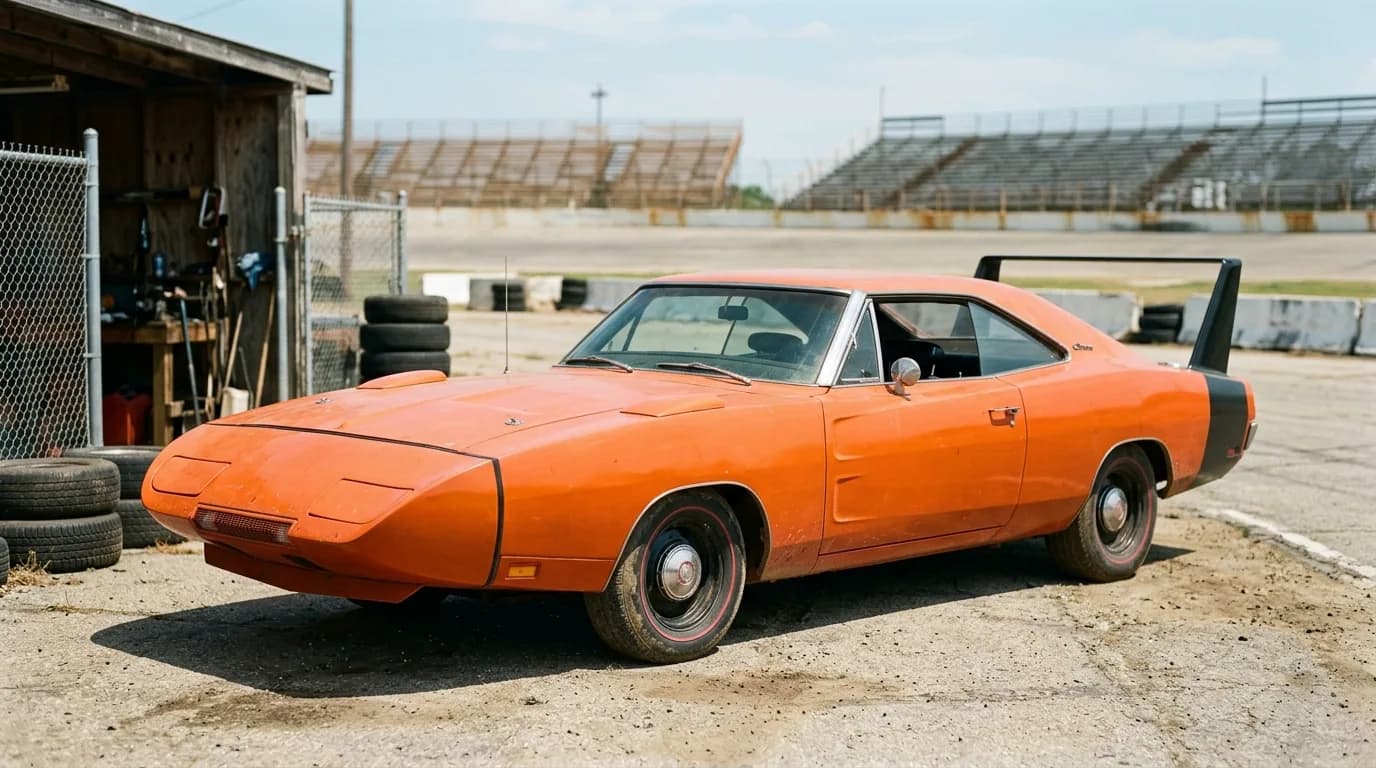
To race the Charger Daytona, Chrysler first had to put 500 of them on the street. The 1969 Daytona and its 1970 cousin, the Plymouth Superbird, were never really street cars first, and the shapes that resulted are still the strangest thing Detroit ever put a warranty on. The AI render above, a faded orange nose cone parked in the shadow of empty grandstands, shows the kind of place they were built for: not a boulevard, not a drive-in, but a superspeedway.
An Aero Answer to Ford's Speedway Dominance
By 1968, the standard Dodge Charger's handsome fastback roofline was creating as much lift as style at 190 mph, and Ford's slippery Torino Talladega was winning the speedway races that mattered most. Dodge's fix was radical: an 18-inch pointed steel nose cone grafted onto the Charger's front end, a flush rear window filling in the old tunnel roof, and a two-strut rear wing standing roughly 23 inches above the trunk lid to keep the tail planted at speed. NASCAR required 500 street examples to homologate the package for competition, and Dodge built 503 of them for 1969 — the Charger Daytona was born.
Two Birds, One Mission
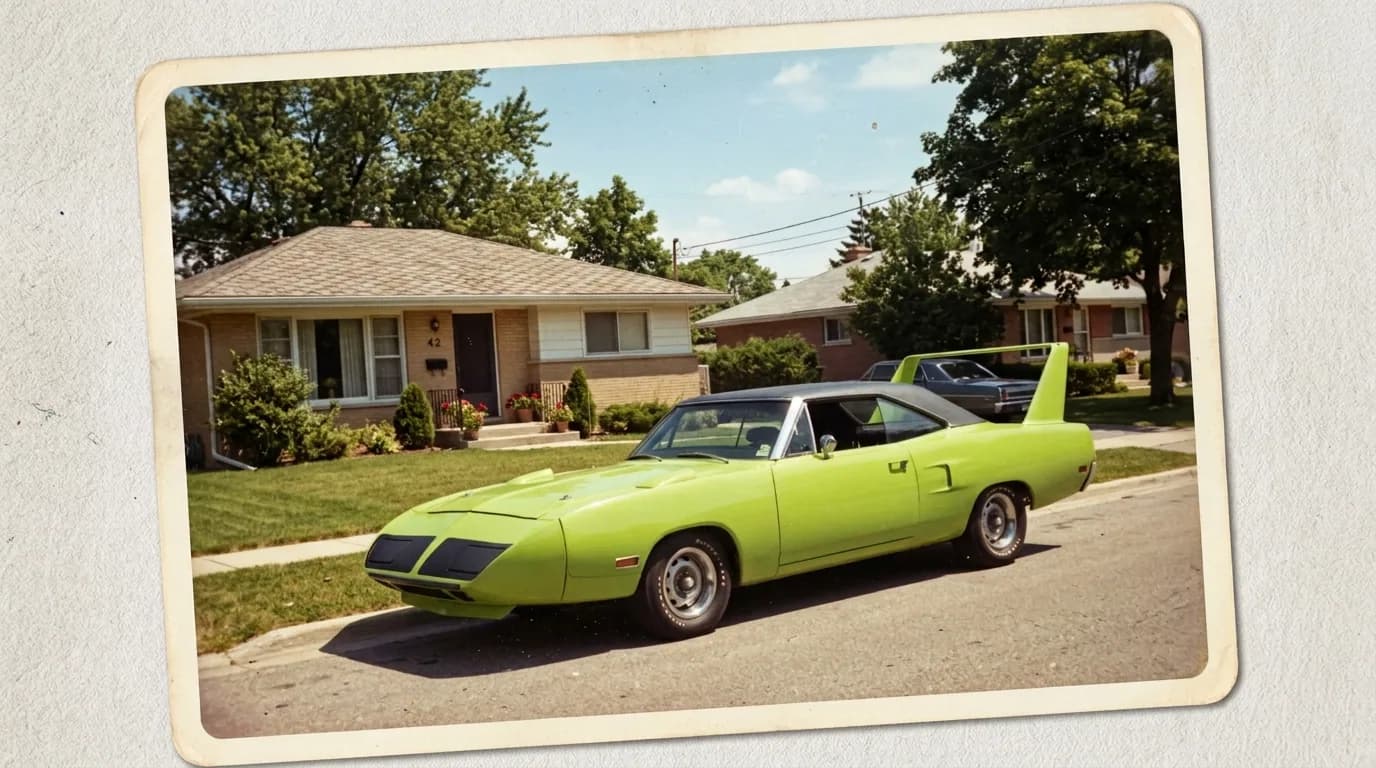
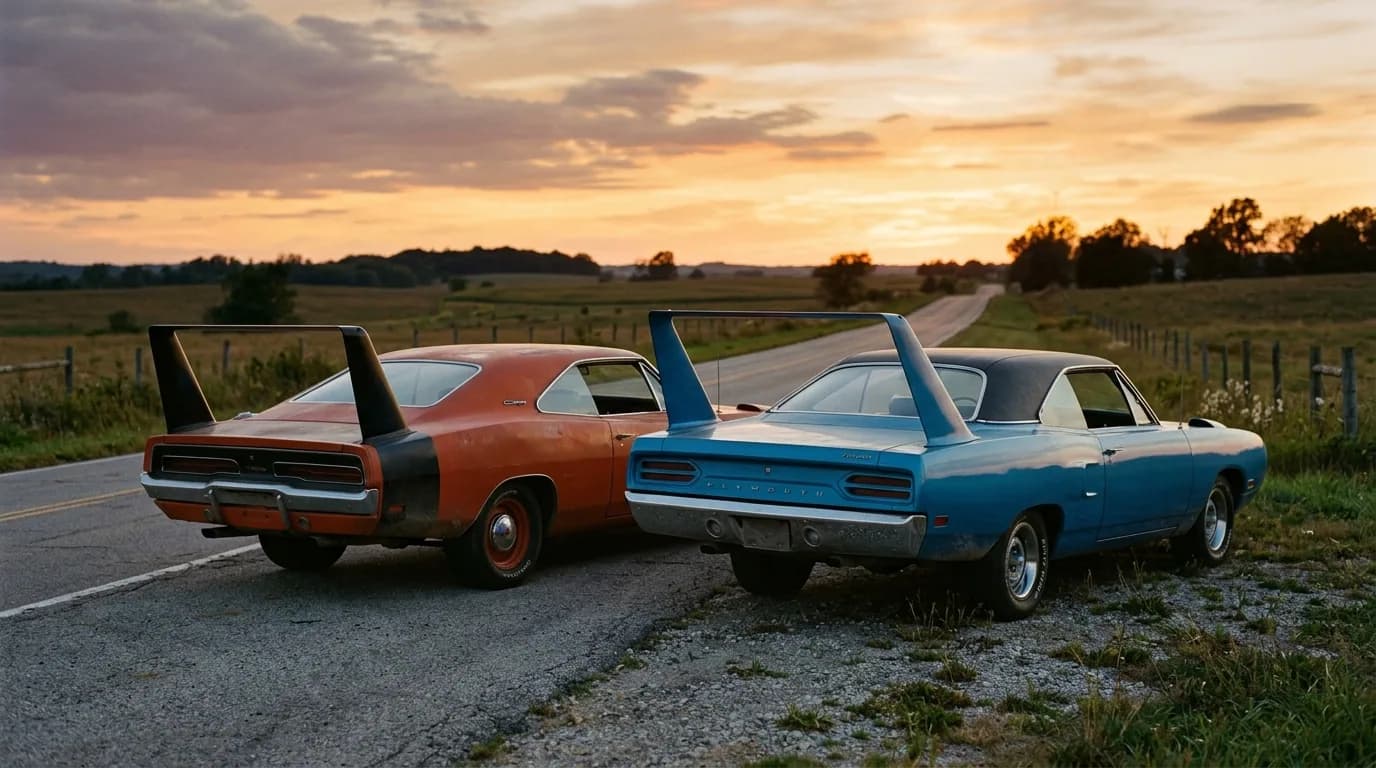
Plymouth needed its own version for 1970, and rather than restyle the Road Runner from scratch, engineers grafted Daytona-style aero onto it — with a catch. NASCAR had raised the homologation bar to one car per two dealers, meaning Plymouth had to build around 1,920 units just to qualify, versus the Daytona's flat 500. The resulting Superbird added about 19 inches to the Road Runner's nose, wore a standard vinyl roof to hide where the reworked backlight met the old roof stamping, and even carried a horn that mimicked the cartoon Road Runner's "beep beep." Look closely and the wing gives it away too: the Superbird's sits angled back a bit more than the Daytona's steeper, more upright mount. Both cars offered the same running gear — a 375-hp 440 Magnum standard, a 425-hp 426 Hemi on option — and the Superbird added a middle choice, the 390-hp 440 Six Pack. Plymouth built 1,935 Superbirds in all: 135 with the Hemi, 716 with the Six Pack, and the rest on the base 440.
200 MPH and a NASCAR Championship
The aero worked. On March 24, 1970, Buddy Baker took a Chrysler Engineering Daytona to Talladega Superspeedway and became the first driver in NASCAR history to top 200 mph on a closed course, running consecutive laps over 200 with a best of roughly 200.4 mph. That same season, Bobby Isaac drove the #71 K&K Insurance Dodge Charger Daytona to the 1970 NASCAR Grand National championship, then set a closed-course speed record of 201.104 mph at Talladega that November — a mark that stood until 1983.
The Rule That Grounded the Wing Cars
Winning that decisively was the aero cars' undoing. Worried about the speeds and the lift they generated, NASCAR mandated restrictor plates at high-speed ovals starting in 1970, then rewrote the rulebook for 1971 to cap any winged car at a 305-cubic-inch engine — or force it to carry heavy compensating weight. Either way, the Daytona and Superbird were no longer worth racing, and Chrysler quietly let the wing-car program end. The aero war that had defined 1969 and 1970 was over within a single rules cycle.
From Unsellable to Untouchable
Back on dealer lots, the Superbird's looks were a hard sell to everyday buyers — the wing and nose made for a car nobody could parallel park with confidence, and plenty sat unsold well into 1971 and 1972. Some dealers reportedly "de-winged" leftover cars back to standard Road Runner trim just to move them. Six decades on, the math has flipped completely: Hagerty's valuation guide puts a numbers-matching Superbird anywhere from about $192,000 in fair condition to $371,000 for a concours example, while a documented Hemi car set a $1.65 million world auction record at Barrett-Jackson in 2022. The Daytona, rarer still at just 70 Hemi cars out of 503 built, has done even better at auction — Mecum sold a Hemi Daytona for $3.3 million at its 2024 Monterey sale, a record for the wing-car breed. The cars that dealers once couldn't give away are now some of the most expensive Mopars in existence.
Specs
- Daytona production (1969)
- 503 units, incl. 70 with the 426 Hemi
- Superbird production (1970)
- 1,935 units — 135 Hemi, 716 440 Six Pack, rest 440
- Standard engine (both)
- 440 cu in Magnum V8 — 375 hp / 480 lb-ft
- Optional engine (both)
- 426 cu in Hemi V8 — 425 hp / 490 lb-ft
- Superbird-only option
- 440 cu in Six Pack V8 — 390 hp
- Daytona nose cone
- 18 in, pointed steel; rear wing about 23 in tall
- Buddy Baker's 200 mph run
- Talladega, March 24, 1970 — about 200.4 mph
- 1970 NASCAR champion
- Bobby Isaac, #71 K&K Insurance Dodge Charger Daytona
Get the Look
As an Amazon Associate we earn from qualifying purchases.
A shelf-scale way to study the nose cone and wing angles side by side.
Check price at AmazonDeeper reading on the homologation race that produced both cars.
Check price at AmazonRetro wall art for a Mopar corner of the garage.
Check price at AmazonBasic dust protection for a garage-kept classic between shows.
Check price at AmazonSuited to keeping a bright factory color free of swirl marks between shows.
Check price at AmazonFAQ
- What is the difference between a Dodge Charger Daytona and a Plymouth Superbird?
- The Daytona (1969) is based on the Dodge Charger and lacks a vinyl roof, while the Superbird (1970) is based on the Plymouth Road Runner, came with a standard vinyl roof to hide its reworked rear window, and even has a horn that mimics the Road Runner cartoon's "beep beep." The Superbird's rear wing also sits angled back slightly more than the Daytona's.
- How many 1969 Dodge Charger Daytonas were built?
- Dodge built 503 Charger Daytonas for 1969 to meet NASCAR's 500-unit homologation rule, and only 70 of them were ordered with the 426 Hemi engine.
- Why did NASCAR ban the winged Dodge and Plymouth aero cars?
- NASCAR didn't ban them outright — for the 1971 season it limited any winged car to a 305-cubic-inch engine unless it carried extra weight, a rule that made the Daytona and Superbird uncompetitive and ended Chrysler's wing-car program.
- Who was the first NASCAR driver to break 200 mph?
- Buddy Baker, driving a Chrysler Engineering Dodge Charger Daytona, topped 200 mph at Talladega Superspeedway on March 24, 1970 — the first time any NASCAR car had done so on a closed course.