1987 Buick Grand National: Detroit's Turbo V6 Out-Muscles the V8s
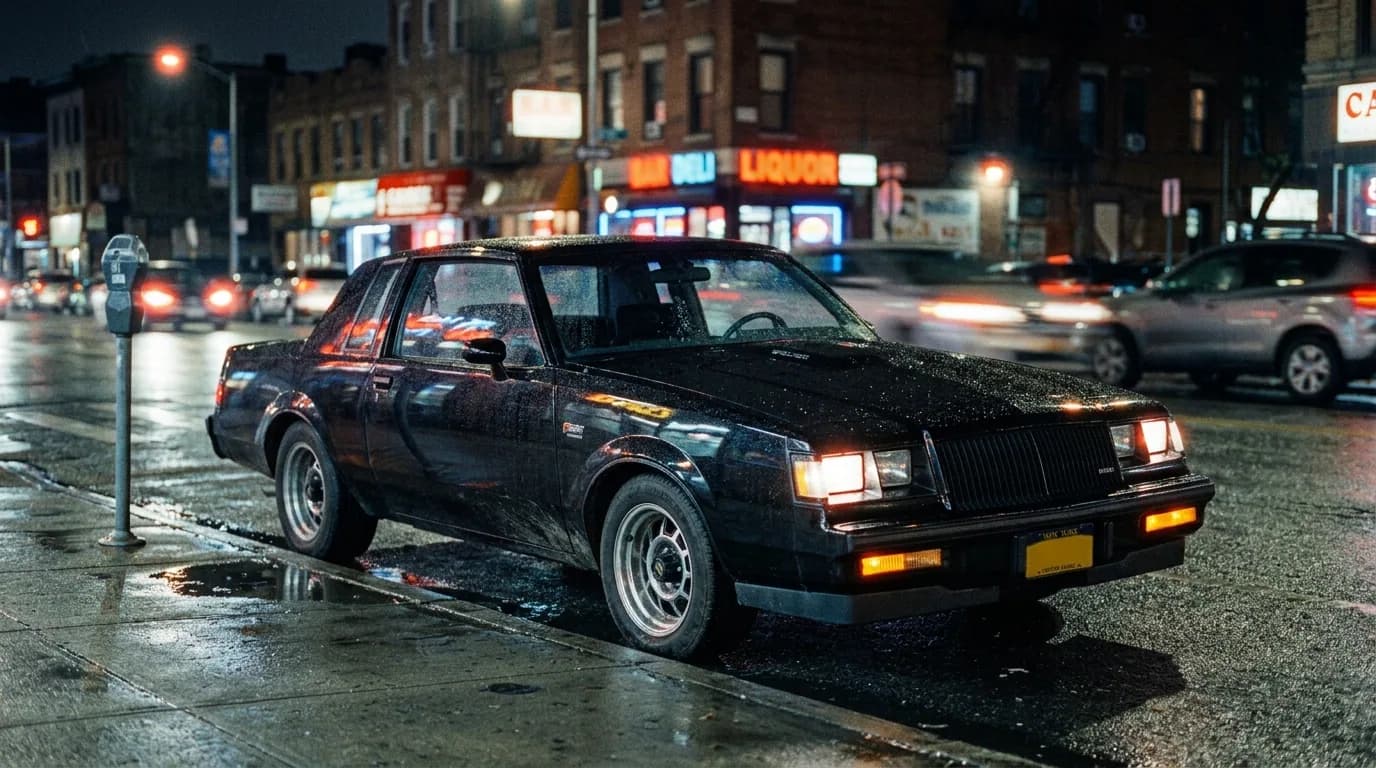
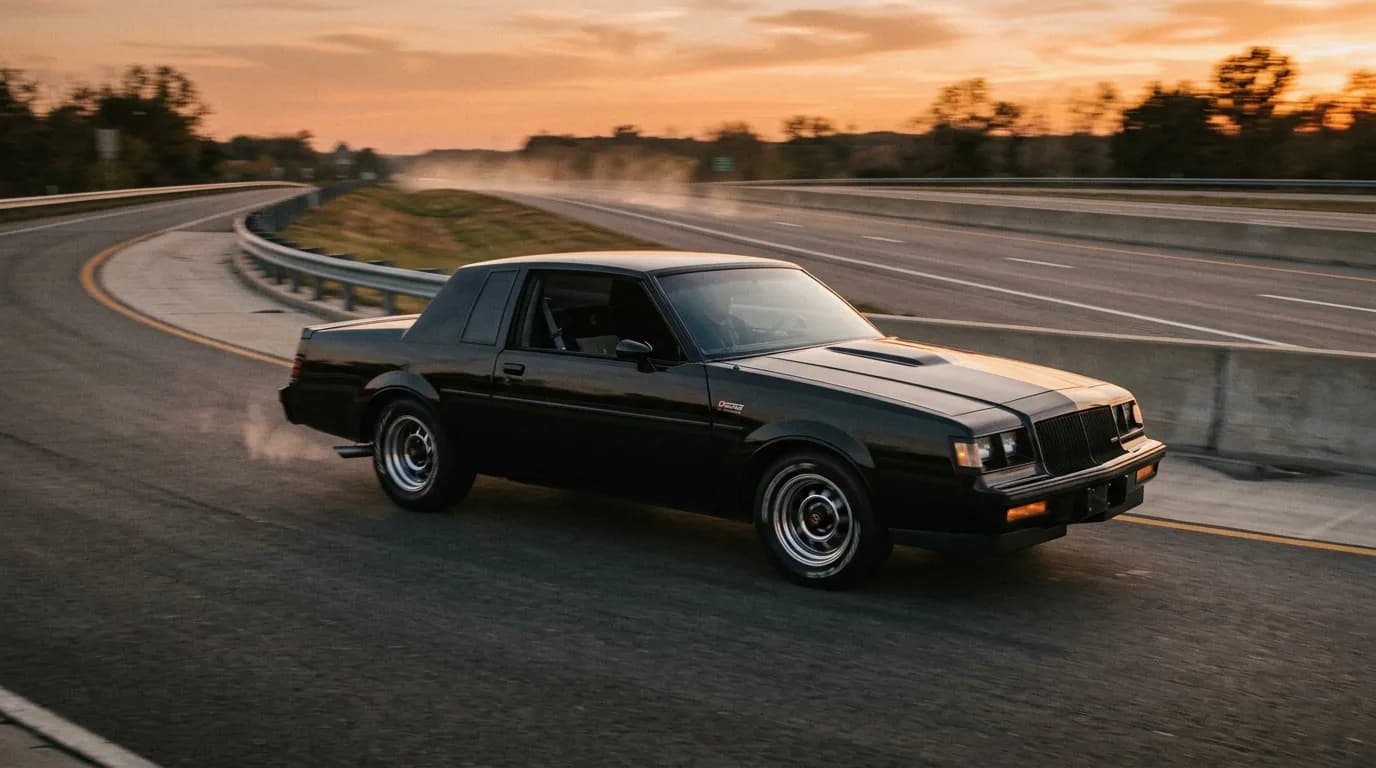
A Buick from the division known for retiree comfort out-accelerated a Corvette in 1987, at least in Car and Driver's published numbers. Our AI render above, a black Grand National idling at a rain-slicked corner with neon bleeding across wet asphalt, shows how little the car advertised the fact: no V8 rumble, no fender flares, no wing on the trunk, just a blacked-out Regal that looked like it was waiting for something.
A Regal With Something to Prove
The Grand National name started in 1982 as a trim package on Buick's otherwise unremarkable Regal, a commemorative nod to the division's back-to-back NASCAR Grand National manufacturer's championships in 1981 and 1982, initially saddled with a naturally aspirated V6 making a modest 125 horsepower. Buick pulled the model for 1983 to rework it, then brought it back in 1984 exclusively paired with a turbocharged 3.8-liter V6 — the car that established the all-black paint, trim, and wheel treatment the Grand National would keep for the rest of its run. The 1984–1985 cars ran a non-intercooled turbo rated at 200 horsepower; 1986 added an intercooler and pushed the factory rating to 235 horsepower, with real-world output that dyno testing of the era suggested ran well past that number. By 1987, the final year for the model, Buick had the formula fully sorted.
The Turbo V6 That Broke the Rules
The 1987 Grand National's 3.8-liter turbocharged V6 was factory-rated at 245 horsepower and 355 lb-ft of torque, run through sequential fuel injection and an intercooler that let Buick turn up boost without the detonation problems that had limited earlier turbo Regals. Car and Driver clocked a 1987 Grand National at 0-60 mph in 4.9 seconds and through the quarter-mile in 13.9 seconds — quick enough that the magazine's published acceleration figures put it ahead of a Corvette, a Porsche 944 Turbo, and a Porsche 928S. For context, a manual-transmission 1987 Corvette ran 0-60 in roughly 5.8 seconds and the quarter-mile in around 14.4 seconds. A turbocharged family sedan from a division known for retiree comfort had, for one model year, out-accelerated America's sports car.
Darth Vader's Car
The all-black treatment — body, trim, wheels, even the exhaust tips — combined with the Grand National's blunt, unapologetic styling earned it the "Darth Vader" nickname from enthusiasts and buff-book writers alike, a tag that only made more sense once the car started outrunning flashier machinery at stoplights. Unlike the wings-and-stripes muscle cars of the previous decade, the Grand National's menace was quiet: a plain-looking two-door that gave away almost nothing until the turbo spooled up.
GNX: When Buick Called In McLaren
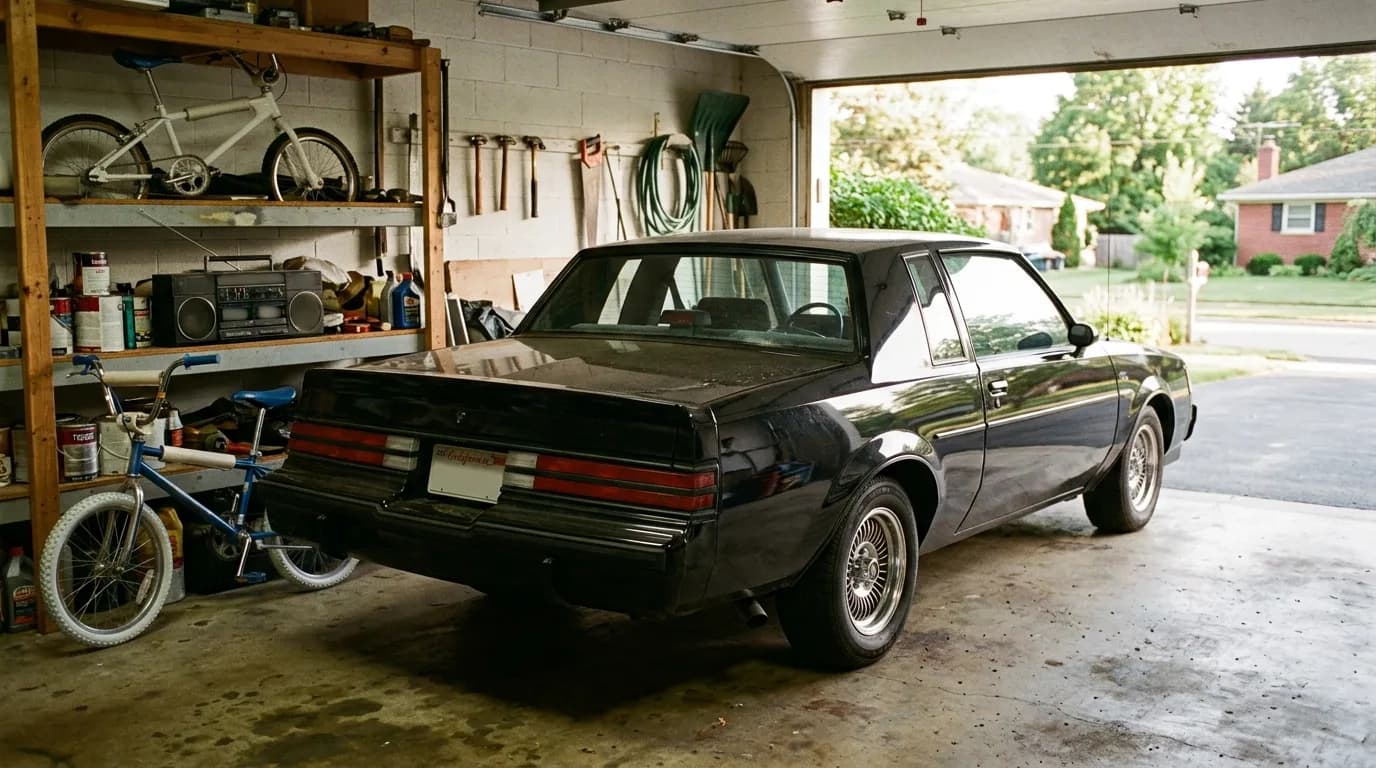
For a send-off, Buick partnered with ASC/McLaren to build the GNX, a package of 547 Grand Nationals pulled aside for a reworked turbocharger and ceramic-coated headers, a bigger intercooler, retuned rear suspension, and unique 16-inch wheels wrapped in wider rubber than the standard car. Buick officially rated the GNX at 276 horsepower and 360 lb-ft of torque, though outside testing found real output closer to 300 horsepower and 400 to 420 lb-ft. Inside, the GNX swapped Buick's usual gauges for a full Stewart-Warner set — including a boost gauge — and every car carried a numbered plaque on the dash identifying its place among the 547 built.
Spotting the Real Thing
A genuine Grand National carries specific badging on the grille, decklid, and lower body cladding, along with a turbo boost gauge on the dash and the model's signature blacked-out treatment on every trim piece a lesser Regal would leave chrome. A GNX goes further still: front fender air vents, GNX-specific badges, and 245/50R16 front and 255/50R16 rear tires on wheels no standard Grand National wore. Buick also sold the same turbocharged drivetrain in the T-Type, a Regal that could keep pace with a Grand National in a straight line but skipped the all-black treatment entirely — proof the engine, not the paint, was always the real story.
What They're Worth Now
Values have climbed steadily as the turbo Buicks age into recognized collector cars. Hagerty pegs a standard Grand National in excellent condition at around $68,000, with driver-quality, Good-condition cars closer to $41,000. The GNX sits in an entirely different tier — Hagerty's guide lists a #2 (Excellent) example near $176,000, with concours-condition cars pushing past $250,000. For a car built to prove a turbo V6 could embarrass big-inch V8s, the market has made its verdict just as emphatic.
Specs
- 1987 engine
- 3.8L (231 cu in) turbocharged V6, 245 hp / 355 lb-ft
- 1986 engine (for comparison)
- Same turbo V6, intercooled, rated 235 hp
- 0-60 mph / quarter mile
- 4.9 sec / mid-13s (Car and Driver test)
- 1987 Grand National production
- 20,193 units
- GNX rating
- 276 hp / 360 lb-ft factory; outside testing suggested closer to 300 hp / 400-420 lb-ft
- GNX production
- 547, converted by ASC/McLaren, each individually numbered
- Value today
- Hagerty: GN excellent ~$68,000; GNX #2 (Excellent) ~$176,000, concours $250,000+
Get the Look
As an Amazon Associate we earn from qualifying purchases.
All-black paint and wheels, at desk scale.
Check price at AmazonBackground on the turbo Regal's rise from also-ran to legend.
Check price at AmazonWall art for a Darth-Vader-black garage.
Check price at AmazonBlack paint shows every swirl mark — this helps keep it flat and even.
Check price at AmazonStorage protection for a low-mileage GN or GNX.
Check price at AmazonFAQ
- How much horsepower did the 1987 Buick Grand National have?
- The factory rated it at 245 horsepower and 355 lb-ft of torque from a turbocharged, intercooled 3.8-liter V6 — enough for a 0-60 mph time of about 4.9 seconds.
- Why is the Buick Grand National called the "Darth Vader" car?
- Its all-black body, trim, and wheels, combined with its blunt styling and quiet reputation for outrunning flashier cars, earned it the nickname among enthusiasts and automotive writers in the 1980s.
- What's the difference between a Grand National and a GNX?
- The GNX was a limited run of 547 Grand Nationals modified by ASC/McLaren with a reworked turbo, larger intercooler, retuned suspension, and unique wheels and tires, officially rated at 276 hp versus the standard car's 245 hp.
- How many Buick GNX cars were built?
- 547, each converted from a Grand National by ASC/McLaren and fitted with a numbered dash plaque.