Mopar Fender Tag Decoder: How to Read a 1960s-70s Tag
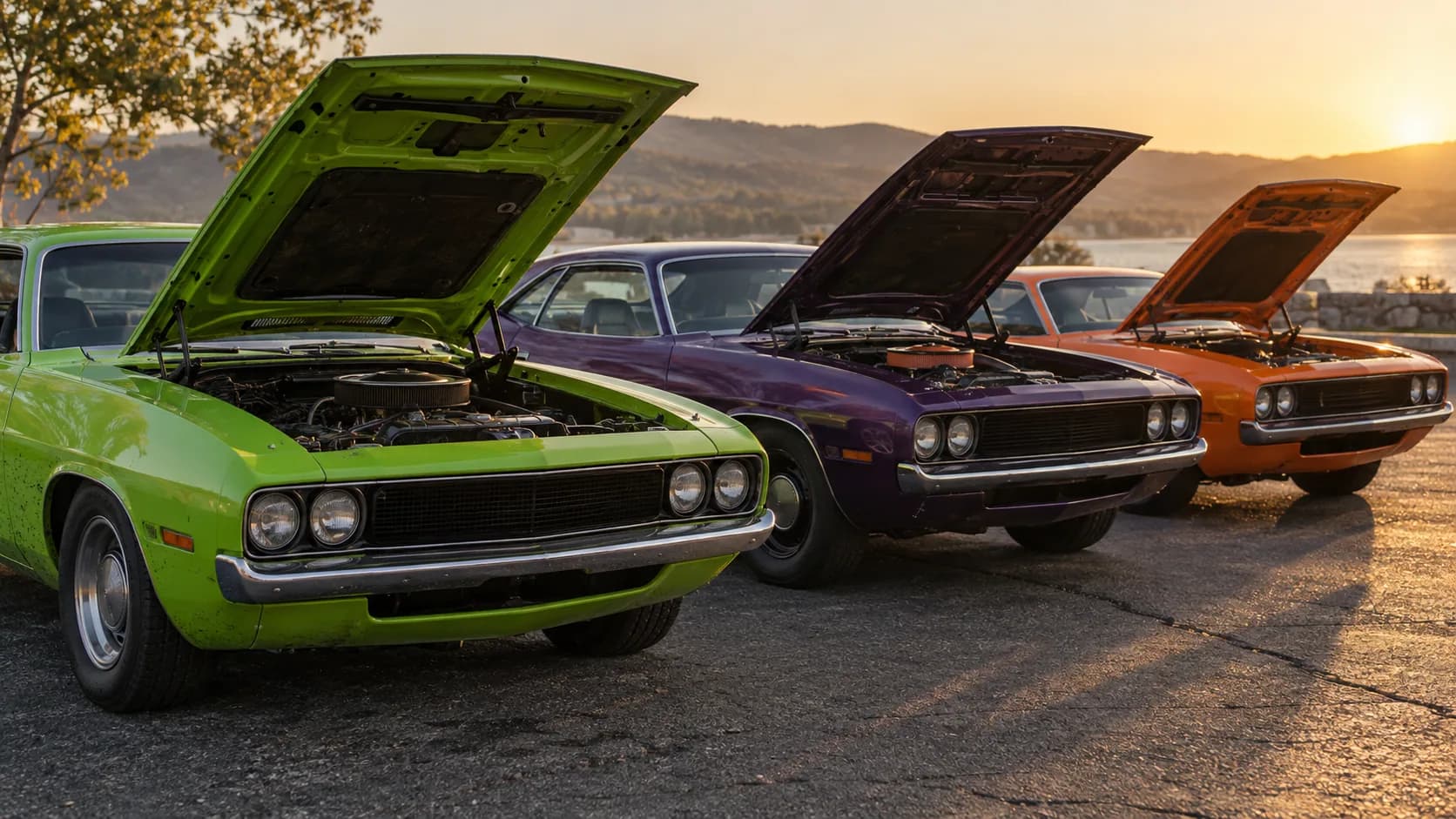
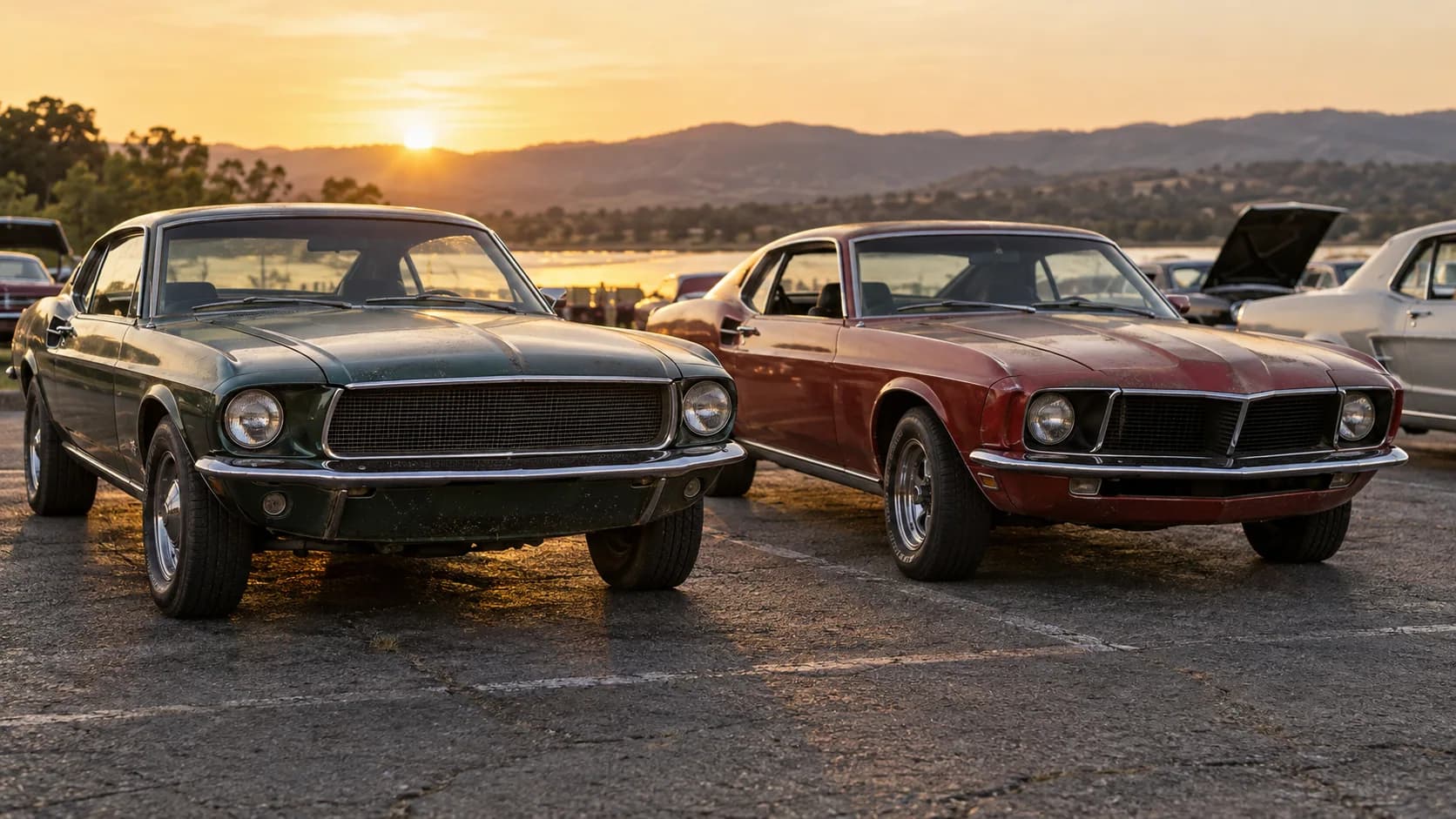
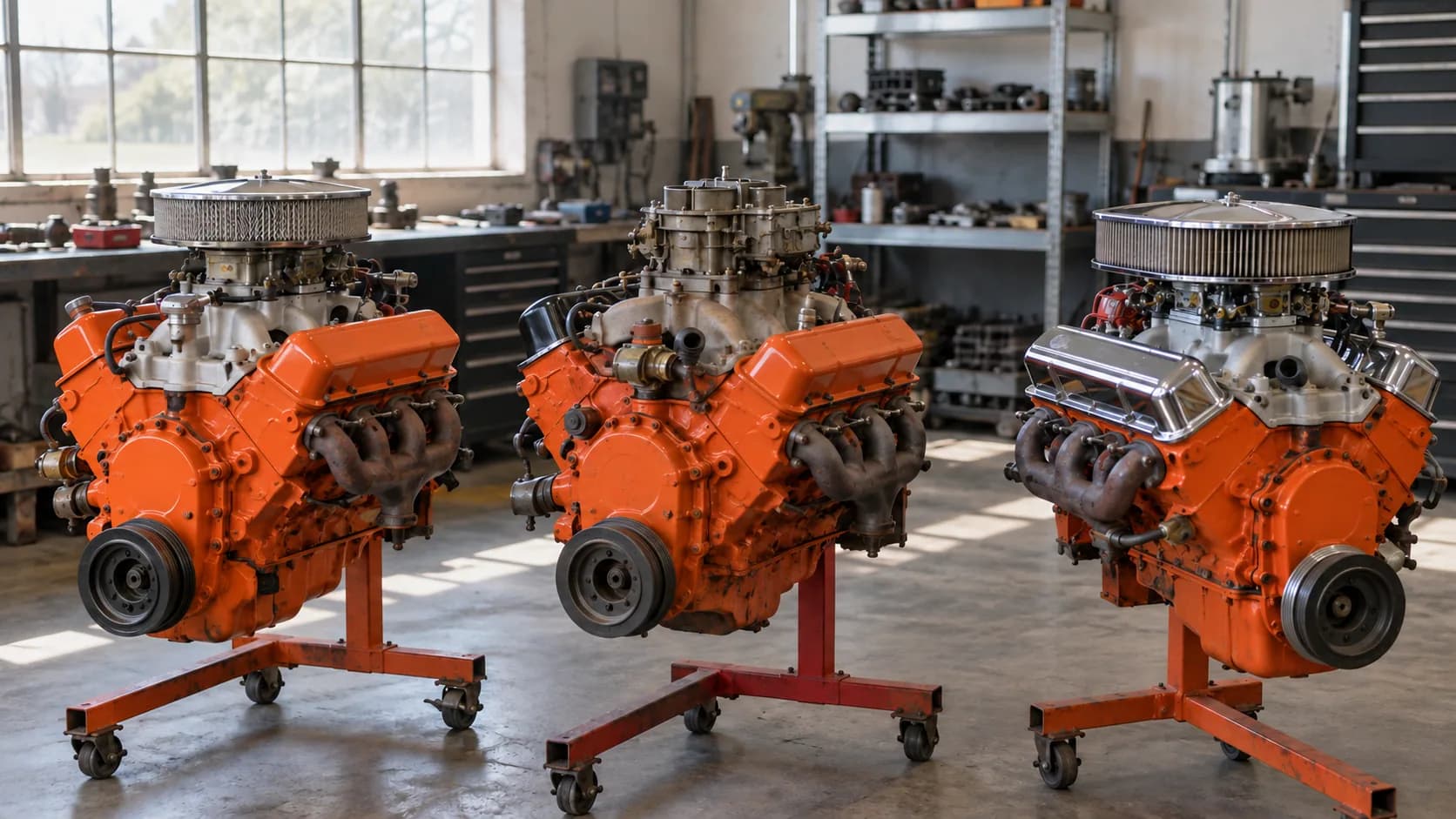
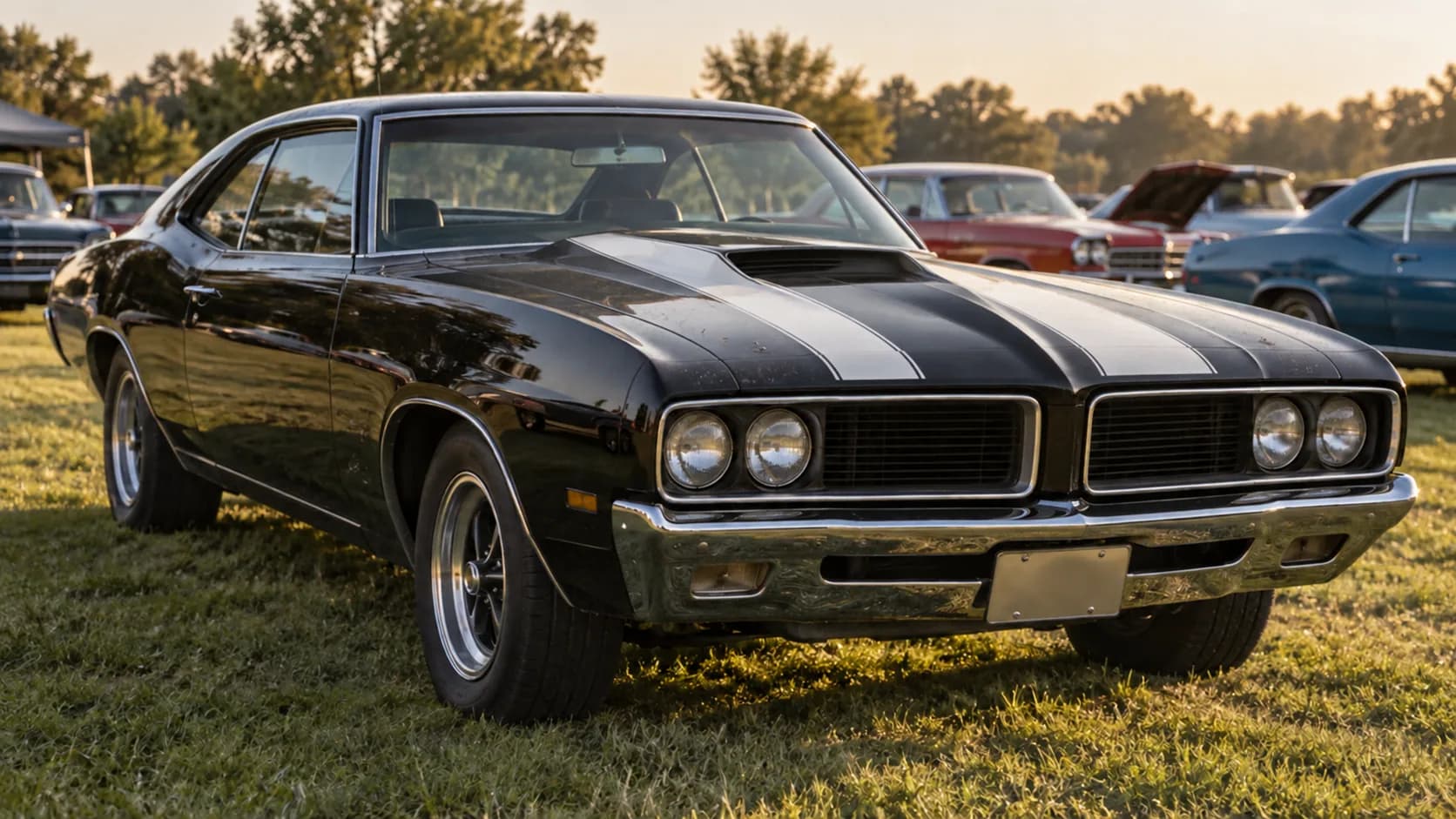
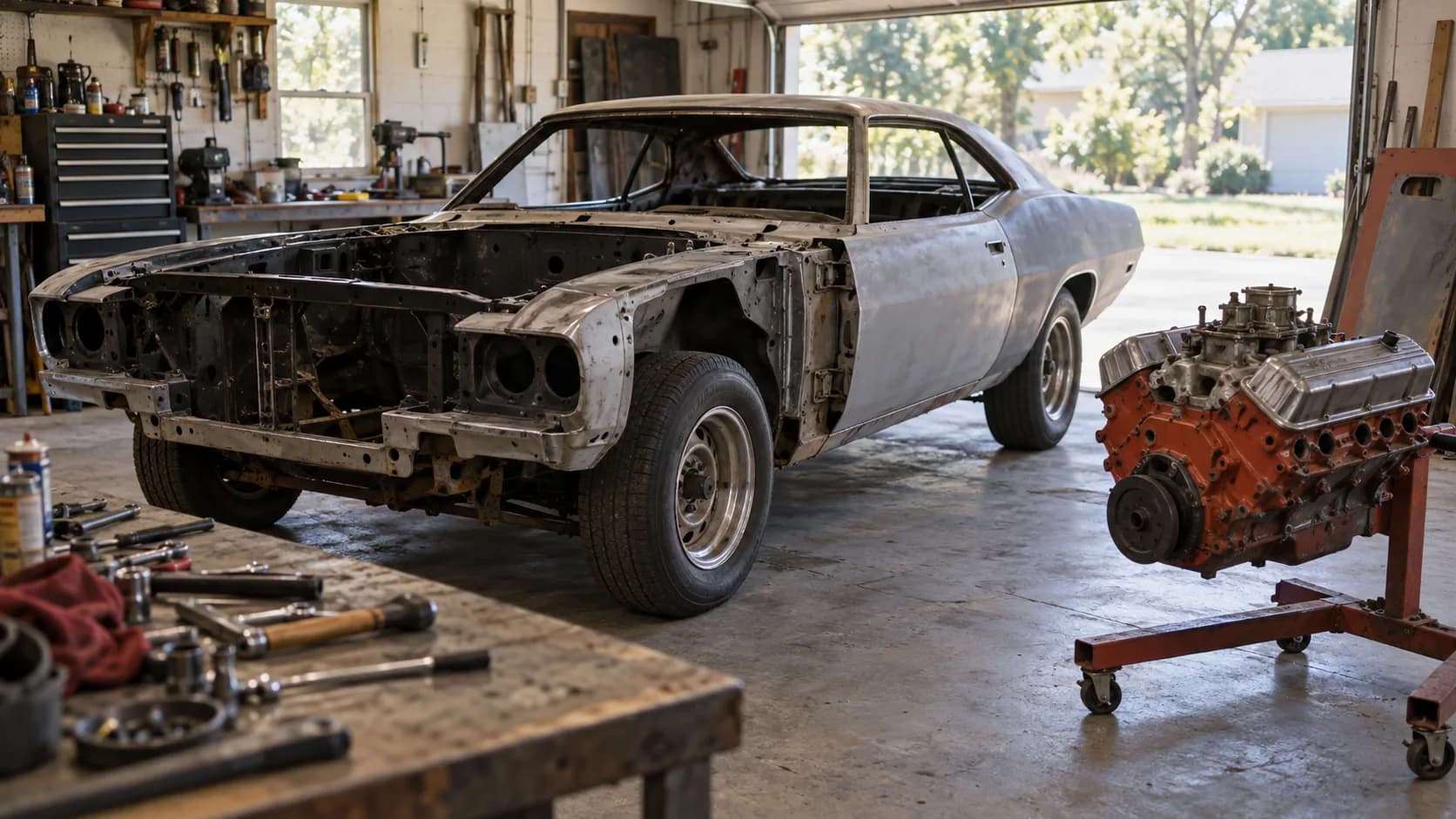
A strip of stamped aluminum no bigger than a playing card can decide whether a 1970 Mopar is the real thing or a well-dressed clone. The renders above are AI-generated images, not photos of real cars: a lime green, a purple and an orange coupe with their hoods up at sunset, a small plate on a grimy inner fender, and a bare-metal shell waiting on its engine. The tag is very real, and once you know the layout it reads like a sentence. Here is where to find it, how to read it, and how to tell when it does not belong to the car.
Where to Find the Fender Tag
On most late-1960s and 1970s Chrysler, Dodge and Plymouth cars the tag sits on the driver's side inner fender, held by small screws or rivets. Some older cars carry it on the radiator core support, the cowl or the A-pillar instead. A missing tag is not the end, because the body carries numbers elsewhere.
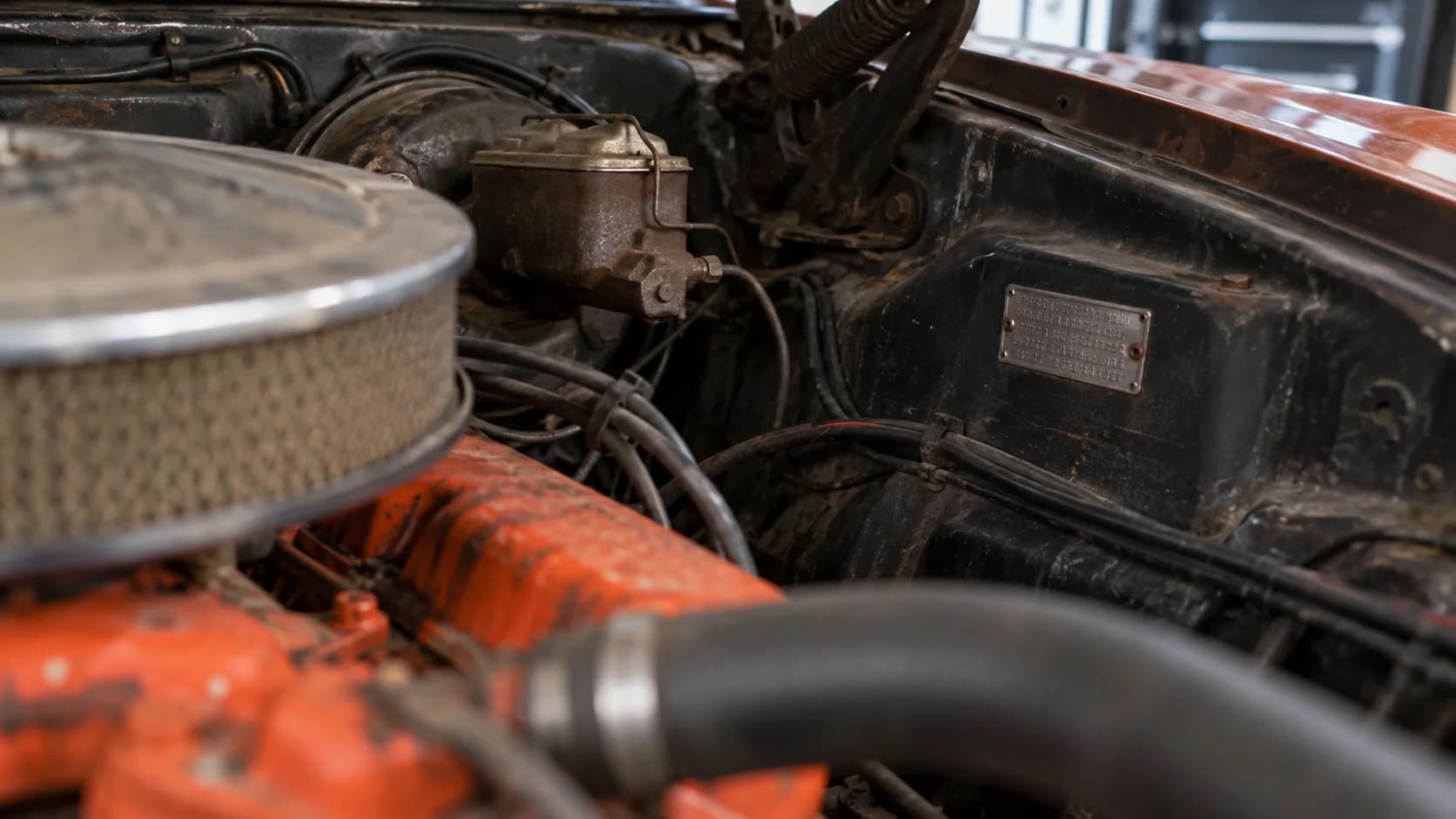
How to Read It: Bottom Row First
Start at the lower left corner and read left to right, then work up one row at a time. Tag layouts changed over the years, but on a typical 1969-and-later car the bottom row goes like this: engine sales code, transmission code, then the VIN broken into its body code, engine and year characters, and sequence number.
The next row up holds the paint code, the interior trim code, the upper door frame color (000 when there is none), the scheduled production date and the vehicle order number. Above that come the upper body or vinyl top color, a country code and the option sales codes, which can spill onto a second row. The last row ends with END, or with CTD when the options continue on a second tag.
The build date is a three-character code: the month, then the day. Months 1 to 9 are January through September, and A, B and C stand for October, November and December. So 721 means July 21. That date is when the car was released for production, which is not always the day it was assembled.
Paint and Trim Codes
From 1969 on, most paint codes use three characters. The first letter shows the year the color was introduced (E for 1969, F for 1970, and so on through L for 1975), and the rest identify the color. A 1969 color on a 1969 car usually shows only two characters, then picks up the E when it carries into 1970. That is why Hemi Orange reads V2 on a 1969 tag and EV2 on a 1970 tag.
Dodge and Plymouth used different names for the same High Impact paint, so one code can mean two colors on paper:
- FJ5: Sublime at Dodge, Lime Light at Plymouth, offered for 1970.
- EV2: Hemi Orange at Dodge, Tor Red at Plymouth, offered 1969 through 1972.
- FC7: Plum Crazy at Dodge, In-Violet at Plymouth, 1970 and 1971.
- FY1: Top Banana at Dodge, Lemon Twist at Plymouth, 1970 through 1973.
Trim codes work the same way. A 1969 code table splits the interior code into a price class letter, a seat type number and a color letter, with X for black.
Engine and Sales Codes
The first code on the bottom row is the engine. A 1969 code table lists:
- E74: 426 Hemi with two four-barrels.
- E86: 440 four-barrel high performance.
- E87: 440 with three two-barrels, the Six Pack.
- E55: 340 four-barrel.
E86 and E87 sit right next to each other, and mixing them up turns a four-barrel 440 into a Six Pack on paper. Codes can shift between model years, so always check a table for the car's exact year. The transmission code follows, with D21 for a four-speed manual and D32 or D34 for TorqueFlite automatics on that same 1969 table.
Sales codes fill the upper rows. The same table lists V1 for a vinyl top, with the third character giving the color, V8 for the bumble-bee stripes, N96 for the fresh-air hood, M21 for drip rail moldings and A12 for the 1969 440 Six Pack package. Do not confuse V21, a performance hood treatment, with the V2 paint code.
Fender Tag, VIN and Broadcast Sheet
For 1969 and later cars, the VIN on the fender tag should match the VIN plate on the dash. Its fifth character is the engine, the sixth the model year. In 1970, R meant a 426 Hemi and V meant the 440 Six Pack, so a Hemi tag on a car whose VIN shows a different engine letter is a problem. Cars from 1968 and earlier show the vehicle order number on the tag instead of the VIN.
The body carries its own stamps. On 1969 and later cars, the last eight VIN characters are stamped on the radiator core support and under the weatherstrip along the driver's side trunk extension. 1970 to 1974 E-bodies and 1971-and-later B-bodies also have the VIN on the driver's side of the firewall.
The broadcast sheet is the paper record that rode down the assembly line. Look in the front and rear seat springs, under the carpet (often on the driver's side), or taped to the glove box liner or the heater housing. Each shop printed its own copy, so a car can have several, none, or even another car's sheet.
Spotting a Fake or Swapped Tag
Replacement fender tags are made for restorers whose originals are lost, which means a clean tag on its own proves nothing. Cross-check everything. The tag VIN, the dash VIN and the hidden body stamps should agree. The engine code on the tag should match the engine letter in the VIN. The options on the tag should match what is actually on the car, or at least the holes and brackets that equipment needed. Restorers also look for the sequence number stamped under the paint on the radiator support and on the driver's side trunk rail.
For early Max Wedge and Race Hemi cars, the VIN and the shipping order number are described as the two fingerprints. Counterfeiters can copy a VIN, but guessing the correct order number for a fake tag is far harder. For any big-money car, hire an inspector who knows that exact year and body.
Specs
- Usual location
- Driver's side inner fender (some older cars: core support, cowl or A-pillar)
- Reading order
- Bottom row first, left to right, then upward
- Build date format
- Month (1-9, A-C) plus day, e.g. 721 = July 21
- Paint code year letters
- E = 1969, F = 1970, through L = 1975
- Engine codes (1969 table)
- E74 426 Hemi, E86 440 4-bbl, E87 440 Six Pack
- VIN on tag
- 1969 and later; 1968 and earlier show the order number
- 1970 VIN engine letters
- R = 426 Hemi, V = 440 Six Pack
FAQ
- Where is the fender tag on a Mopar?
- On most 1960s and 1970s Chrysler, Dodge and Plymouth cars it is on the driver's side inner fender. Some older cars have it on the radiator core support, cowl or A-pillar.
- How do you read a Mopar fender tag?
- Start at the bottom row on the left and read left to right, then move up a row. On 1969-and-later tags the bottom row begins with the engine code, then the transmission code and the VIN.
- What does EV2 mean on a fender tag?
- EV2 is the High Impact color Dodge called Hemi Orange and Plymouth called Tor Red. The E shows it was introduced for 1969; a 1969 car usually shows it as V2.
- What engine is E74 on a Mopar fender tag?
- E74 is the 426 Hemi with two four-barrel carburetors. E86 is the 440 four-barrel and E87 is the 440 Six Pack on a 1969 code table.
Know someone who drove one? Share this guide
Get the Look
As an Amazon Associate we earn from qualifying purchases.
- Mopar muscle car restoration and decoding book — A printed code reference for the bench.
- Fender tag rivets for Mopar — For reinstalling an original tag after paint.
- 1:18 diecast Plymouth Cuda or Dodge Challenger — High Impact colors on the shelf.
Sources
- maxwedge.com — documenting.php
- 71superbee.com — 1969 Codes
- maxwedge.com — highimpact.php
- maxwedge.com — broadcast.php
- racehemi.maxwedge.com — real.php
- news.classicindustries.com — mopar-vin-decoder
- news.classicindustries.com — mopar-paint-high-impact-colors
- motales.com — vin-decoder.php
- forabodiesonly.com — printfriendly
- forums.ncrs.org — 77174-real-from-fake