1969 Camaro SS: SS Package, Engines and Barn Find Basics
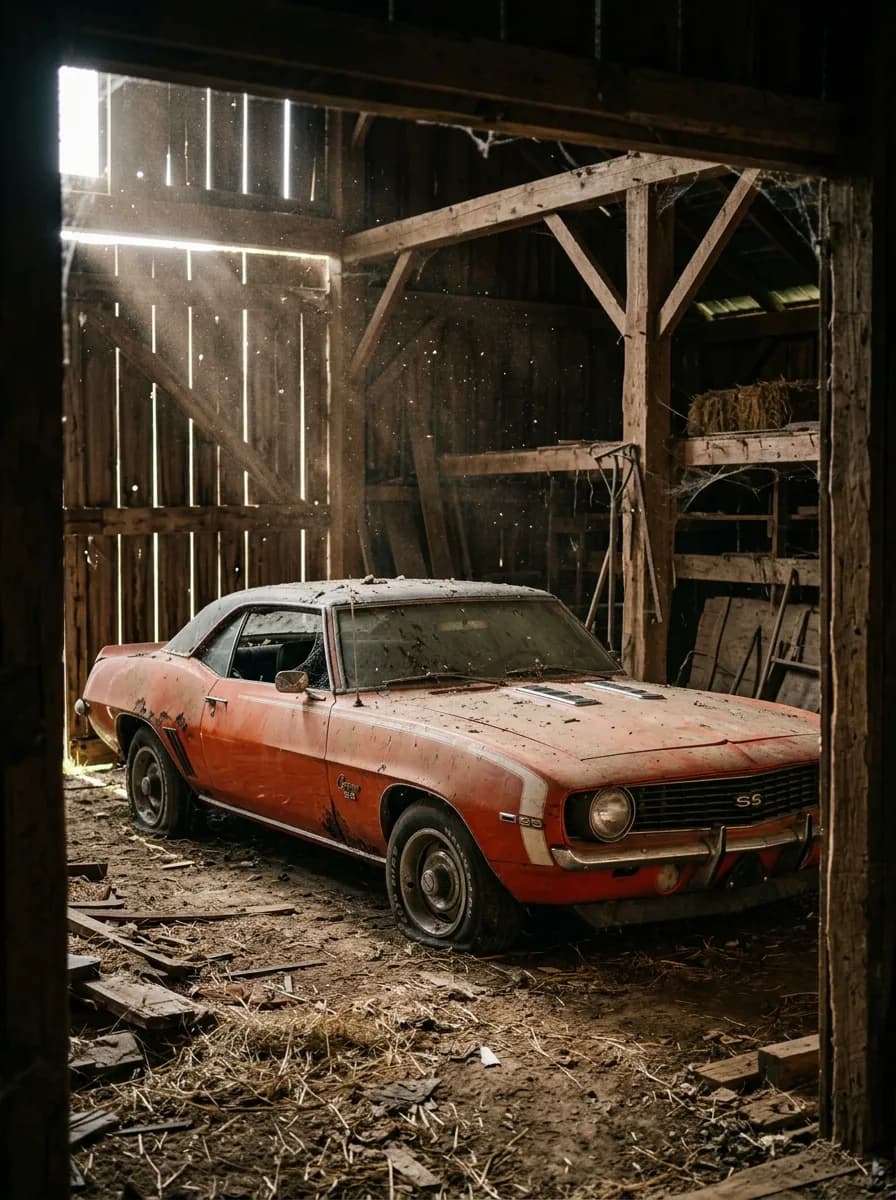
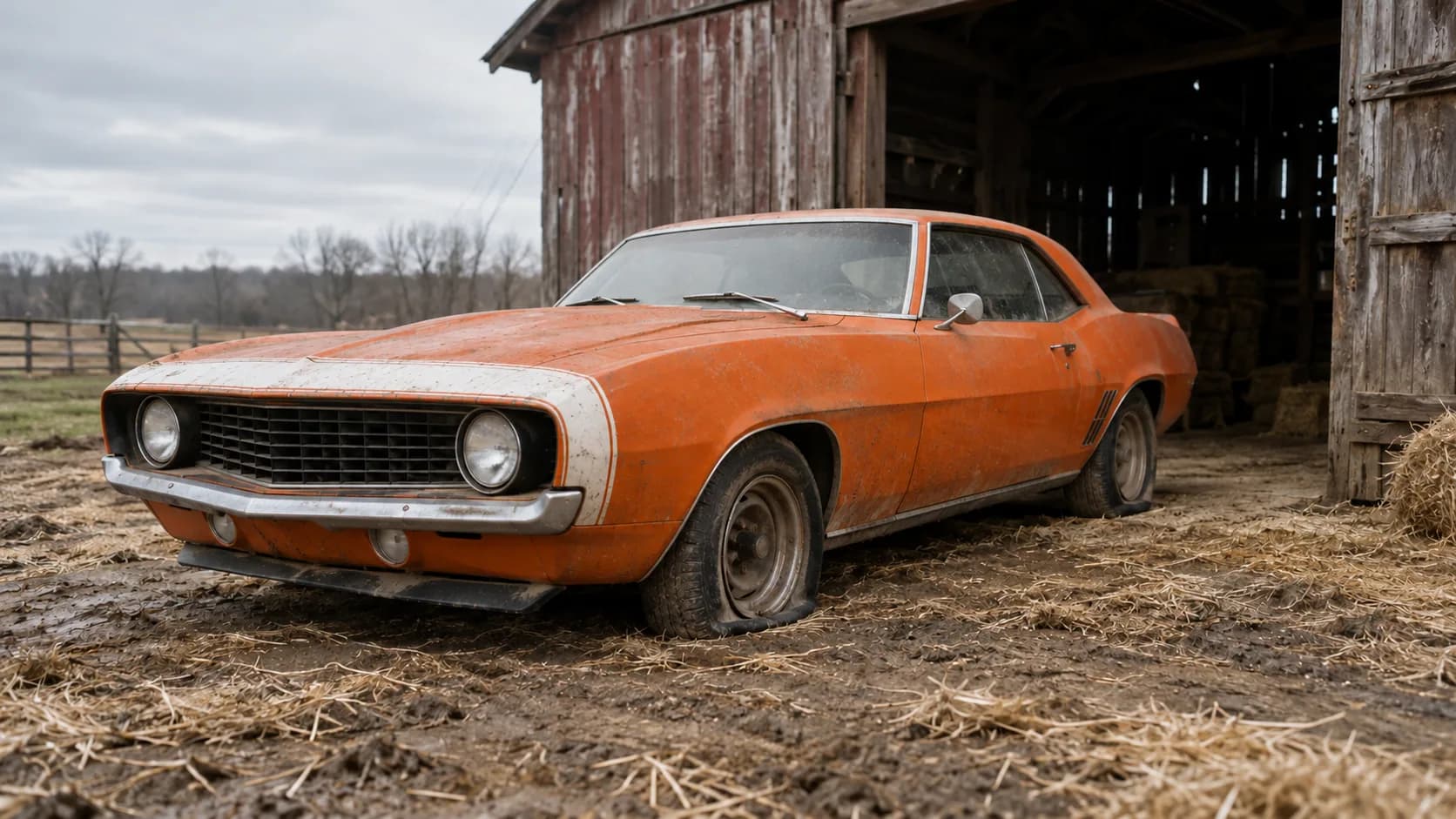
What would you do if a barn door swung open on a 1969 Camaro SS sitting under decades of dust? It's the moment every muscle car hunter dreams about. The AI render above imagines it, paint gone chalky and the SS badge still legible under the grime.
The SS Package, Decoded
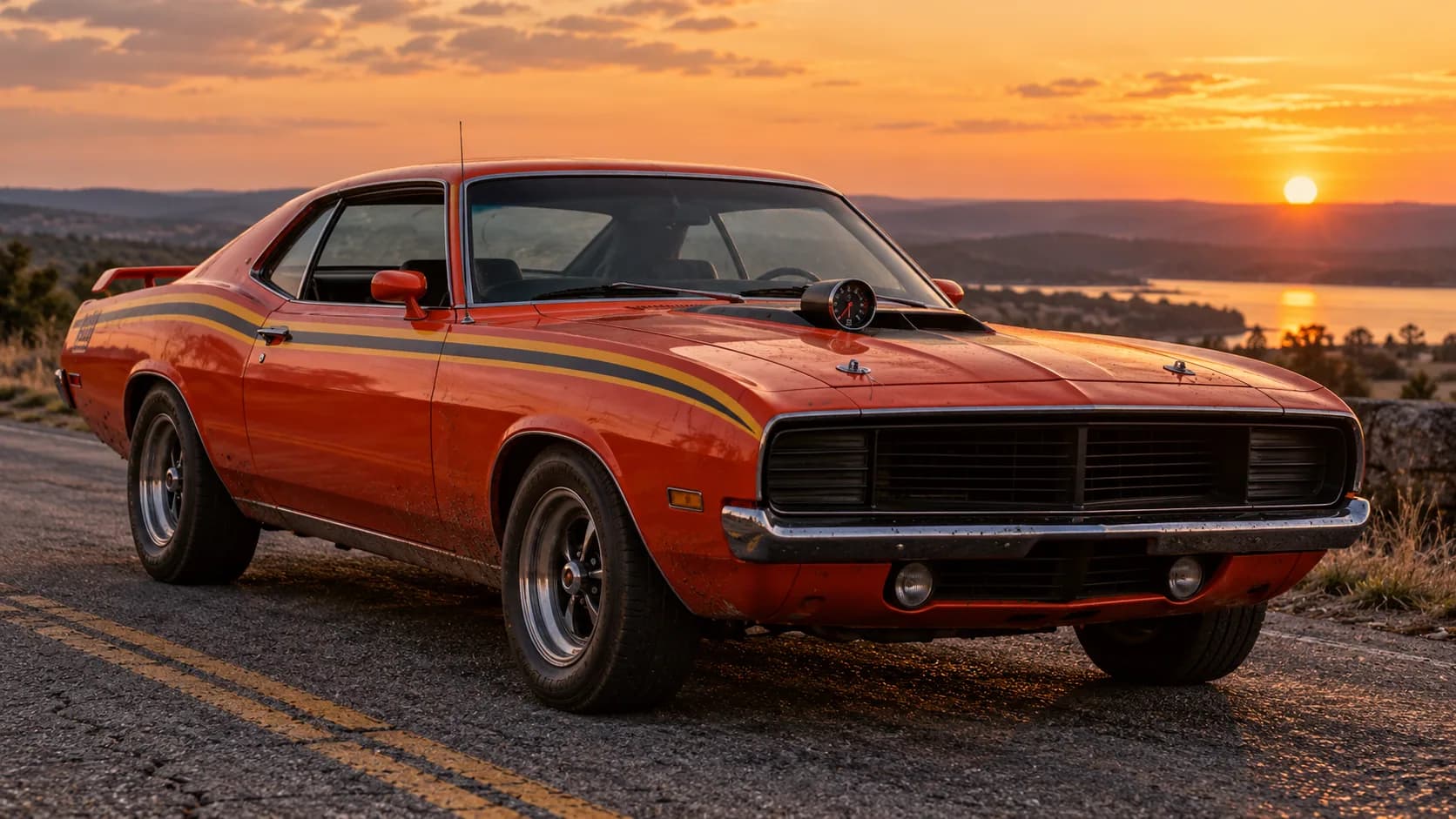
Super Sport on a 1969 Camaro wasn't a trim level you could option just by picking the right badge — it was RPO Z27, a specific package that bundled a blacked-out grille, a distinct hood with underside insulation, sport striping, F70x14 tires, power front disc brakes and dual exhaust on top of whichever engine the buyer chose. It's the combination of those pieces, not any single one, that separates a genuine SS from a car dressed up to look like one later. Chevrolet built roughly 34,900 SS-package Camaros in 1969 across every available engine, making it one of the more common muscle car options of its day, even if surviving, unmolested examples are far scarcer now.
Small-Block or Big-Block: Engine Choices
The SS package started with a 350 cubic inch V8 (RPO L48) rated at 300 hp, paired with a three-speed manual as the base transmission. Buyers who wanted more could step up to a 396 big-block in three states of tune: the L35 at 325 hp, the L34 at 350 hp, or the top-shelf L78 at 375 hp, which could be further optioned with aluminum L89 cylinder heads for less weight over the front wheels. A handful of 1969 Camaros also left the factory with 427 cubic inch engines through the COPO, or Central Office Production Order, system, but those were a separate, unadvertised arrangement handled outside the regular SS ordering process and shouldn't be confused with a standard SS build.
RS, SS and Z/28: Not the Same Car
These three letters get mixed up constantly, and on a 1969 Camaro they mean genuinely different things. RS, Rally Sport, was an appearance package built around hidden headlights and revised taillights — it could be paired with almost any Camaro, regardless of what was under the hood. SS, Super Sport, was a performance package tied to specific engines and suspension upgrades. Z/28 was built for SCCA Trans-Am homologation, centered on a solid-lifter 302 cubic inch V8 rated at 290 hp, with its own dual-stripe treatment and a Z/28 emblem replacing the bowtie on the grille. Chevrolet allowed RS to be combined with either SS or Z/28, which is why hidden headlights alone don't tell you which performance package, if any, is sitting underneath — you have to look past the trim to the drivetrain and the tag.
Behind the Wheel
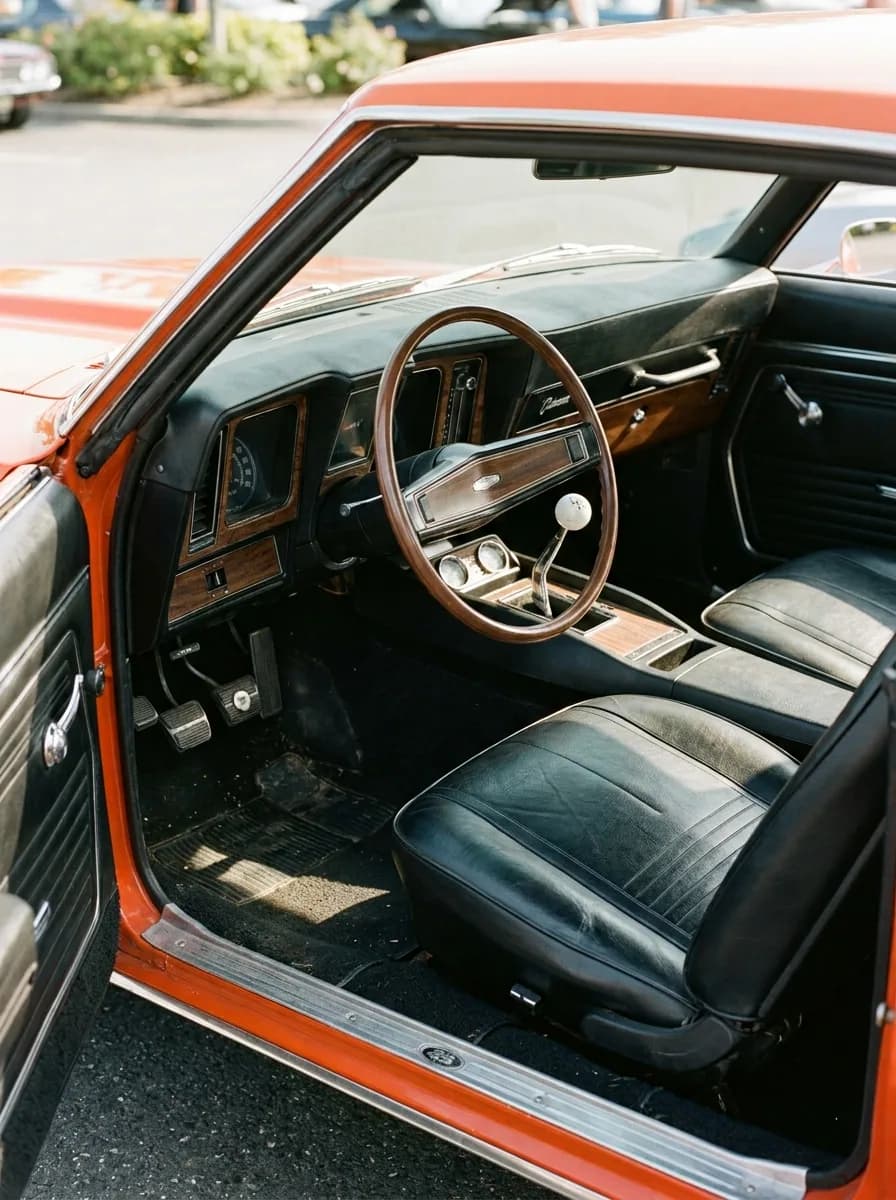
Inside, an SS didn't look dramatically different from any other well-optioned 1969 Camaro — Chevrolet spent its performance budget on the drivetrain, not the cabin. A wood-grain steering wheel and console shift were common buyer choices, sitting ahead of simple round gauges and a bench of controls that feel almost minimalist by modern standards. It's a reminder that the SS package was never about luxury; the black vinyl bucket seats and console were there to hold a driver in place, not to impress a passenger.
The Barn Find Reality Check
Before getting excited about matching numbers, check the cowl tag for the Z27 code and compare it against the VIN and any surviving paperwork. Options like power disc brakes and multi-leaf rear springs came standard on genuine SS cars, but because they were also sold separately, their presence alone doesn't prove SS status — only the documented RPO combination does, and there's no foolproof way to disprove a well-faked one either, which is why the paper trail and casting numbers matter as much as the sheet metal. Once the paper case is made, the mechanical one starts: rust tends to show up first at the trunk drop-offs, the floors and the lower tail panel, and after decades of sitting, every fuel and brake line should be treated as due for replacement before the car turns a wheel again, let alone gets driven home.
Why Collectors Still Chase It
More than half a century later, the 1969 Camaro SS is still one of the most recognized shapes in American performance cars, and Hagerty's data shows values for clean, documented examples continuing to climb. That's exactly why the barn-find scenario — dust, cobwebs, and a cowl tag that checks out — remains the dream: a car built by the tens of thousands has quietly become one where proving the paperwork is worth as much as finding the car itself.
Specs
- SS Package RPO
- Z27 (Camaro Super Sport)
- Production (SS, 1969)
- about 34,900 units, all engines
- Base SS Engine
- 350 cu in V8 (L48), 300 hp
- 396 Options
- L35 325 hp, L34 350 hp, L78 375 hp
- Hood
- SS-specific hood with underside insulation
- Brakes
- Power front disc brakes, standard on SS
FAQ
- What did the SS package actually add to a 1969 Camaro?
- RPO Z27 brought a blacked-out grille, a distinct hood with underside insulation, sport striping, F70x14 tires, power front disc brakes and dual exhaust, on top of either a 350 or 396 V8.
- What's the difference between an SS, an RS and a Z/28?
- RS (Rally Sport) was an appearance package built around hidden headlights and revised taillights. SS (Super Sport) was a performance package tied to specific engines. Z/28 was a homologation special built for Trans-Am racing, with its own solid-lifter 302 and different stripe treatment. Chevrolet let buyers combine RS with either SS or Z/28.
- How do you know if a 1969 Camaro is a real SS?
- Check the cowl tag for the Z27 RPO code, then match the engine's casting numbers and stamped code to what the car's documentation says it left the factory with. Equipment like disc brakes and multi-leaf rear springs came on genuine SS cars but could also be added later, so badges and equipment alone don't prove it.
- What should you check first on a barn find Camaro?
- Start with the cowl tag and VIN before getting excited about the engine. Then check the usual rust spots - trunk drop-offs, floors and the lower tail panel - and assume every fuel and brake line needs replacing before the car turns a wheel again.
Know someone who drove one? Share this guide
Get the Look
As an Amazon Associate we earn from qualifying purchases.
- 1:24 diecast 1969 Camaro SS model car — A shelf-scale version of the barn find.
- 1969 Camaro restoration guide book — For decoding cowl tags and RPO codes.
- Barn find classic car metal sign — Garage decor with the right mood.
Sources
- monarchshowroom.com — 1969-chevrolet-camaro-rss-ss-specs
- camaros.org — options.pdf
- chevyhardcore.com — camaro-engines-through-the-years-the-first-generation
- heacockclassic.com — 1969-chevrolet-camaro-z28-the-other-pony-car
- blog.championcooling.com — spotters-guide-identifying-the-1967-1969-camaro
- camaroworld.macswebs.com — rs_ss
- barnfinds.com — 45-year-barn-find-story-1969-chevrolet-camaro
- hotcars.com — hugger-orange-camaro-z28-barn-find
- nastyz28.com — camaro69