1970 Buick GSX: The Gentleman's Muscle Car Stops Being Polite
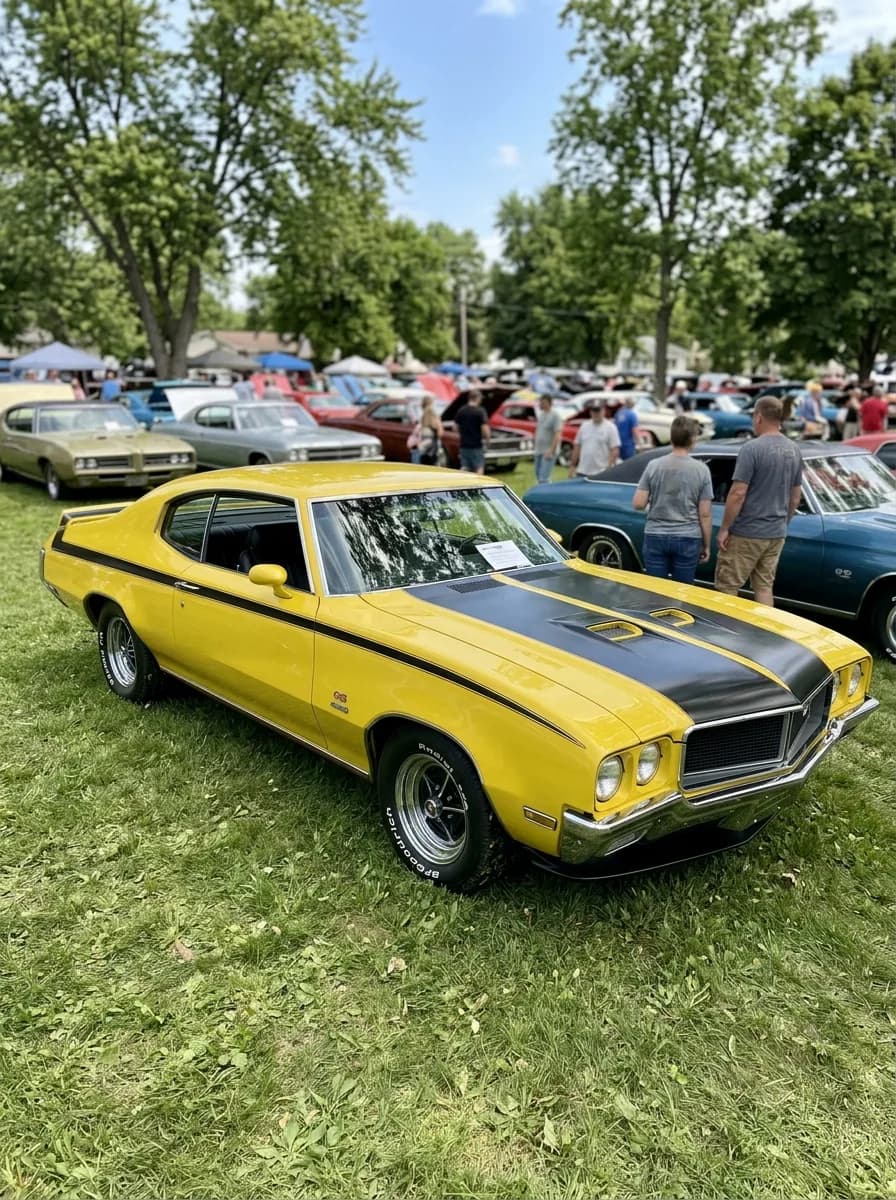
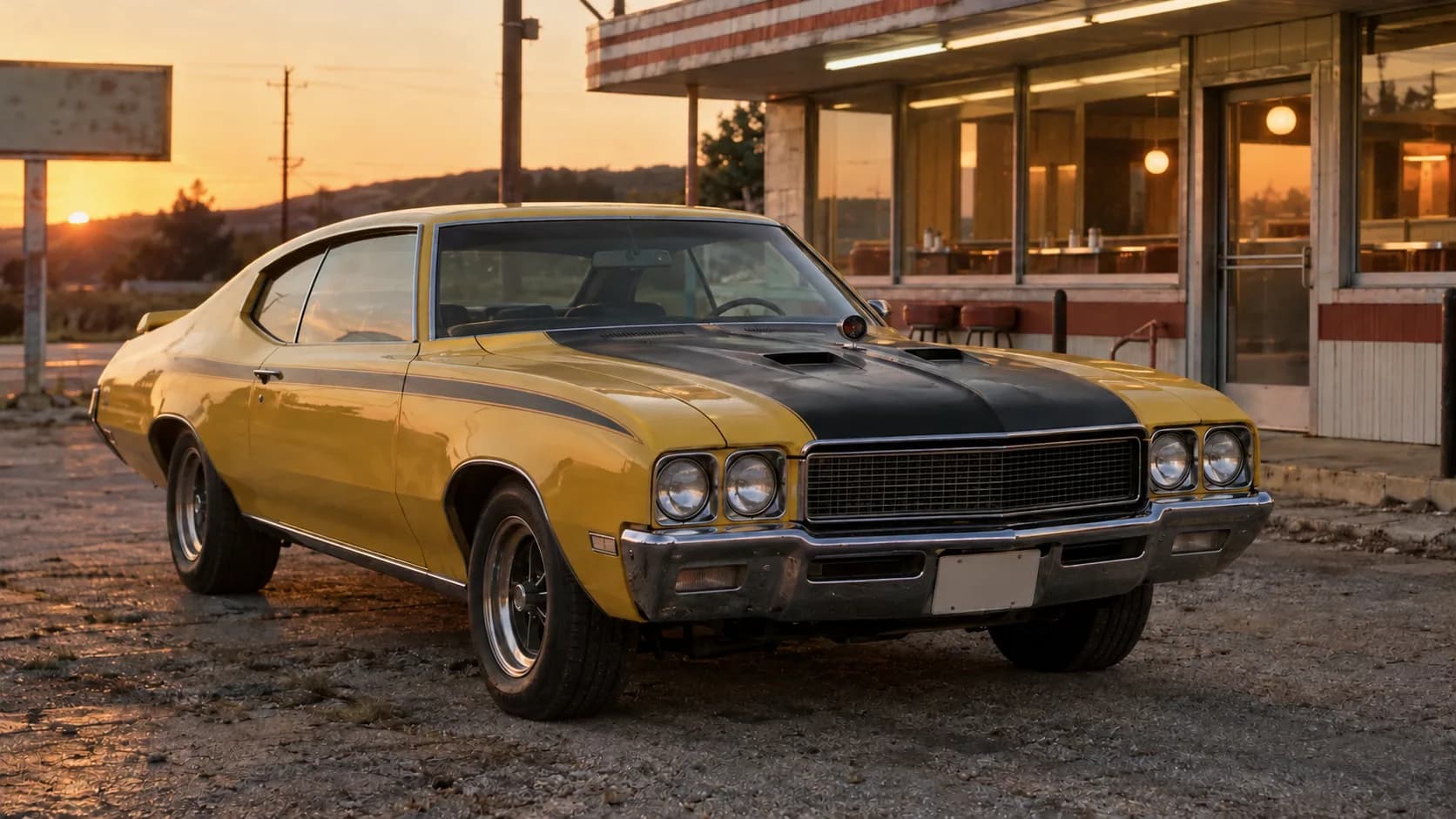
Buick's gentleman's muscle car stopped being polite in 1970, and the paint made the announcement before the engine did. The AI-generated scene above puts a Saturn Yellow GSX at a car show, parked among a field of other muscle cars the way it might have been on any Saturday in 1970. That yellow-and-black combination was practically the car's whole identity.
Buick's Answer to the Muscle Car War
Buick's muscle car story started in 1965, when the Skylark Gran Sport arrived mid-year as a direct answer to Pontiac's GTO — a 401 cubic-inch "Nailhead" V8 option, good for 325 or 340 horsepower, dropped into the same A-body platform GM's other divisions were racing to exploit. By 1967 the Gran Sport had grown into its own model line, badged by displacement (GS 340, GS 400), and it kept evolving as engines grew through the end of the decade. Through all of it, Buick's performance cars still carried the brand's reputation as a gentleman's muscle car — quick, but polite about it, built for buyers who wanted speed without giving up Buick's usual comfort and refinement. For 1970, Buick built the GSX package on top of the range-topping GS 455, and for the first time didn't bother being polite about it.
What the GSX Package Actually Bought
The GSX added $1,196 to the price of a GS 455 and, in return, dressed the car in a way no other Buick had been dressed before: a full-length black body stripe, a blacked-out hood with a factory-installed hood-mounted tachometer, and front and rear spoilers at a time when spoilers on an American production car were still a novelty. Buick wrapped 7-inch wheels in Goodyear Polyglas GT tires to put the power down. None of it was subtle, and none of it was meant to be.
Two Colors, On Purpose
Buick offered the GSX in exactly two colors: Saturn Yellow or Apollo White, both finished with the black stripe treatment. That wasn't a limitation of the paint shop — plain GS 455s were available in Buick's full regular color palette — it was a deliberate choice to keep the GSX visually distinct from every other Gran Sport on the lot. GSX-specific badging on the grille, front fenders, and decklid made sure nobody mistook one for a standard GS 455 from a distance, and it's part of why surviving cars are so easy to spot today.
The 455: Standard and Stage 1
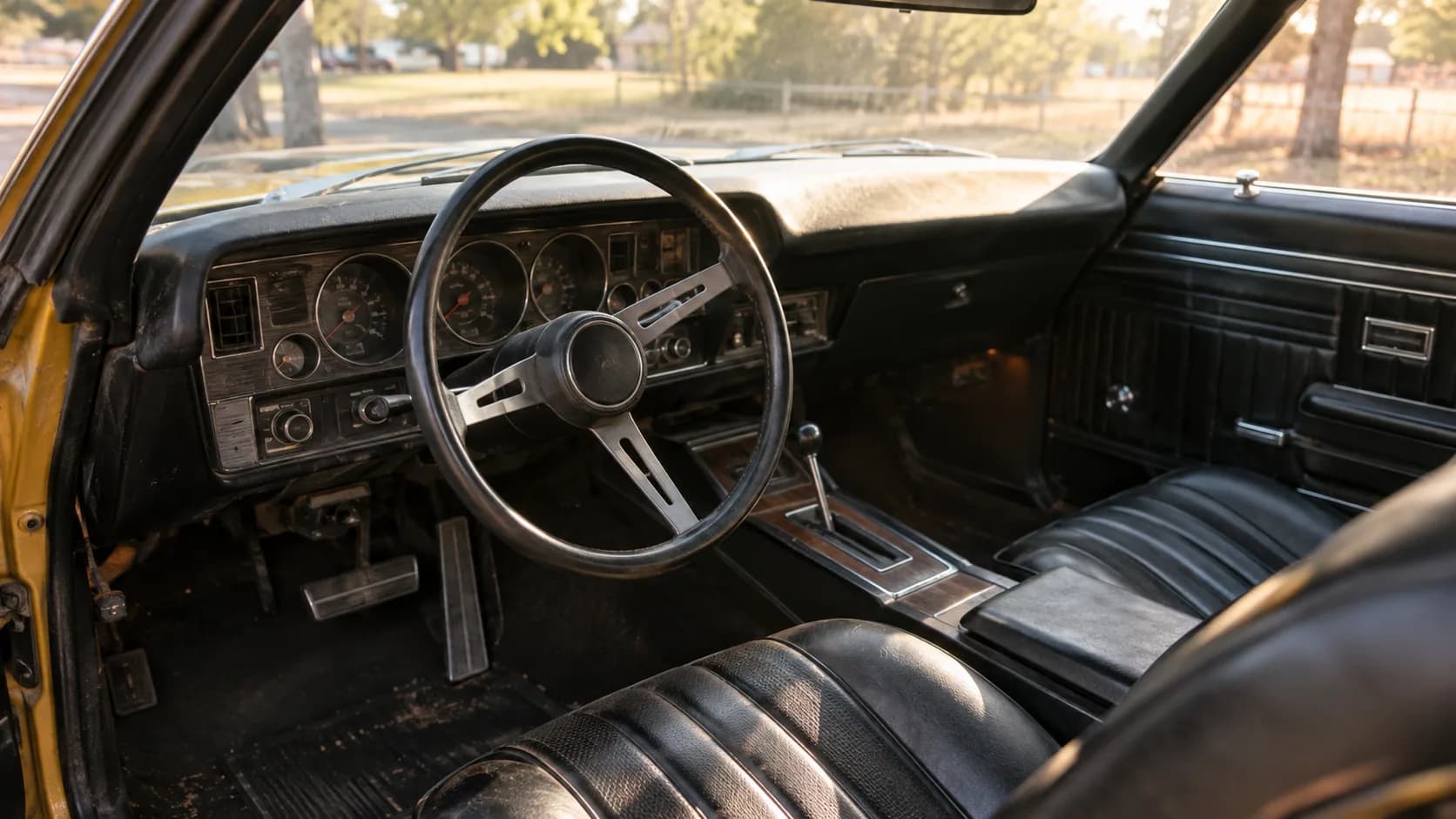
Every GSX came with Buick's 455 cubic-inch V8 rated at 350 horsepower and 510 lb-ft of torque, peaking at just 2,800 rpm — the highest torque figure of any muscle car offered that year. Buyers who added the Stage 1 package got a revised factory rating of 360 horsepower, built on 10.5:1 compression, larger intake and exhaust valves, a hotter performance camshaft, and a Rochester Quadrajet carburetor recalibrated with different jetting to match the extra airflow. Underneath, Stage 1 cars also picked up stiffer dual valve springs, a higher-volume fuel pump, a larger oil pickup, and a positive-traction rear axle to put it all to the pavement. Torque, already the GSX's calling card, stayed the headline number regardless of which version buyers chose.
Rare Then, Rarer Now
Buick built 678 GSXs for the 1970 model year — the figure used in GM's own heritage records, though a handful of other sources cite 687. Of those, 479 buyers checked the box for Stage 1 (280 with the automatic, 199 with a four-speed), making Stage 1 the majority choice rather than the exception. Either way, the GSX was never meant to be common. It was a low-volume flagship built to prove Buick could out-muscle the muscle car establishment, not a volume seller.
The Legacy of the Gentleman's Hot Rod
The GSX name lived on for two more years — just 124 built in 1971 and 44 in 1972, the model's last — as tightening emissions rules and insurance surcharges on big-block muscle cars meant every year after 1970 came with less compression, less power, and less of the original's edge. None of that follow-up run gets cross-shopped against the original — the 1970 GSX is the one collectors chase, and the one that defines what the name means. It's the car that took Buick's reputation for composed, well-mannered performance and bolted a hood tach and a spoiler onto it, proving the "gentleman's muscle car" tag could still hide a genuine street fighter underneath. Of everything Buick built during the muscle car era, it remains the loudest statement the brand ever put its name on.
Specs
- Standard engine
- 455 cu in V8, 350 hp / 510 lb-ft
- Stage 1 package
- 360 hp, same 510 lb-ft torque rating
- Peak torque
- 510 lb-ft at 2,800 rpm
- Colors offered
- Saturn Yellow or Apollo White only
- 1970 GSX production
- 678 built (GM heritage figure; a few sources cite 687)
- Stage 1 take rate
- 479 of 678 — about 70% of GSX buyers
- GSX package price
- $1,196 over a GS 455
FAQ
- What engine came standard in the 1970 Buick GSX?
- A 455 cubic-inch V8 rated at 350 horsepower and 510 lb-ft of torque. The optional Stage 1 package raised the factory rating to 360 horsepower.
- What colors did the 1970 GSX come in?
- Just two: Saturn Yellow or Apollo White, both paired with a black body stripe and blacked-out hood.
- How many 1970 Buick GSXs were built?
- 678, the figure used in GM's own heritage records (a few other sources cite 687). Of those, 479 were built with the Stage 1 package.
- Is a GSX just a Buick GS 455 with different paint?
- No. The GSX added its own package on top of the GS 455 — hood tachometer, front and rear spoilers, specific stripe graphics, and 7-inch wheels — not just a color choice.
Know someone who drove one? Share this guide
Get the Look
As an Amazon Associate we earn from qualifying purchases.
- 1970 Buick GSX 1:18 Diecast Model Car — Saturn Yellow and black stripes, at desk scale.
- Buick Muscle Cars History Book — Background on the Gran Sport line the GSX was built from.
- Vintage-Style Buick GSX Metal Garage Sign — Wall art for a Buick-loyal garage.
Sources
- gm.com — 1970-buick-gsx
- streetmusclemag.com — rare-rides-the-1970-buick-gsx-and-gsx-stage-1
- musclecarfan.com — buick-built-only-678-of-these-1970-gsxs-and-its-510-lb-ft-torque-monster-could-out-pull-a-hemi
- hotcars.com — buick-gsx-facts
- hotcars.com — heres-how-much-a-buick-gsx-455-is-worth-today
- slashgear.com — rarest-buick-muscle-car-1970s
- autoevolution.com — 1970-buick-gsx-a-look-back-at-the-original-muscle-car-era-s-torque-king-214431
- autoevolution.com — 1965-skylark-gran-sport-the-forgotten-buick-muscle-car-that-s-still-affordable-today-229319
- macsmotorcitygarage.com — buick-joins-the-muscle-craze-1965-skylark-gran-sport
- stage1registry.com — stage1info