1970 Oldsmobile 442 W-30: The Numbers Behind Oldsmobile's Rocket 455
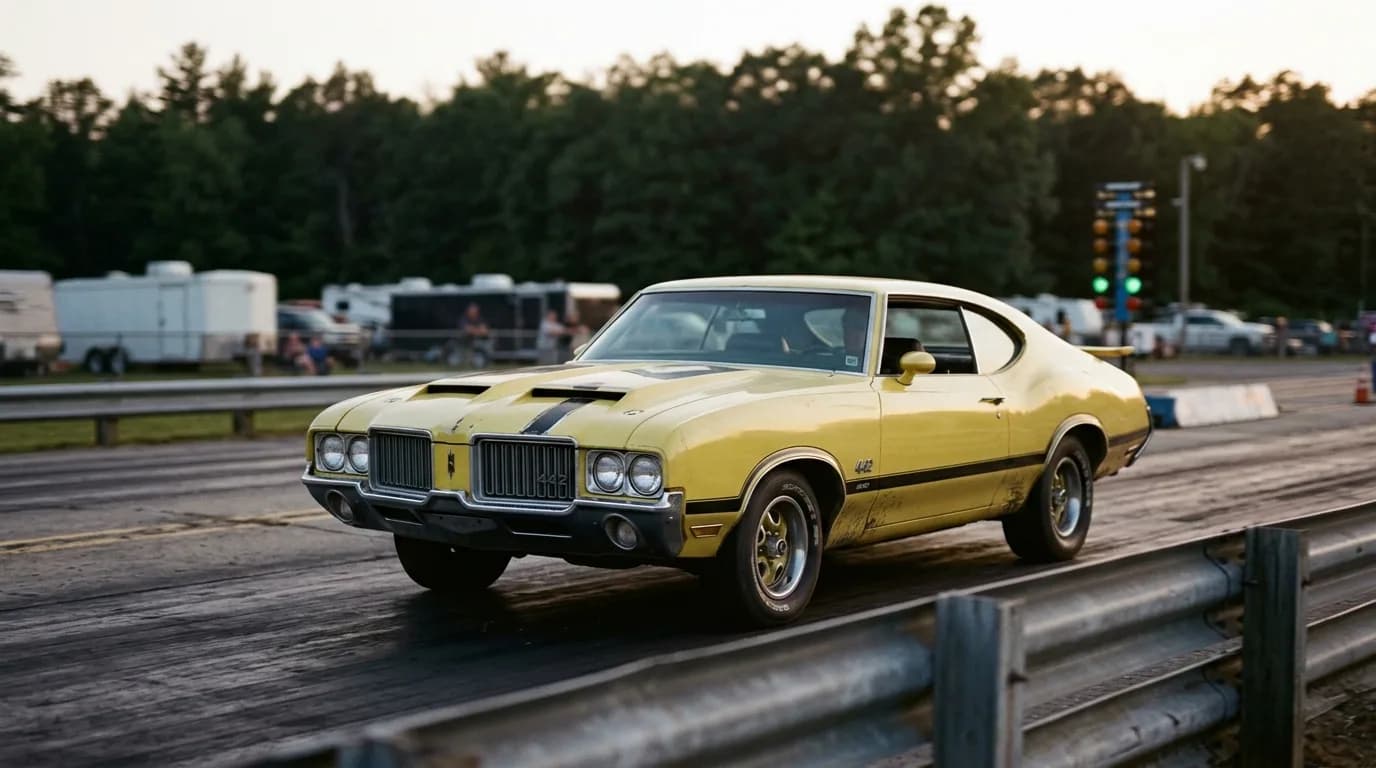
In 1964, 4-4-2 was a parts list. By 1970 it was a whole attitude. Our AI-generated render above stages a Sebring Yellow 442 near the burnout box at a drag strip in the fall of 1970, campers and trailers backed up along the fence the way they were at every local track on a Saturday night, and the badge on the grille divider and the twin hood scoops were Oldsmobile's way of telling the rest of the muscle car class it wasn't playing the polite, buttoned-down Rocket division anymore.
A Name That Stopped Meaning What It Said
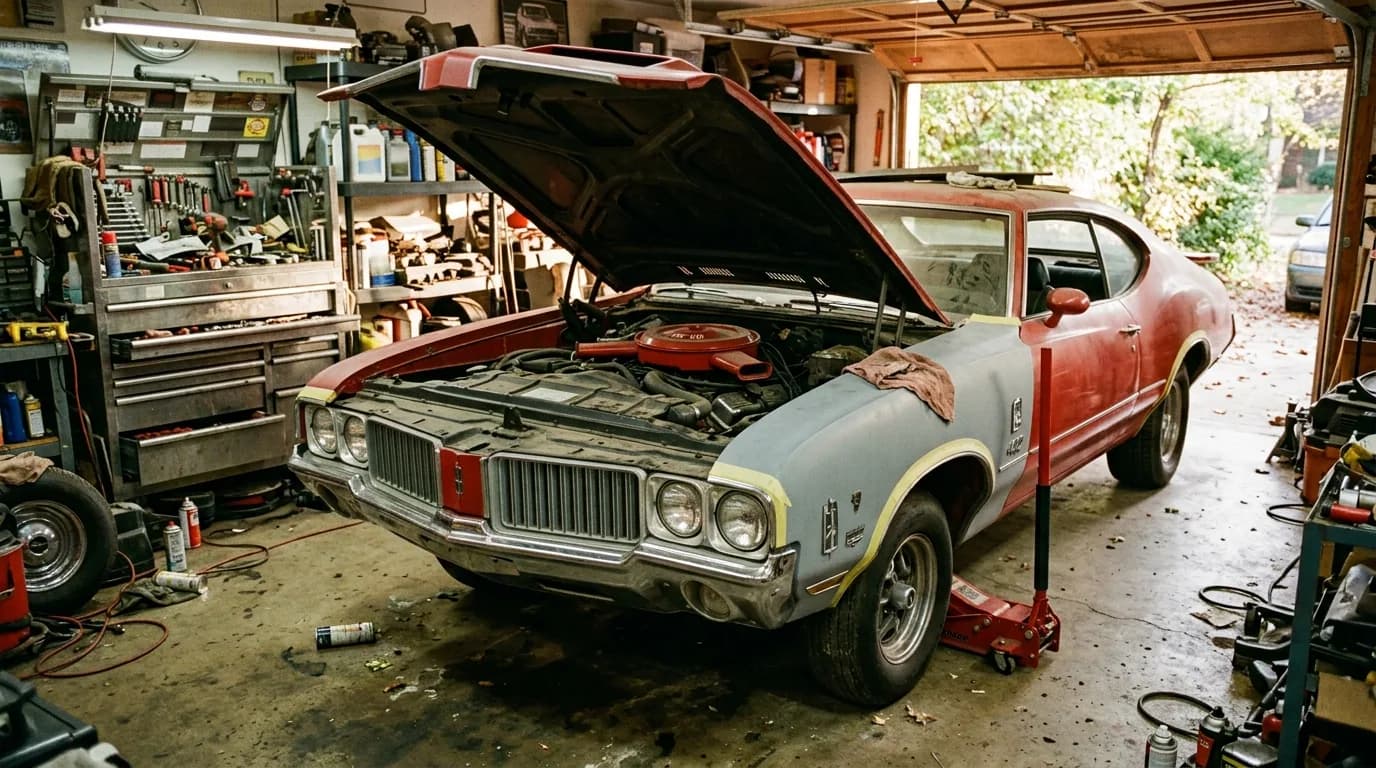
When the 4-4-2 debuted in 1964 as an option package on the F-85/Cutlass, the numbers were literal: a four-barrel carburetor, a four-speed manual transmission, and dual exhaust. Oldsmobile changed the formula almost immediately — by 1965 the first "4" had been reassigned to mean the new 400-cubic-inch V8 instead of the four-barrel carb, and automatic-equipped cars could wear the badge too. By the time the 442 became its own model line later in the decade, the name had stopped describing specific hardware and started describing a car: Oldsmobile's mid-size performance flagship, whatever engine or transmission happened to be under the hood.
1970: Oldsmobile Stops Holding Back
For 1970, General Motors lifted its corporate rule capping intermediate-car engines at 400 cubic inches, and Oldsmobile didn't waste the opening. The 442 got the 455-cubic-inch Rocket V8 as its standard engine, rated at 365 horsepower and 500 lb-ft of torque — the highest standard output the nameplate had carried. The same spring, a 442 served as the actual pace car for the 1970 Indianapolis 500, with Oldsmobile building 626 replica pace car convertibles for sale — 268 on the 442 and 358 on its Cutlass Supreme sibling — to let buyers park a piece of that May afternoon in their own driveway.
The W-30: Oldsmobile's Serious Option
Buyers who wanted more checked the box for W-30, a factory performance package built around the W-25 fiberglass hood: twin functional scoops feeding a vacuum-operated flapper valve that opened under hard acceleration, part of what Oldsmobile called Outside Air Induction. Underneath, W-30 cars got a lightweight aluminum intake manifold, a hotter camshaft, high-flow cylinder heads and exhaust manifolds, and a Rochester Quadrajet recalibrated to match the extra air. The factory rating rose to 370 horsepower on the same 500 lb-ft of torque — a modest bump on paper that undersold how the combination actually drove. A handful of 1970 W-30s, an estimated 300 to 350 by later counts, were also built with an optional aluminum differential housing and cover in place of the standard cast-iron piece, a one-year-only weight-saving detail most buyers never checked the box for.
Spotting a 442 in the Wild
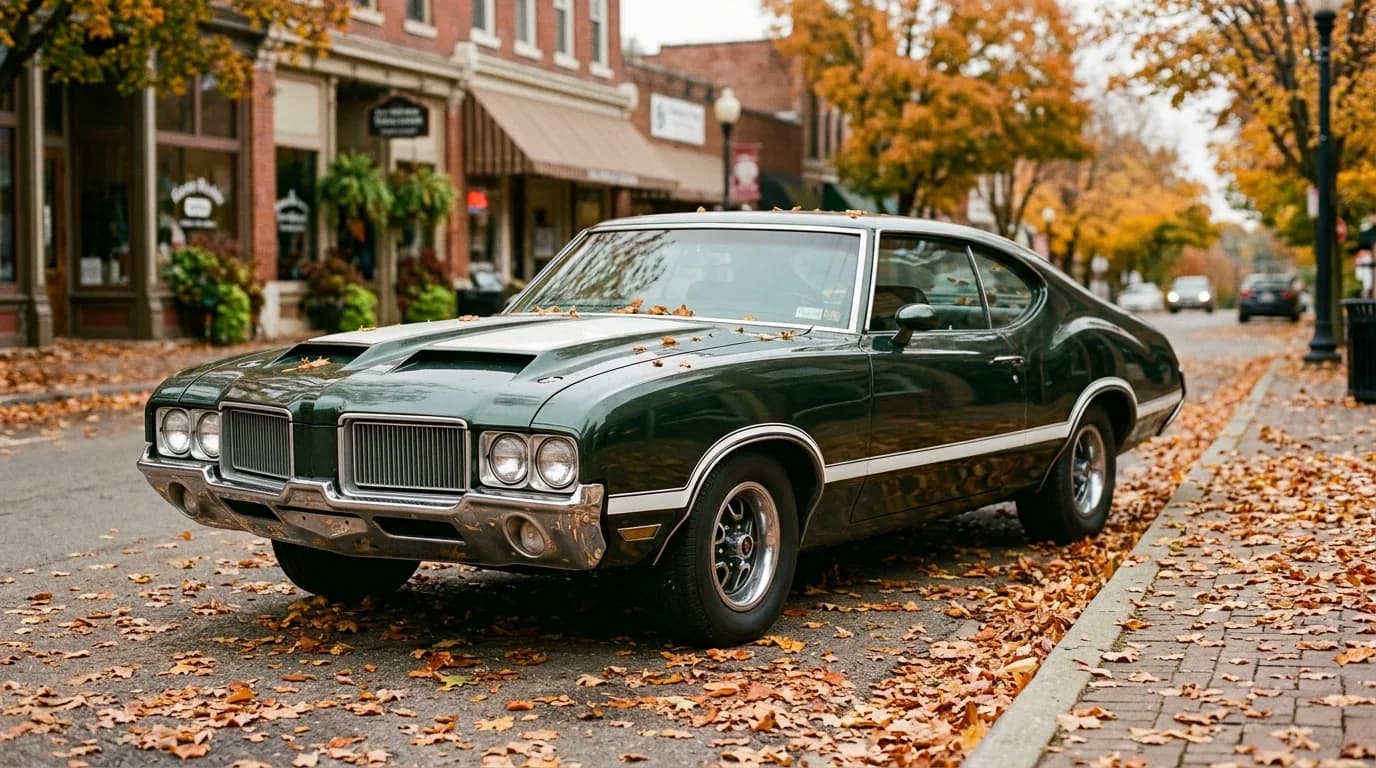
A genuine 442 carries its badge on the grille's center divider and again on the rear, flanked by quad headlamps recessed into twin grille openings. A vinyl body stripe ran the beltline, following the character line from the front fender through the doors to the rear quarter panel — vinyl rather than paint, which is why so many surviving cars show fading or peeling in that exact spot. A W-30 adds the twin-scoop W-25 hood on top of all of it, plus dual exhaust exiting out back. None of it was subtle, and Oldsmobile didn't intend it to be.
Rare Then, Collectible Now
Oldsmobile built about 19,330 442s for 1970 across three body styles — 14,709 hardtops, 2,933 convertibles, and 1,688 Sports Coupes — and only 3,100 of those were ordered with W-30. That scarcity shows up in what they bring today: Hagerty's guide puts a #2 (Excellent) 1970 W-30 convertible at roughly $156,000, while the median second-generation 442 in #3 (Good) condition sits closer to $44,600.
The Legacy
The 1970 442 sits at the top of the nameplate's own arc: the last year before insurance surcharges and tightening emissions rules started squeezing horsepower out of every big-block muscle car on the market, and the only year the 442 carried a 455 this strong alongside a package as thorough as the W-30. It's the car that took a name that had already been redefined twice and made it mean something new one more time — Oldsmobile's Rocket division, at its loudest.
Specs
- Standard engine
- 455 cu in V8, 365 hp / 500 lb-ft
- W-30 package
- 370 hp, same 500 lb-ft torque rating
- W-30 hood
- W-25 twin-scoop fiberglass hood, vacuum-operated Outside Air Induction flapper
- 1970 442 production
- About 19,330 (14,709 hardtops, 2,933 convertibles, 1,688 Sports Coupes)
- W-30 production
- 3,100 of the 19,330 442s built
- 1970 Indy 500 pace car replicas
- 626 convertibles built — 268 on the 442, 358 on the Cutlass Supreme
- Value today
- Hagerty #2 (Excellent) W-30 convertible ~$156,000; #3 (Good) median ~$44,600
Get the Look
As an Amazon Associate we earn from qualifying purchases.
Sebring Yellow with the twin-scoop hood, at desk scale.
Check price at AmazonBackground on the 442 and Rocket division performance era.
Check price at AmazonWall art for an Olds-loyal garage.
Check price at AmazonKeeps a Sebring Yellow paint job and stripes looking factory-fresh.
Check price at AmazonStorage protection for a numbers-matching W-30.
Check price at AmazonFAQ
- What does "442" stand for on the Oldsmobile 442?
- It originally meant a four-barrel carburetor, four-speed manual, and dual exhaust in 1964. By 1965 Oldsmobile redefined the first "4" to mean its 400-cubic-inch V8, and later the 442 became a standalone model name rather than a description of specific hardware.
- What was the difference between a standard 1970 442 and a W-30?
- Both used the 455-cubic-inch V8, but the standard engine made 365 hp while the W-30 package raised that to 370 hp on the same 500 lb-ft of torque, adding a twin-scoop fiberglass hood, a hotter cam, an aluminum intake, and high-flow heads and exhaust manifolds.
- How many 1970 Oldsmobile 442s were built?
- About 19,330 across all body styles, with only 3,100 of those ordered with the W-30 package.
- Was the Oldsmobile 442 really the pace car for the 1970 Indy 500?
- Yes. A 442 paced the field at the 1970 Indianapolis 500, and Oldsmobile built 626 replica pace car convertibles for sale — 268 based on the 442 and 358 on the Cutlass Supreme.