Detroit 8V92: Two-Stroke V8 Diesel History, Specs and Sound
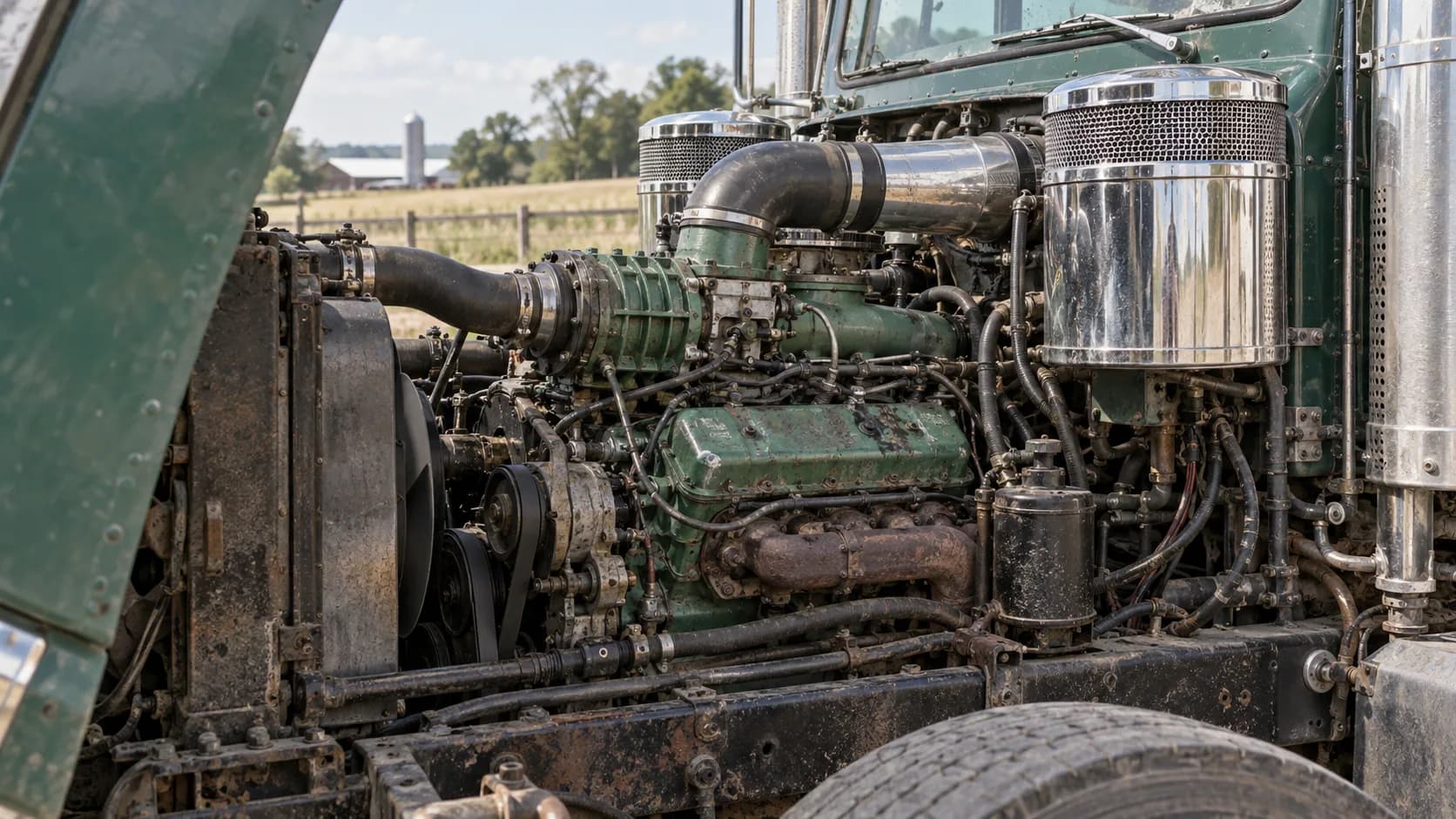
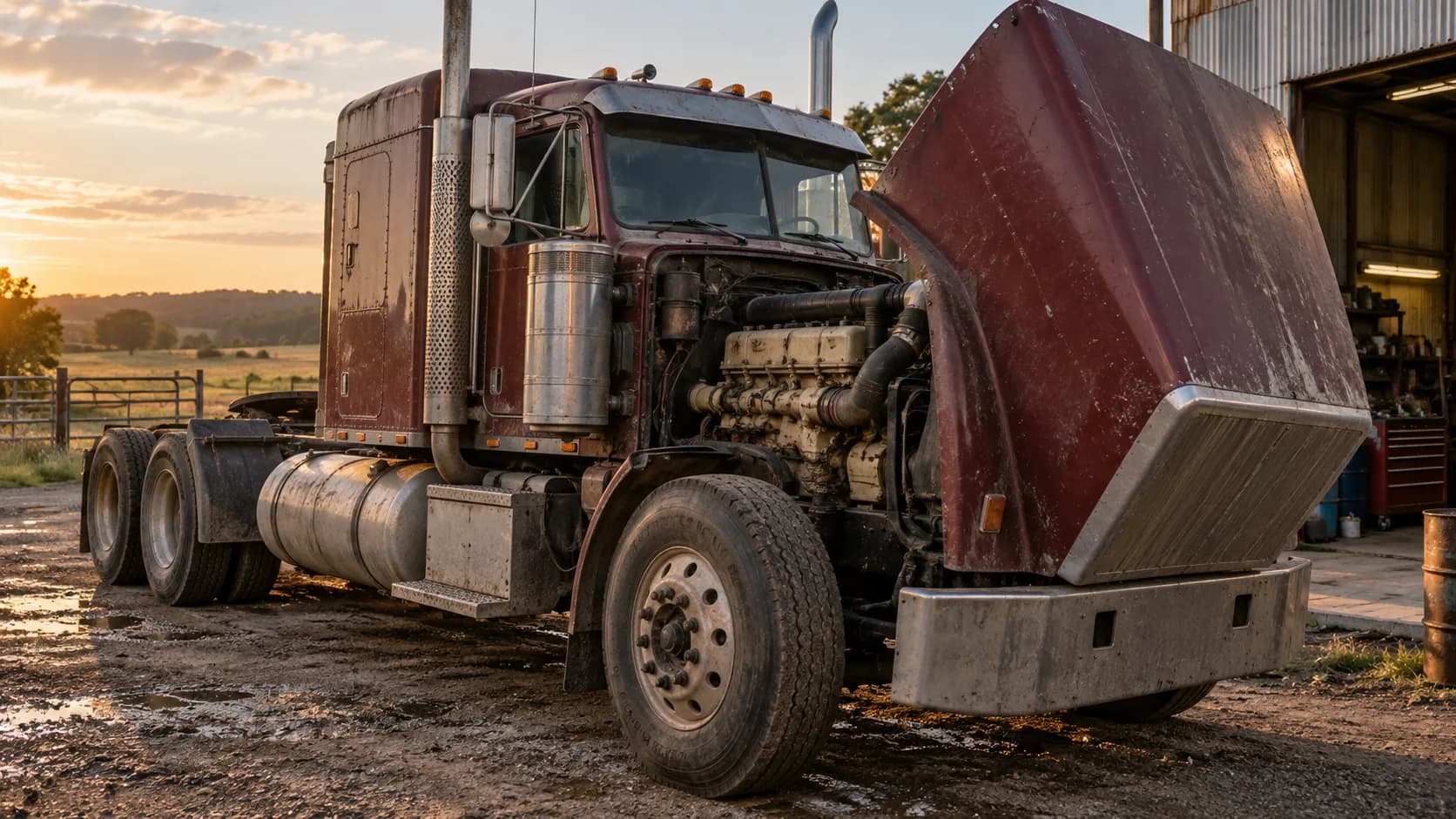
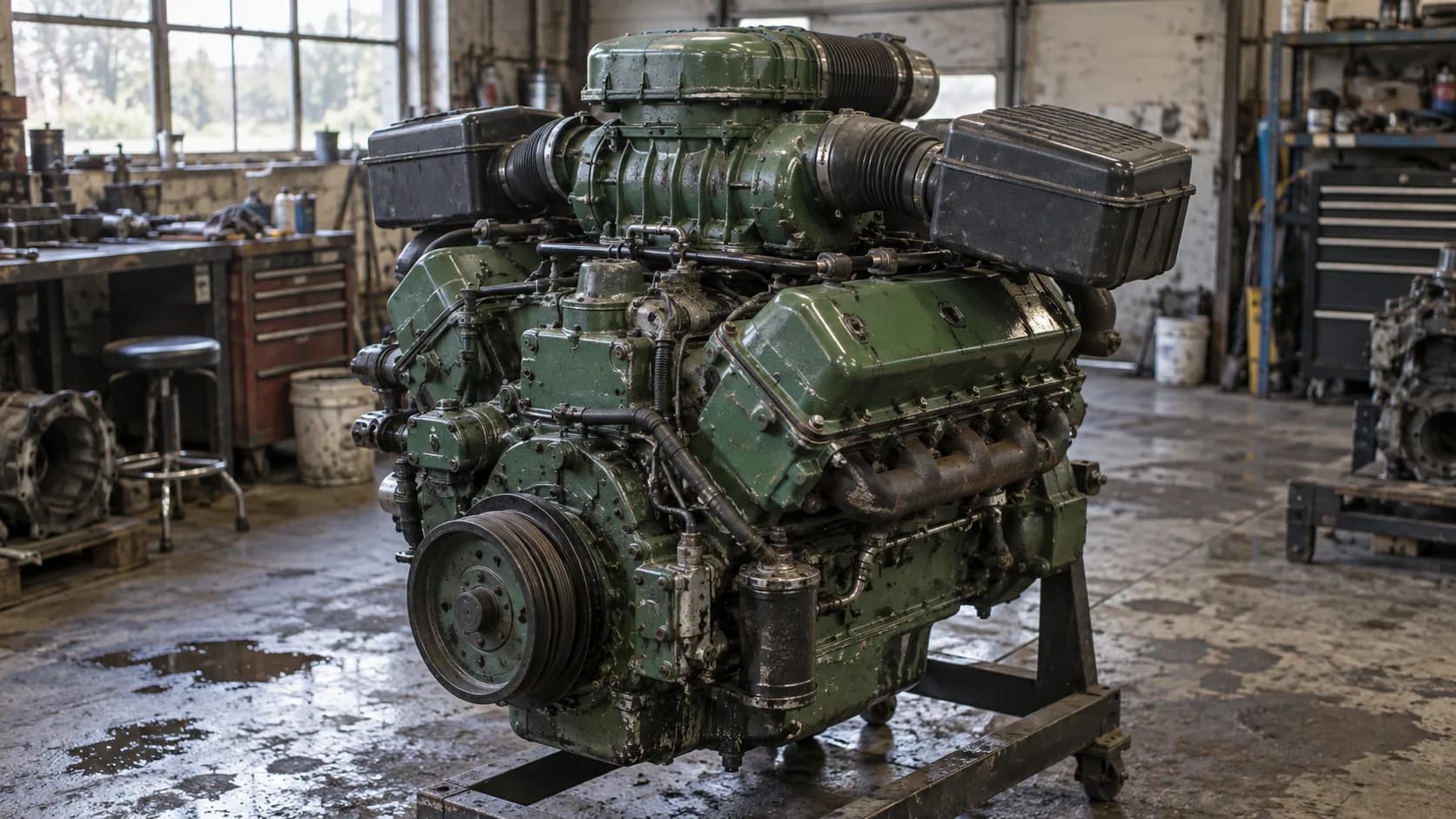
Few diesel sounds stop a truck stop conversation like a two-stroke Detroit V8 winding out toward governed speed. The renders above imagine that world, a green blower engine on a shop stand, another tucked between the frame rails of an older truck with its hood tilted open, and a rig pulling past a farm at sunset with smoke at the stacks, and all three are AI-generated images rather than photos of real engines or trucks. The engine behind them is real. The Detroit Diesel 8V92 was one of the defining heavy-duty diesels of the 1970s and 1980s, and it still has a loyal following.
How a Two-Stroke Diesel With a Blower Works
Detroit's 92 Series grew out of the older Series 71. The 92 is essentially a rebored 71, introduced in 1974 and built in V6, V8, V12 and V16 forms, with the 6V92 and 8V92 the most popular. Like the 71, it is a two-stroke, so every cylinder fires once per crankshaft revolution instead of every other revolution.
A two-stroke diesel without crankcase breathing cannot pull in its own air, so Detroit bolted a gear-driven Roots blower to the engine. The layout the 92 shares with the 71 is simple: the blower pushes air through passages in the block and into ports in the cylinder walls at slightly above atmospheric pressure. When the piston uncovers those ports near the bottom of its stroke, fresh air rushes in and drives spent gas up and out through poppet exhaust valves in the head. Because the flow runs one way, bottom to top, the system is called uniflow scavenging. Each cylinder has a unit injector, and the same camshaft that opens the exhaust valves also works the injectors.
Model codes tell you what is bolted on. In a name like 8V92TA, 8V means eight cylinders in a V, 92 is the cubic inches per cylinder, T means turbocharged and A means aftercooled. The engine also supported Detroit's electronic DDEC controls in versions I through IV.
Displacement and Horsepower Ratings
Eight cylinders of 92 cubic inches works out to 736 cubic inches, about 12.1 liters. Wikipedia lists a 4.84-inch bore, a 5.00-inch stroke, and compression ratios of 17:1 for turbo engines and 19:1 otherwise. Typical maximum speed was 1,950 to 2,100 rpm.
Ratings varied widely by year and application. Published ratings put the 8V92 at 360 hp and 983 lb-ft, the 8V92T at 430 hp and 1,186 lb-ft, and the 8V92TA at 435 hp and 1,242 lb-ft, all with peak torque at 1,400 rpm. Parts supplier Diesel Pro Power lists higher turbo-aftercooled ratings, and Overdrive has profiled a 1986 GMC General running a 500-hp 8V92TA. Treat any single number as one rating among many, and check the engine tag on a real engine.
Why It Screams
Fans of the Series 71 nicknamed the 6V-71 the Screaming Jimmy, a name that came from its high-pitched sound at its 2,100 rpm operating speed, a noise that could make the engine seem to be turning nearly twice that fast. The 8V92 runs in the same speed range and shares the same two-stroke, blower-fed design, which is why owners describe the same howl. With every cylinder firing on every revolution, the exhaust pulses come twice as often as on a four-stroke turning the same rpm.

Trucks, Buses and the Silver 92
The 92 Series went into trucks, buses, motor homes, fire apparatus, construction and industrial equipment, military vehicles and boats, and it was a major North American bus engine in the 1980s and early 1990s. Detroit sold the family as its fuel-saving line, and the 6V-92TT was claimed to save 10 to 20 percent on fuel over earlier engines of similar power.
In trucks, the Overdrive profile of that 1986 GMC General, nicknamed Black Widow, pairs the 8V92TA with a five-speed Allison automatic. Forum threads also discuss 8V92 power upgrades in Peterbilt 359s, though a factory option list is hard to find.
Then there is the Silver 92. Owners use the name for later 92s painted silver instead of the familiar Detroit green. Forum posters generally place the change around 1981 or 1982, some tie it to engine serial numbers, and posters cite ratings such as 435 hp and 475 hp. They also warn that paint is a poor guide, since rebuilders used their own colors. None of that comes from factory literature, so treat it as enthusiast lore.
Reputation and Maintenance
Owners in forum threads call the 8V92 tough but thirsty, and they joke that it leaks oil like every older Detroit. Power and Motoryacht puts the leaks down to a complex system of seals that often failed over time, and says the problem was largely overcome after Roger Penske took over Detroit Diesel from General Motors in 1988 (the new Detroit Diesel Corporation began as a Penske-GM joint venture). The same magazine says genuine replacement parts became hard to find for a time, though MTU's Reliabilt program now sells genuine parts and rebuilt engines. If you are shopping for a truck or bus with an 8V92, look for oil seepage and ask for service records.
Why It Was Replaced: Emissions and the Series 60
The two-stroke layout that made the 92 compact and loud also made it dirty. Power and Motoryacht says its main drawback was that unburned fuel could slip out the exhaust before the port closed. Electronic controls cut emissions for a while, but the design eventually could not meet stricter laws. The Series 92 left the on-highway market in the summer of 1995, replaced by the four-stroke Series 60. Power and Motoryacht gives 1998 for the end of all two-stroke Detroit production, so the dates depend on what is being counted. The four-stroke Series 50 also took over some of its work.
The Series 60 arrived in 1987 as a four-stroke inline six and was the first production engine with integrated electronic controls as standard. It became the engine of the next era. The 8V92 lives on in restored trucks, converted buses and workboats, and in the sound that still turns heads.
Specs
- Series 92 production
- 1974-1995 (Wikipedia)
- Layout
- Two-stroke V8, Roots blower, uniflow scavenging
- Displacement
- 736 cu in (92 per cylinder), about 12.1 L
- Bore x stroke
- 4.84 x 5.00 in
- Compression ratio
- 17:1 (turbo), 19:1
- Ratings (Wikipedia)
- 360 hp (8V92) to 435 hp (8V92TA); higher ratings existed
- Typical max speed
- 1,950-2,100 rpm
- Successor
- Detroit Diesel Series 60 four-stroke (also Series 50)
FAQ
- How much horsepower does a Detroit 8V92 have?
- It depends on the version. Wikipedia lists 360 hp for the 8V92, 430 hp for the 8V92T and 435 hp for the 8V92TA. Higher ratings were also offered, and an 8V92TA profiled by Overdrive makes 500 hp.
- What is the displacement of a Detroit 8V92?
- About 736 cubic inches, or roughly 12.1 liters. Each of the eight cylinders displaces 92 cubic inches, which gives the series its name.
- Why does a Detroit two-stroke diesel scream?
- Every cylinder fires on every crank revolution and the engine runs up to about 2,100 rpm, so the exhaust note is fast and high-pitched. The 6V-71 was nicknamed the Screaming Jimmy for that sound.
- What replaced the Detroit 8V92?
- The four-stroke Detroit Diesel Series 60 replaced the 92 Series, which Wikipedia says left the market in the summer of 1995. Emissions were the main problem, since the two-stroke design let some unburned fuel escape through the exhaust.
Know someone who drove one? Share this guide
Get the Look
As an Amazon Associate we earn from qualifying purchases.
- Detroit Diesel 92 series service manual — The shop reference for 6V92 and 8V92 work.
- Detroit Diesel metal sign — A garage wall piece for two-stroke fans.
- Classic semi truck diesel book — Background on the trucks these engines powered.
Sources
- en.wikipedia.org — Detroit_Diesel_Series_92
- en.wikipedia.org — Detroit_Diesel_Series_71
- en.wikipedia.org — Detroit_Diesel
- dieselpro.com — detroit-diesel-92-series-engine-models-and-their-specs
- overdriveonline.com — poor-mans-peterbilt-stuart-geltmakers-black-widow-gmc-general
- powerandmotoryacht.com — new-life-2-cycle-detroit-diesels
- highwayandheavyparts.com — detroit-diesel-history
- forums.yesterdaystractors.com — detroit-8v-92-silver-92.325281
- thetruckersreport.com — detroit-diesel-8v92-questions.297550
- thetruckersreport.com — post
- busconversionmagazine.com — index.php
- en.wikipedia.org — GMC_General