Detroit Diesel Series 60 (1987-2011): Specs, HP and History
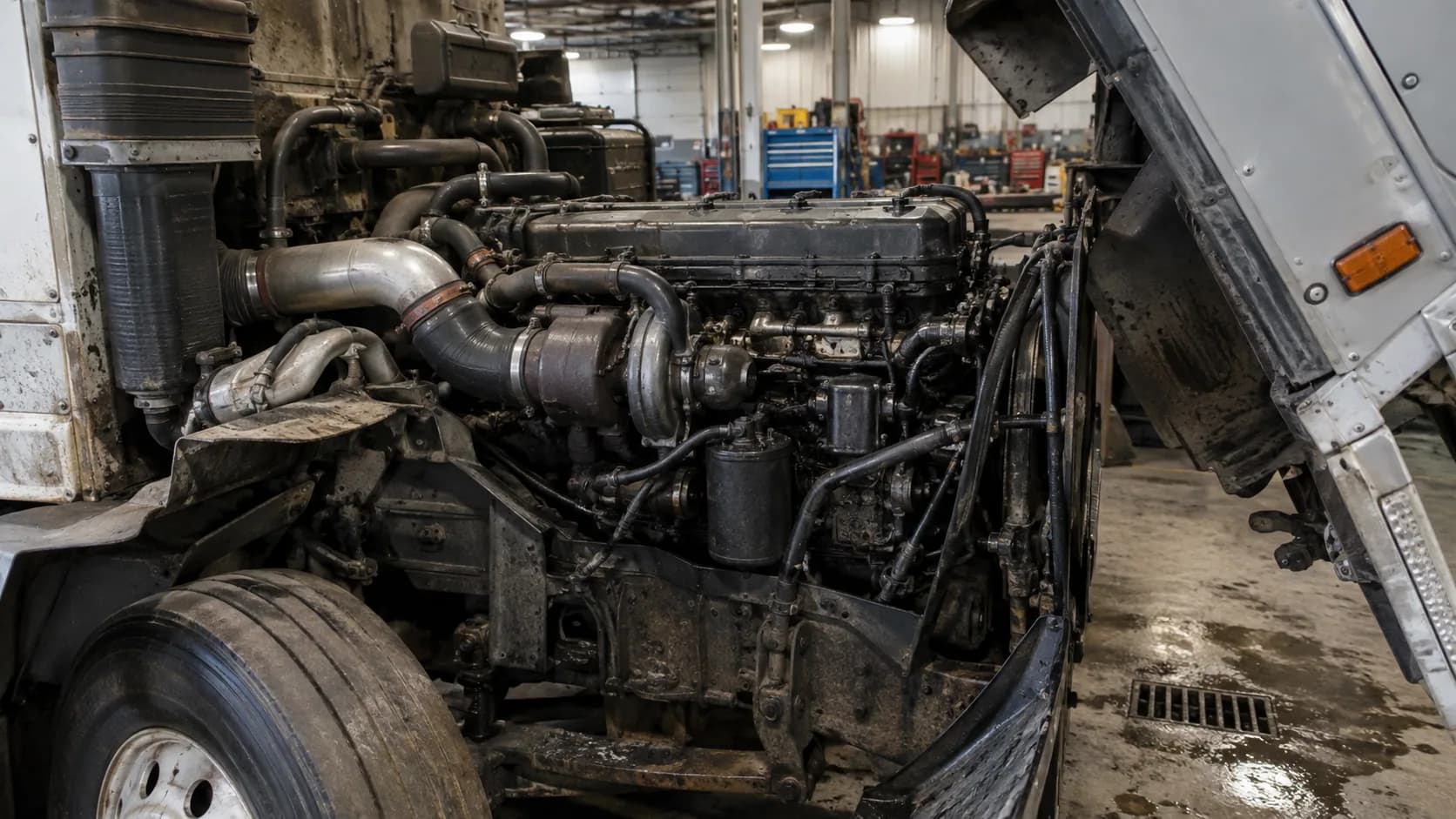
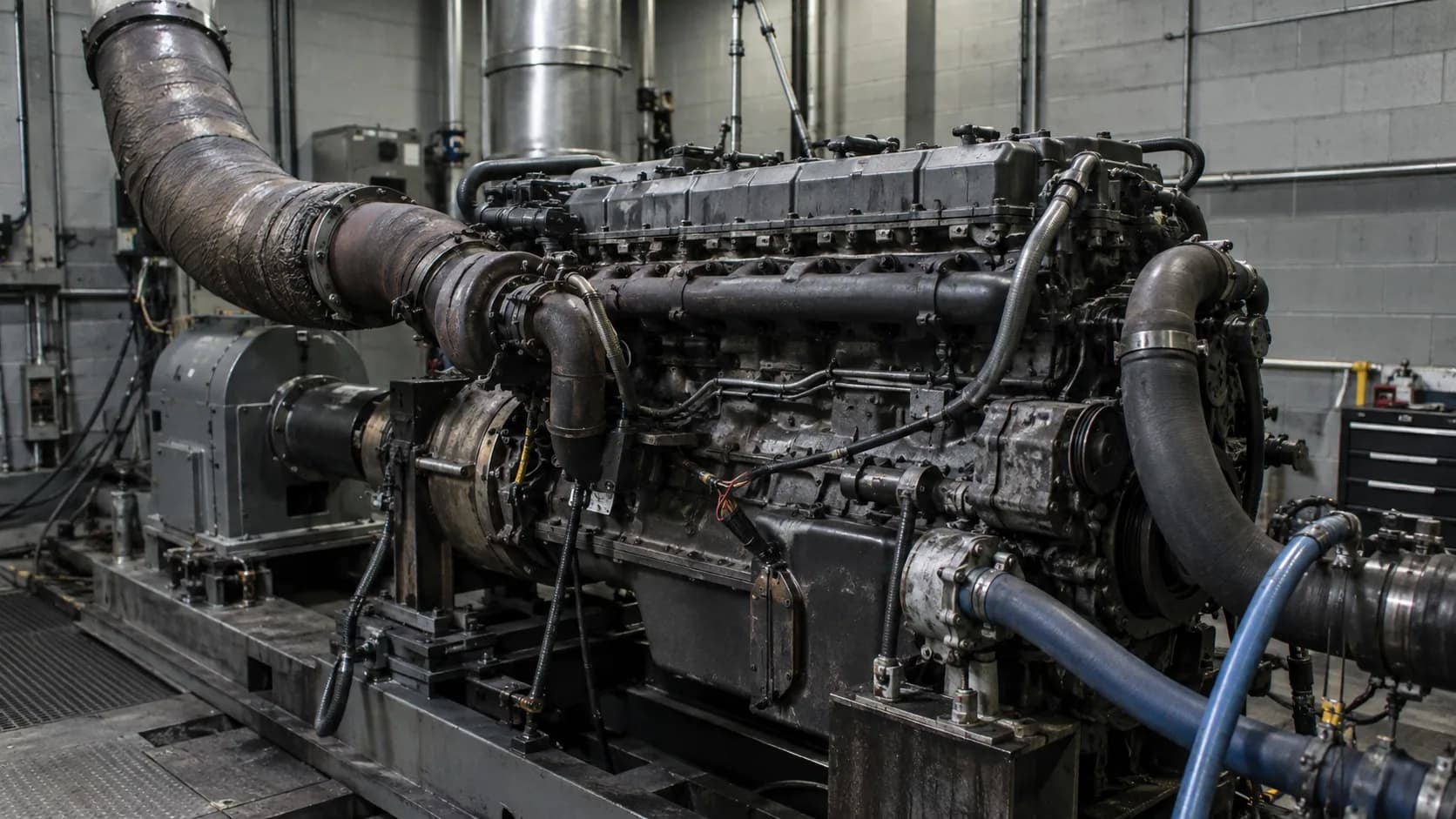
Walk through any truck-stop lot in the 1990s and 2000s a lot of the hoods you passed covered a Detroit. The render above imagines a workshop bay with a white truck's hood tipped up and a dark inline six, a big silver intake tube and a turbo sitting in the middle of it, tool chests lining the back wall. It's an AI-generated image, not a real truck, but the engine it stands in for is one of the most widely built heavy diesels: the Detroit Diesel Series 60.
A New Direction in 1987
Detroit Diesel launched the Series 60 in 1987, a four-stroke inline six with an overhead camshaft. Wikipedia, citing Detroit Diesel's own 1996 description, says it was the first heavy-duty diesel engine with fully integrated electronic controls, so treat "first" as the company's claim. The DDEC (Detroit Diesel Electronic Control) system was the face of that. The Series 60 ran from 1987 to 2011, and Detroit had built one million of them by 2008.
Three Sizes: 11.1, 12.7 and 14.0 Liters
The Series 60 came in three displacements. The 11.1-liter (677 cubic inch) was released with the original engine and discontinued in 1998; Wikipedia lists it at roughly 300 to 365 horsepower. The 12.7-liter (775 cubic inch) was the on-highway workhorse, and it was discontinued in 2007. The 14.0-liter (854 cubic inch) arrived in 2001 and carried the engine to the end of production in 2011. By 2001 the 14-liter had reached 575 horsepower and 1,850 lb-ft of torque, according to Wikipedia.
The electronics are a story of their own. DDEC-I was a two-box system and the first generation, DDEC-II was a single ECM mounted on the engine, DDEC-III added dual-voltage capability around 1992, DDEC-IV began in 1996 and covered multiple emissions-compliant versions, and DDEC-V arrived around 2002 with a dual-microprocessor design. Wikipedia lists DDEC-IV and V running through 2010.
Where You'll Find It
The Series 60 appeared in a long list of heavy conventionals, which is a big part of why parts and know-how are so easy to find today. Kenworth's W900 family offered it, the Peterbilt 379 listed it among its engines, and the Freightliner Century Class carried it too, alongside the Cat 3406E and Cummins N14. It was also used in motorcoaches (the 12.7-liter especially) and, from 1999, in marine applications.
The EGR Era and What to Watch
In 2002, U.S. emissions regulations brought exhaust gas recirculation to heavy-duty diesels, and the Series 60 was among the engines affected. Transport Topics covered EGR cooler trouble on the Series 60 across its 2002-2009 electronic-control generations, with Detroit improving the design in 2004 to eliminate inlet and outlet leaks. Early failures were reported at roughly 30,000 to 150,000 miles, and one fleet estimated cooler life at 200,000 to 250,000 miles. A leaking cooler can put coolant into the oil or upset exhaust temperature control, which can lead to further engine damage.
Highway and Heavy Parts also lists cold-start trouble, overheating from poor cooling-system upkeep, spun bearings on older engines from low oil pressure at idle, and a piston-pin defect on pre-2002 engines. None of these are unusual for a high-mileage engine of any brand, but they are worth a pointed question to a seller.
Buying a Truck With a Series 60
The first thing to ask is whether it's a pre-EGR or EGR engine. Pre-2002 engines skip the EGR cooler worry entirely and are simpler to live with. Post-2002 engines deserve a cooling system inspection: ask about coolant loss, white or sweet-smelling exhaust smoke, and any cooler replacement history. A cooling-system pressure test is cheap compared with an engine.
Ask which displacement it is, too. The 12.7-liter ran from 1987 to 2007 and the 14.0-liter from 2001 to 2011, and the 14-liter carries the highest ratings. Beyond that, check the usual: oil leaks, oil pressure at idle, cold-start behavior, and service records that show regular oil and coolant maintenance. Because the engine was built in such numbers for so long, parts and mechanics who know it should not be hard to find.
The DD15 and the End of the Run
When production ended in 2011, the Series 60 was replaced by the DD15, closing out 24 years of production. A clean one can still make a sensible heart for a working truck.
Specs
- Production
- 1987-2011
- Layout
- Inline six-cylinder turbo diesel
- Displacements
- 11.1 L (to 1998), 12.7 L (to 2007), 14.0 L (2001-2011)
- 11.1 L output
- Roughly 300-365 hp (Wikipedia lists both 300 and 330 as the low end)
- 14.0 L output
- Up to 575 hp and 1,850 lb-ft by 2001 (Wikipedia)
- Electronics
- DDEC I through V (DDEC VI on 2007-2010 14 L)
- EGR
- Added with 2002 U.S. emissions rules
- Successor
- Detroit DD15 (2011)
FAQ
- What years was the Detroit Series 60 made?
- Detroit Diesel built the Series 60 from 1987 to 2011, when the DD15 replaced it. Detroit had produced one million of them by 2008.
- What size is a Detroit Series 60 engine?
- It came in three sizes: 11.1 liters (discontinued 1998), 12.7 liters (discontinued 2007) and 14.0 liters, introduced in 2001 and built until 2011.
- How much horsepower does a Series 60 have?
- The 11.1-liter was listed at roughly 300 to 365 hp, and the 14.0-liter reached 575 hp and 1,850 lb-ft of torque by 2001, according to Wikipedia.
- Are Series 60 engines with EGR reliable?
- The EGR cooler is the known weak point on Series 60 engines built from about 2002 on. Transport Topics reported early cooler failures, with design improvements in 2004, so inspect the cooling system closely when buying.
Know someone who drove one? Share this guide
Get the Look
As an Amazon Associate we earn from qualifying purchases.
- Detroit Diesel Series 60 engine scale model — A shelf version of one of the best-selling heavy diesels ever.
- Detroit Series 60 service manual — For anyone who wants torque specs and procedures on paper.
- Diesel coolant tester kit — A cheap first check on an engine with a cooling-system history.
Sources
- en.wikipedia.org — Detroit_Diesel_Series_60
- ttnews.com — emu-egr-cooling-issues-vex-fleets
- highwayandheavyparts.com — detroit-diesel-series-60-common-failures-and-problems
- highwayandheavyparts.com — detroit-diesel-electronic-control-versions-and-development
- en.wikipedia.org — Freightliner_Century_Class
- en.wikipedia.org — Peterbilt_379
- en.wikipedia.org — Kenworth_W900