How to Shift an Eaton Fuller 10-Speed (and Why the Super 10 Differs)

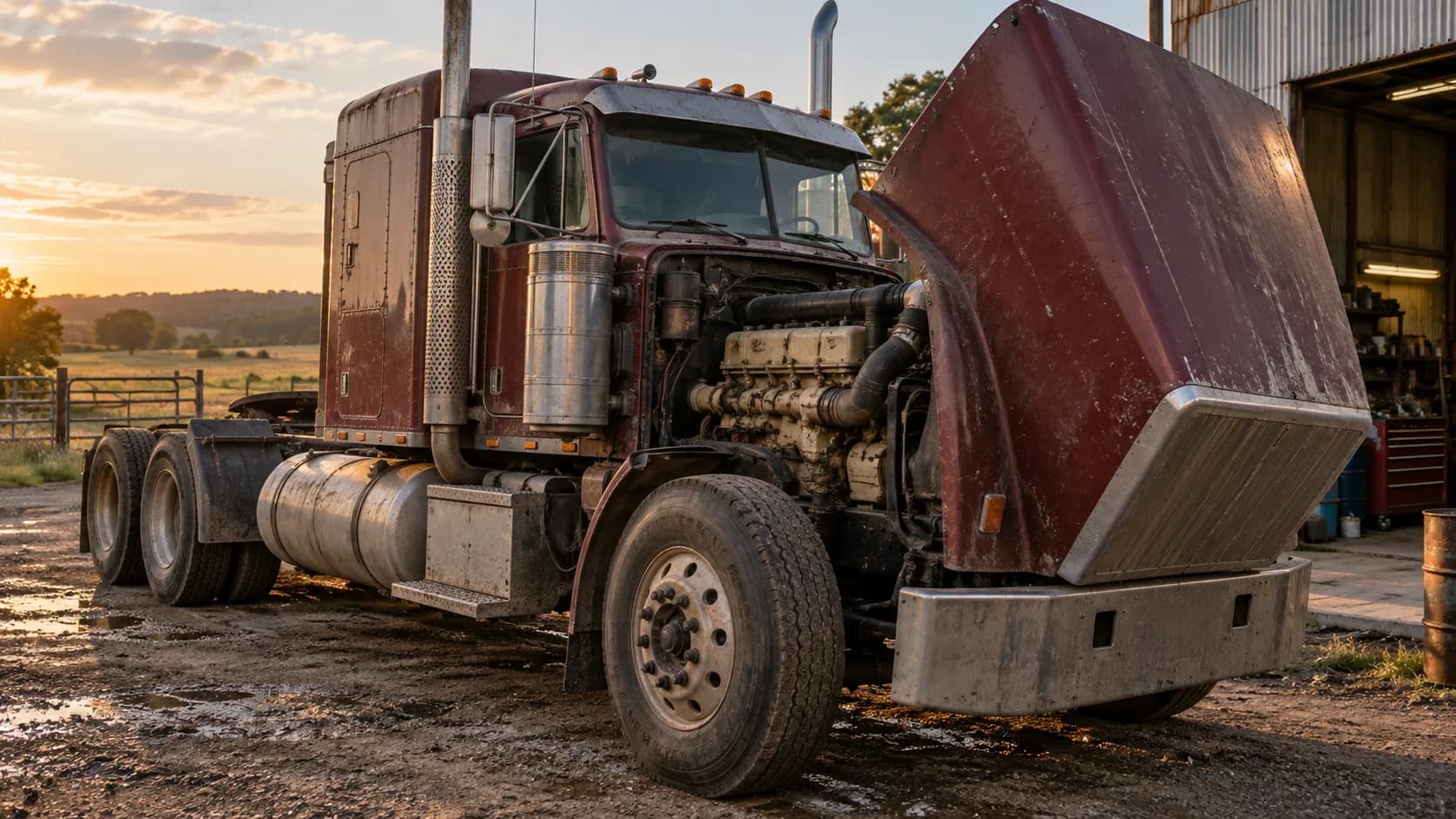
Ten forward gears, one hand, and a small lever on the front of the knob that decides whether the next shift lands in 6th or back in 1st. The render above is an AI image of a worn cab and shifter, not a photo of a specific truck or transmission, but the question behind it is real: how do you actually drive an Eaton Fuller 10-speed? There are two answers, because the range-shift RT and RTLO family and the Super 10 shift in completely different ways.
Range-Shift 10-Speed vs Super 10: Know Which One You Have
A range-shift 10-speed has five lever positions and a range lever on the front of the knob. In LO range those five positions give 1st through 5th; in HI range the same five positions are used again for 6th through 10th. Reverse sits up and to the left. 1st is down on the left rail, 2nd is up and 3rd is down in the center, and 4th and 5th sit up and down on the right. In HI, 6th shares the 1st hole and 10th shares 5th.
The Super 10 has no range lever. Instead, a shift button on the side of the knob picks between two ratios in each lever position: button rearward for 1st, 3rd, 5th, 7th and 9th, button forward for 2nd, 4th, 6th, 8th and 10th. Reverse and 1-2 sit on the left rail, 3-4 and 5-6 on the center rail, and 7-8 and 9-10 on the right rail. The auxiliary range change happens automatically as the lever moves from the center rail to the right rail. If the knob has a lever on its front face, it is a range-shift box. If it has only a button on the side, check the transmission tag, because Eaton's Super 10 instructions cover models such as the RTLO-14610A and RTLO-14610B.
Neither one works like a 13 or an 18-speed. A 13-speed adds a splitter that works only in high range, and an 18-speed splits every position, low range included, while both still keep the range lever. The Eaton Fuller 13-Speed vs 18-Speed guide on this site covers those boxes in detail.

Upshifting a Range-Shift 10-Speed, Step by Step
Push the clutch to the floor only when stopped, because a full push engages the clutch brake, which stops the input gearing so the starting gear goes in. With the range lever down in LO, select a starting gear and pull away.
Each upshift is a double clutch. Release the throttle, press the clutch just enough to take the lever out of gear, and move to neutral. Let the clutch out, wait for engine speed to fall to where the next gear needs it, then press the clutch again, move the lever into the next gear, release the clutch and get back on the throttle.
The key move comes in 5th. While still in 5th, flip the range lever up to HI. That is preselecting. Then make the normal lever shift to the 6th position, the same hole as 1st. The range changes on its own as the lever passes neutral. Eaton's driver instructions call for preselecting all range shifts.
Shift points depend on engine, axle and load, so watch the tachometer. As a reference point, Eaton's Super 10 example for an 1800 rpm governed engine shifts 1st at about 1000 rpm and works up to 1700 rpm in the upper gears. Fuller 10-speeds use ratio steps of roughly 30 to 35 percent depending on the model, so a shift at 1700 rpm drops the engine to somewhere around 1260 to 1300 rpm in the next gear.
Downshifting and the Range Lever
A downshift reverses the dance. Release the throttle, clutch, move to neutral, let the clutch out, then raise engine speed with the throttle to match the lower gear before clutching and moving the lever in. When you are in 6th and need 5th, push the range lever down to LO while still in gear, then shift to the 5th position.
CDL handbooks tell drivers to shift down before starting down a hill and before entering a curve, so the truck is already in a gear it can hold without hard braking.

How the Super 10 Shifts
Eaton describes three kinds of Super 10 shifts. A button-only shift handles 1-2, 3-4, 5-6, 7-8 and 9-10. To upshift, move the button forward, break torque by lifting off the throttle or pressing the clutch, and wait. The shift completes by itself once engine speed drops to match the next gear. Eaton's advice: be patient and watch the tachometer. A button-only downshift is the opposite: with the throttle still applied, move the button rearward, break torque, then raise engine rpm.
A combination shift covers 2-3, 4-5, 6-7 and 8-9. Move the button rearward, break torque, and double clutch the lever to the next position. A lever-only shift skips a whole ratio and is meant only for bobtail or lightly loaded running.
Eaton's limits are specific. Avoid button and combination downshifts above about 1400 rpm, and lever-only skip downshifts above about 1000 rpm. Do not move the lever to the center or left rail above 40 mph. The 1st-to-2nd button shift can be made at about 1000 rpm, even fully loaded. Reverse has two ratios, and low reverse is the one recommended for normal backing. On a Super 10 Top 2, the transmission shifts between 9th and 10th on its own.
Double Clutching vs Floating Gears
Floating means moving the lever without the clutch, matching engine speed to road speed. Plenty of experienced drivers float a Fuller most of the day, but the CDL handbook method is double clutching, and that is what new drivers are taught first. If a gear grinds, go back to neutral, fix the rpm and try again rather than forcing it. On a Super 10, Eaton calls for double clutching on lever shifts, while button shifts only need torque broken.
Common Mistakes
The classic range-shift error is forgetting to preselect HI in 5th: the lever goes into the 1st position, still in LO, inviting a hard over-rev. Moving the range lever while sitting in neutral is the other one, and Eaton's instructions say never to do it with the vehicle moving. On a Super 10, the button should not be moved with the lever in neutral either.
Eaton also warns against coasting with the lever in neutral, against slamming or jerking the lever into gear, and against range shifts while moving in reverse. Do not push the clutch to the floor on a moving shift, or the clutch brake will fight the gears.
Specs
- Forward speeds
- 10
- Range-shift 10 controls
- Range lever on knob: LO for 1st-5th, HI for 6th-10th
- Super 10 controls
- Side shift button: rearward for odd gears, forward for even
- Super 10 range change
- Automatic, between center and right rail (6th to 7th)
- Super 10 ratios (RTLO-XX610B)
- 11.06:1 in 1st to 0.74:1 in 10th, 35% steps
- Super 10 reverse
- Two ratios, low (12.93) and high (9.58) on XX610B
- Super 10 speed limit for rail moves
- No center or left rail above 40 mph
- Super 10 Top 2
- Shifts between 9th and 10th automatically
FAQ
- How do you shift an Eaton Fuller 10-speed?
- With the range lever down in LO, double clutch through 1st to 5th. In 5th, flip the range lever up to HI, then shift to the 1st-gear position for 6th and work through 7th to 10th in the same holes.
- What is the difference between a Super 10 and a regular 10-speed?
- A regular 10-speed uses a range lever to reuse five lever positions twice. A Super 10 has no range lever; a button on the side of the knob selects between two ratios in each position, and the range change happens automatically.
- Do you have to double clutch a 10-speed?
- Double clutching is the method taught in CDL handbooks and called for by Eaton on lever shifts. Many experienced drivers float gears without the clutch, but that takes practice and accurate rpm matching.
- What rpm should you shift a 10-speed at?
- It depends on the engine, axle and load. Eaton's Super 10 example for an 1800 rpm governed engine shifts between about 1000 rpm in 1st and 1700 rpm in the upper gears, and warns against downshifting above about 1400 rpm.
Know someone who drove one? Share this guide
Get the Look
As an Amazon Associate we earn from qualifying purchases.
- Eaton Fuller 10-speed shift knob — Check the model before ordering; range and Super 10 knobs differ.
- CDL training manual and test prep book — Covers shifting, downgrades and the skills test.
- 1:32 diecast semi truck flatbed — A long-hood tractor and flatbed for the shelf.
Sources
- globaltransmissionsupply.com — roadranger-eaton-fuller-heavy-duty-rtlo-10-transmissions.pdf
- globaltransmissionsupply.com — 10-speed-transmission-ratios
- pgttruckparts.com — eaton-fuller-shift-patterns
- eaton.com — eaton-fuller-heavy-duty-transmission-driver-instructions-trdr0515-en-us.pdf
- eaton.com — eaton-fuller-heavy-duty-transmissions-en-us.pdf
- eaton.com — eaton-fuller-heavy-duty-transmission-driver-instructions-trdr0670-en-us.pdf
- dds.georgia.gov — 34221
- thetruckersreport.com — 436484
- truckingtruth.com — how-do-you-downshift-a-10-speed
- truckingtruth.com — 10-speed-transmission-question