Peterbilt 386: History, Specs, Engines and 386 vs 389 vs 579

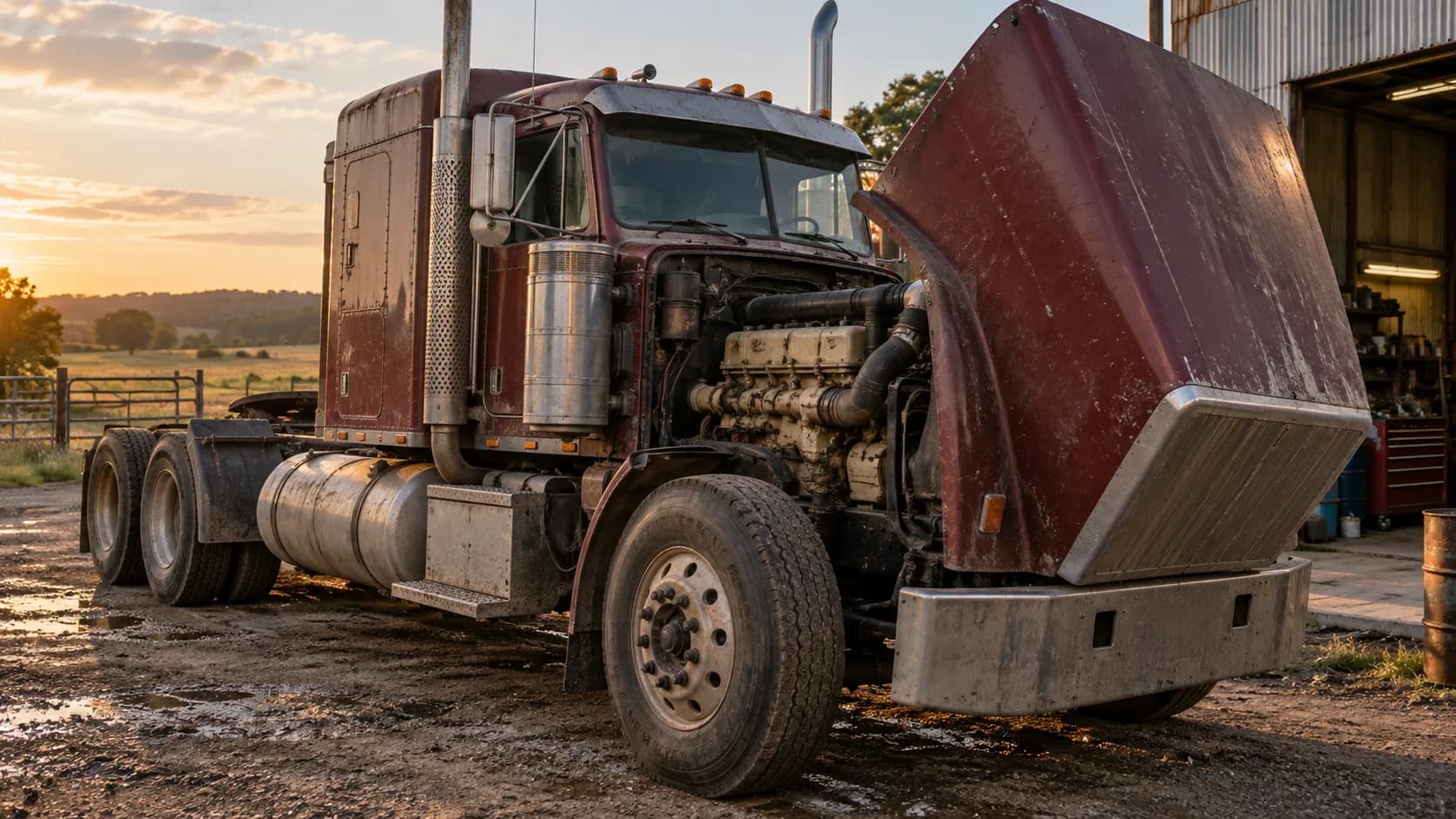
Somewhere between the flat-topped long hood of a 379 and the wide-body 387 sat a Peterbilt that tried to keep both camps happy. The render above imagines that kind of sloped-nose tractor at a truck stop at sundown, reefer in tow, and like the other two images on this page it is AI-generated, not a photo of a real truck. The Model 386 itself was real, and for about a decade it was the Peterbilt for drivers who wanted better fuel mileage without giving up the traditional cab.
Where the 386 Came From
Peterbilt unveiled the Model 386 at a press conference during the Mid-America Trucking Show in Louisville, Kentucky, on March 30, 2005. It was pitched as a smaller-scale aero truck for regional and short-haul operators who cared about fuel economy and resale value, while the 387 stayed on as the company's top aerodynamic model.
Peterbilt named the Model 385-120 as the 386's predecessor, though the 385 itself stayed in the 2006 lineup. The company claimed about 10 percent better aerodynamic efficiency than the 385-120, which it put at roughly 0.3 mpg. Published model lists date the 386 from 2005 to 2015.

Aero Design: What Made It Different
The idea was simple: take the sloped, aerodynamic hood design of the 387 and pair it with the standard Peterbilt cab instead of the 387's wide-body cab, which it shared with the Kenworth T2000. Launch coverage lists a contoured sun visor, side chassis fairings, a steeply sloped hood, swept-back fenders and a form-fitted bumper made of Metton composite, which Peterbilt described as 60 percent lighter than steel.
Under the skin it was not just a reskinned 387. The 386 used a different chassis, with the radiator mounted lower and the front axle moved. A launch-era road test noted that the radiator sat in front of the front cross member rather than on the frame rails, that the underside of the hood was smoothed for airflow, and that the hood tilted past 90 degrees. The same test found the cab sitting about 2.5 inches higher on the frame than on a 379. Published model lists give the 386 a 126-inch BBC.
386 vs 389 vs 579
These three often get mixed up in used-truck searches, so here is the short version.
The 389 is the traditional one. It replaced the 379 with redesigned headlamps, fenders and trim, and its 131-inch BBC is the longest hood in Peterbilt's lineup. Its hood is the flat-topped long nose, not a sloped aero shape. The two classic long-hood renders further down this page show that square-hood side of the family, not the 386.
The 386 sits in the middle: a 126-inch BBC, a sloped aero hood and swept fenders, but the same style of standard Peterbilt cab, doors and porthole window that long-hood buyers knew.
The 579 is a different generation. Peterbilt unveiled it at the Mid-America show in March 2012 on an all-new cab and chassis, with production slated to start in Denton, Texas, that May. It has a 123-inch BBC and an aluminum cab about 83 inches (2.1 meters) wide, and it took over as the company's aerodynamic flagship. The 387's direct successor was the 587, built from 2010 to 2016, which in turn gave way to the 579. If the cab is noticeably wide and the whole front end looks rounded and modern, it is a 579, not a 386.

Engines and Sleepers
Early road testing listed Caterpillar's C13 and C15 alongside the Cummins ISX, and the test truck ran a Cat C15 ACERT rated at 475 hp and 1,650 lb-ft, paired with an Eaton Fuller 9/13-speed convertible transmission. Caterpillar announced in June 2008 that it would leave the North American Class 8 engine market, selling engines through 2009 and promising to support existing ones for their life. So a Cat-powered 386 will be an early truck.
The PACCAR MX took over from there. In June 2010 Peterbilt delivered the first truck with a production 2010 EPA-certified PACCAR MX, and it was a Model 386, handed to McClymonds Supply and Transit at the Denton plant. The 12.9-liter engine was rated from 380 to 485 hp, with up to 1,750 lb-ft. Cummins ISX trucks also show up in later dealer listings.
There was also a natural gas version. In September 2011 Peterbilt announced that the Model 386 LNG, powered by a 15-liter Westport GX engine rated up to 475 hp and 1,750 lb-ft, was the industry's first alternative-fuel vehicle with EPA SmartWay designation.
The 386 was sold as a day cab or with Peterbilt's detachable Unibilt sleepers, which the company promoted as a way to give a truck a second life as a day cab later. The road test listed 36, 48, 63 and 73-inch sleepers plus a 70-inch UltraCab, and used listings commonly show 63-inch and 70-inch units.
How to Identify and Buy a Used 386 Today
Start with the hood. A 386 has a sloped hood with swept-back fenders and a contoured bumper, but the cab and doors look like a regular Peterbilt. A flat-topped long hood means 379 or 389; a wide, rounded cab means 387, 587 or 579. The VIN and the door data plate settle the model and model year.
Next, match the engine to the year. A Cat C13 or C15 points to the early years, before Caterpillar's exit. An MX means 2010 or later, and an ISX can turn up across the run. Confirm the engine from its own tag, not just from the ad.
Then check the sleeper size and roof height against what you need, since 63-inch and 70-inch sleepers are the common sizes. If the truck has been converted to a day cab, ask how the sleeper was removed. Finally, look at the aero pieces: fairings and composite bumpers get damaged in regional work, and a 386 missing them loses part of the fuel-economy case that sold it. Condition, maintenance records and engine history will drive what a given truck is worth.
Specs
- Unveiled
- March 30, 2005, Mid-America Trucking Show
- Production
- 2005-2015 (per published model lists)
- Predecessor
- Model 385-120
- BBC
- 126 inches
- Design
- 387-style sloped aero hood on the standard Peterbilt cab
- Engines
- Cat C13/C15 (early), Cummins ISX, PACCAR MX (from 2010), Westport GX LNG
- Sleepers
- Day cab or Unibilt 36, 48, 63, 73 in.; 70-inch UltraCab
- Aero claim
- About 10% better than the 385-120, roughly 0.3 mpg
FAQ
- What years was the Peterbilt 386 made?
- Peterbilt unveiled the 386 in March 2005, and published model lists date its production from 2005 to 2015.
- What is the difference between a Peterbilt 386 and 389?
- The 386 has a sloped aerodynamic hood, swept fenders and a 126-inch BBC. The 389 is the traditional flat-topped long hood with a 131-inch BBC, the longest in Peterbilt's lineup.
- What engine is in a Peterbilt 386?
- Early trucks were offered with Cat C13 and C15 engines and the Cummins ISX. From 2010 the 12.9-liter PACCAR MX was available, and a Westport GX LNG version was also built.
- Did the Peterbilt 579 replace the 386?
- The 579, launched in 2012, became Peterbilt's aerodynamic flagship and directly replaced the 587. It uses an all-new, wider cab, so it is a different generation from the 386 rather than an update of it.
Know someone who drove one? Share this guide
Get the Look
As an Amazon Associate we earn from qualifying purchases.
- Peterbilt 386 diecast model truck — The sloped-hood Pete for the shelf.
- Peterbilt trucks history book — Background on the whole conventional lineup.
- CB radio for trucks — The cab essential for any regional runner.
Sources
- fleetowner.com — peterbilt_386_model_033005
- trucknews.com — 1003116477
- trucknews.com — road-test-peterbilt-386
- en.wikipedia.org — List_of_Peterbilt_vehicles
- fleetowner.com — pete-delivers-first-truck-with-2010-mx-engine
- ttnews.com — caterpillar-exits-us-truck-market
- offshore-energy.biz — usa-peterbilt-lng-truck-earns-smartway-designation
- fleetowner.com — best-peterbilt-ever-unveiled-mats
- trailer-bodybuilders.com — peterbilt-adds-386-aero
- ccjdigital.com — peterbilt-installs-first-paccar-mx-engine