Women in Trucking History: Pioneers From 1918 to the CB Era
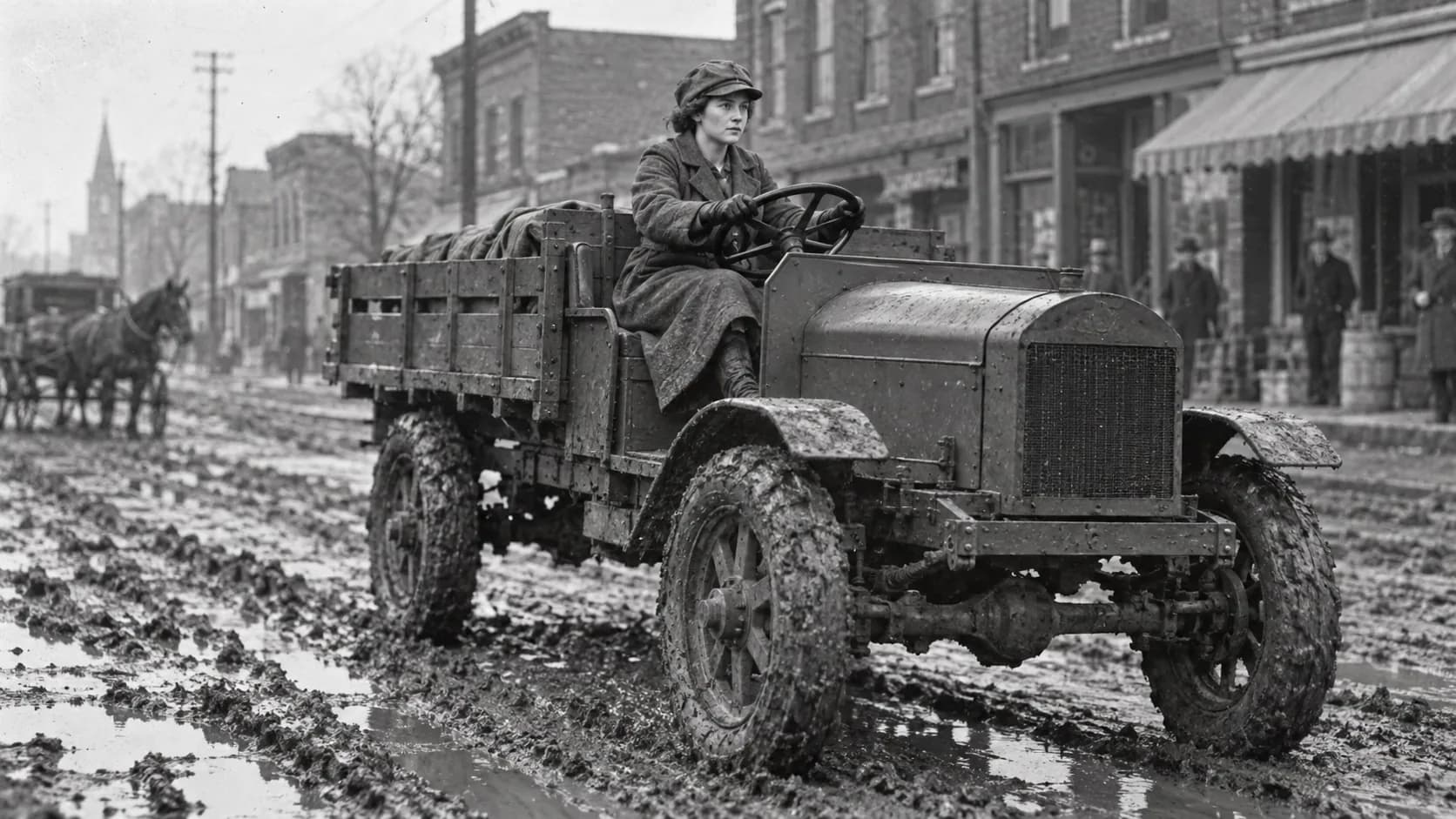
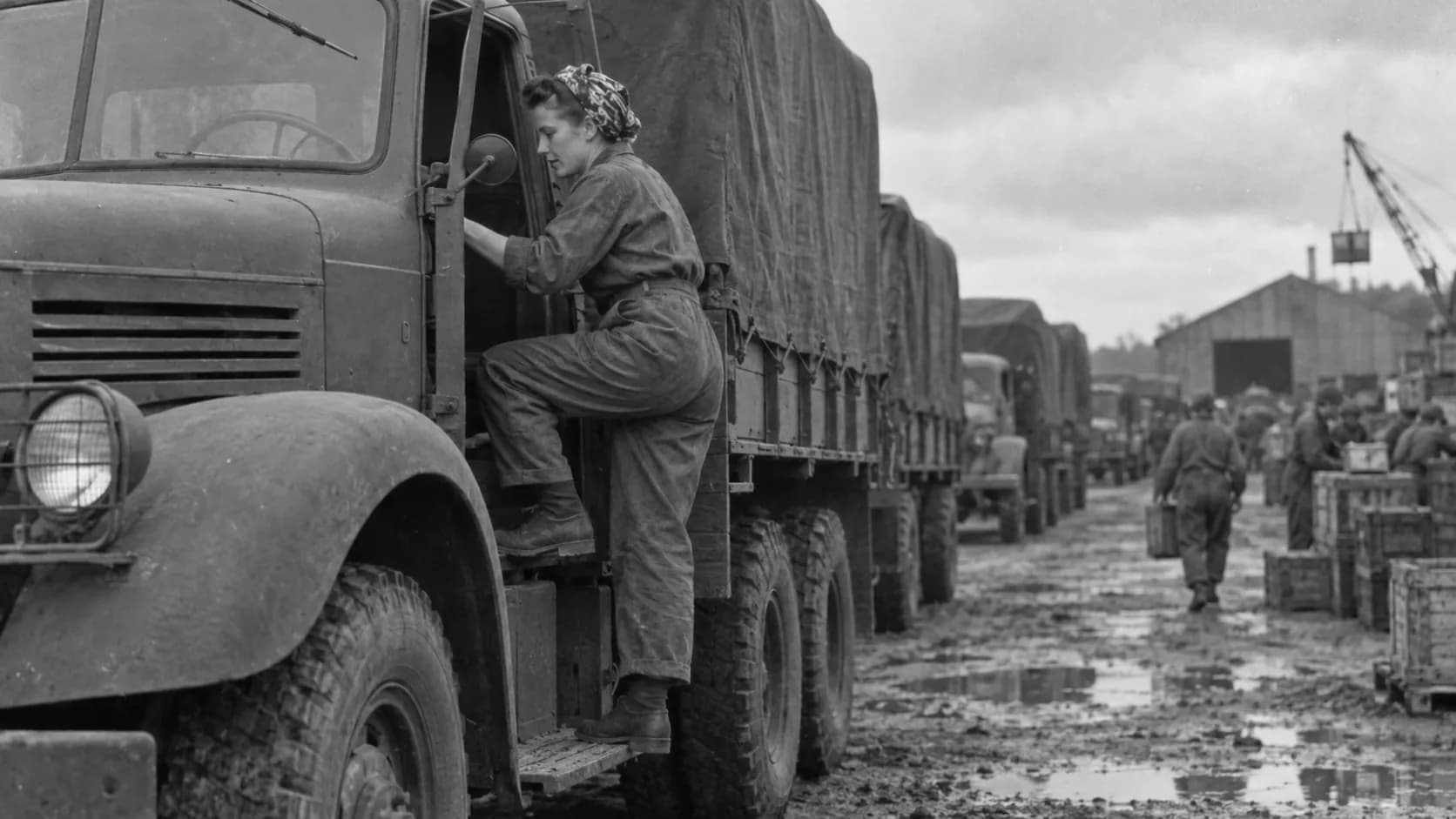
A mud-caked chassis, a wooden stake bed and a driver in a wool coat and cap gripping the wheel: that is roughly what trucking looked like when the first women started earning a living behind it. The three renders in this story are AI-generated images of anonymous drivers, not photographs of Luella Bates, Lillie Drennan or anyone else named below. The history they point to is real, though, and it starts more than a century ago in a small Wisconsin town.
Luella Bates and the Four Wheel Drive Auto Co.
In 1918, with many local men away in World War I, the Four Wheel Drive Auto Co. (FWD) of Clintonville, Wisconsin, hired about 150 women. Luella Bates was one of them. She test-drove the company's Model B truck around Wisconsin, and Wikipedia's biography says she was the first of six women chosen as test and demonstration drivers.
When the war ended and the men came home, most of those women lost their jobs. Bates stayed. FWD turned her into a demonstrator and goodwill ambassador, and in January 1920 she drove a Model B to the New York Auto Show. There she met New York Secretary of State Francis Hugo and became the first woman truck driver licensed in New York. She is widely described as the first licensed woman truck driver in the country, although that national claim is usually stated as a belief rather than a documented record.
The 1920 tours that followed tied her to Hugo's Safety First campaign and took her through about 25 towns between Kansas City, Missouri, and Bellefontaine, Ohio. Popular Science called her "exhibit A for feminine efficiency" in May 1920. On a later tour she crossed a flooded road in Oklahoma over police objections, a stunt reportedly credited with selling ten trucks. She left FWD in 1922, moved to Milwaukee, married and raised two sons, and died in 1985.
Lillie Drennan: Texas Hauler and Business Owner
Lillie Elizabeth McGee Drennan was born in Galveston, Texas, in 1897. Scarlet fever, caught a few years after she left school, probably caused her near-total hearing loss, and she relied on a hearing aid from her early twenties. In March 1928 she and her second husband, Willard Ernest Drennan, formed Drennan Truck Line to serve the oil boom around Hempstead, Texas. After their divorce in 1929 she took over the company herself.
That same year the Texas Railroad Commission was tightening its oversight of motor freight, and Drennan went for a commercial license. The examiners balked, citing her hearing. She pointed to her driving record and won. She is generally recognized as the first woman licensed as a truck driver in Texas, and Women In Trucking credits her as the first woman to own a trucking firm.
Her record is the part people remember. She ran the line for nearly 24 years, sometimes drove more than 48 hours without sleep, and never had an accident. She received safety awards from the Railroad Commission and the Texas Motor Transportation Association. She sold the business in September 1952 and died in Hempstead in 1974.
World War II: Women at the Wheel
The second world war pulled women into driving jobs on a much larger scale. Congress created the Women's Army Auxiliary Corps in May 1942, and it became the Women's Army Corps in September 1943. The National Park Service notes that WACs drove trucks among many other Army jobs, and more than 150,000 women served in the Army between 1942 and 1950.
Local newspapers of the time recorded the change. In November 1942 the Army hired ten women as truck drivers at Fort MacArthur in California so the men doing the job could move to field posts. The women started on half-ton trucks and command cars, with heavier two-and-a-half-ton trucks planned for later.
Civilian fleets did the same. UPS began hiring women for package handling in October 1942, and in May 1943 Mazie Lanham of Los Angeles became the first woman to drive a UPS package car, according to both UPS and the Teamsters. Male drivers and their helpers were known as "Brown Buddies," so the women working in UPS operations became the "Brown Betties."
The 1970s: CB Radio and a Push for Fair Treatment
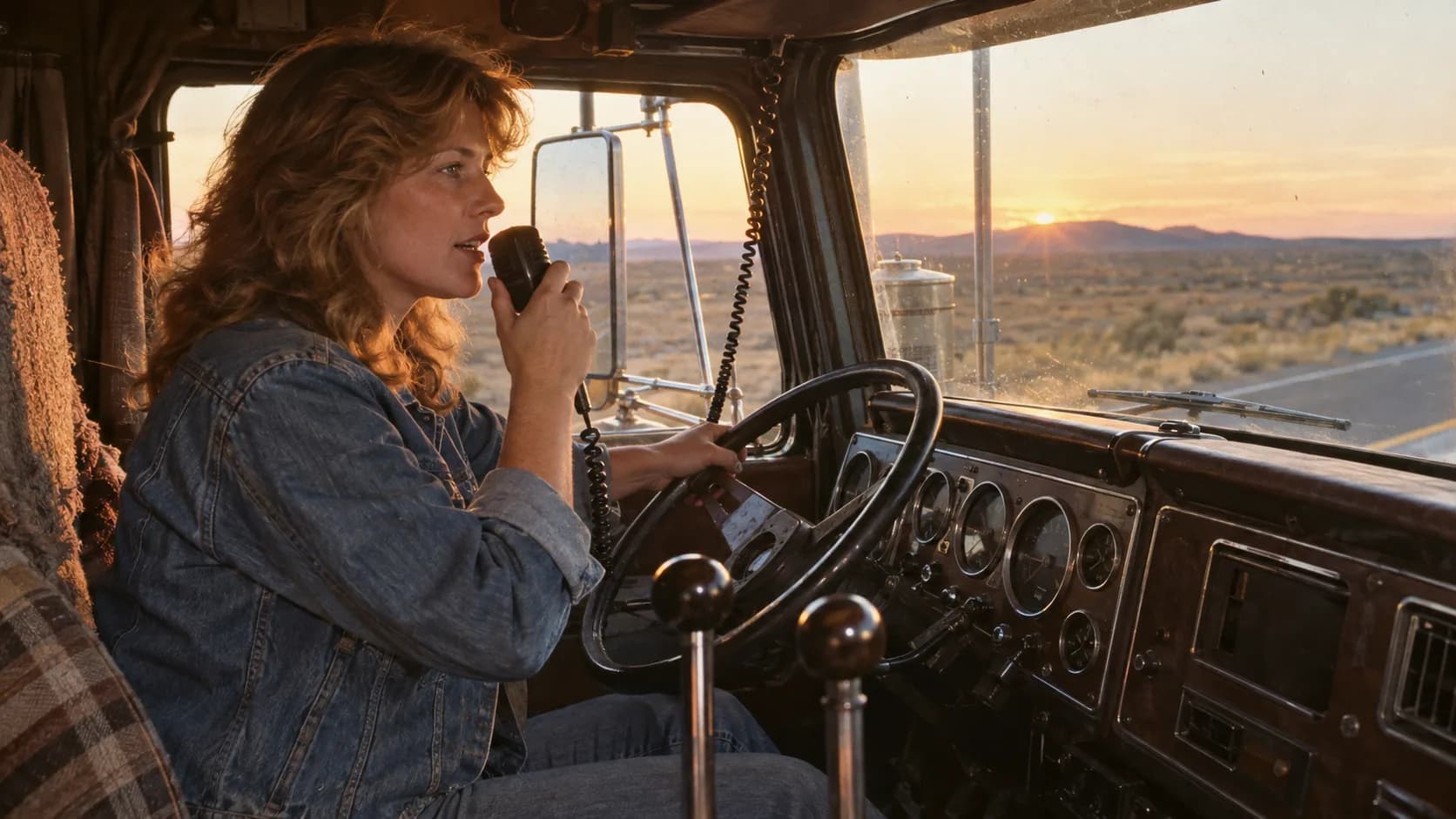
By the 1970s the CB radio had become the trucker's party line. The FCC had set aside CB channels in 1958, and the 1973 oil embargo turned the radio into a practical tool as drivers swapped news about fuel and road conditions. Songs like "Convoy" carried that culture to the rest of the country. The third render imagines that era: a driver on the handset in a worn cab as the sun drops over the desert.
Women drivers were still rare, and the cab was not always a welcoming place. In the 1970s Adriesue "Bitsy" Gomez, who got into the business loading and unloading trucks after moving to California and worked her way up to driving, founded the Coalition of Women Truck Drivers. The group had about 150 members. Its first campaign was simple and telling: truck stops lacked women's restrooms. It went on to push for on-the-job training for women, adjustable seats and pedals, and separate rooms at overnight stops. Time magazine covered her in 1976.
The Road Since Then
The work Gomez started in the 1970s set the stage for later groups such as Women In Trucking, which today publishes profiles of Bates, Drennan, Lanham and Gomez. Counting women drivers is still not easy. A University of Arkansas review of the estimates found figures ranging from about 2 percent up to 10 percent of drivers, depending on the data source; its author put the likely share at roughly 3 to 4 percent, trending upward.
What links all four stories is the same thing that shows in the renders: a person, a truck and a job that needed doing. Bates proved a Model B could be handled by anyone trained to drive it, Drennan built a 24-year safety record, the wartime drivers kept freight moving, and Gomez made the industry look at who it was leaving out.
Specs
- Luella Bates licensed
- January 1920, New York (believed first licensed woman truck driver)
- Bates' truck
- Four Wheel Drive Auto Co. Model B
- Drennan Truck Line
- Founded March 1928 near Hempstead, Texas; sold 1952
- Drennan's license
- 1929, under the Texas Railroad Commission
- First woman UPS package car driver
- Mazie Lanham, May 1943, Los Angeles
- Coalition of Women Truck Drivers
- Founded 1970s by Adriesue "Bitsy" Gomez; about 150 members
FAQ
- Who was the first woman truck driver?
- Luella Bates is widely credited as the first licensed woman truck driver. She drove for the Four Wheel Drive Auto Co. from 1918 and received a New York license in January 1920.
- Who was the first woman to own a trucking company?
- Lillie Drennan of Hempstead, Texas, is often credited as the first woman to own a trucking firm. She co-founded Drennan Truck Line in 1928 and took it over after her 1929 divorce.
- Did women drive trucks in World War II?
- Yes. Women's Army Corps members drove Army trucks, and civilian companies hired women drivers too. Mazie Lanham became the first woman to drive a UPS package car in 1943.
- What was the Coalition of Women Truck Drivers?
- A group of about 150 members founded in the 1970s by Adriesue "Bitsy" Gomez. It fought discrimination in trucking, starting with the lack of women's restrooms at truck stops.
Know someone who drove one? Share this guide
Get the Look
As an Amazon Associate we earn from qualifying purchases.
- Women in trucking history book — Read more about the drivers who opened the road.
- Vintage truck die-cast model — An early stake-bed truck for the shelf.
- CB radio for trucks — The handset that defined the 1970s cab.
Sources
- en.wikipedia.org — Luella_Bates
- womenintrucking.org — herstory-first-female-truck-driver
- en.wikipedia.org — Lillie_Elizabeth_Drennan
- womenintrucking.org — herstory-first-female-trucking-firm-owner
- home.nps.gov — women-go-to-war
- ladailymirror.com — women-truck-drivers-replace-men-at-ft-macarthur
- teamster.org — teamster-women-history-mazie-lanham
- crst.com — women-in-trucking-trucking-trailblazers
- ntslogistics.com — a-history-of-cb-radios-and-truckers
- walton.uark.edu — what-percentage-of-truck-drivers-are-female.php
- en.wikipedia.org — Women's_Army_Corps
- newsroom.pilotcompany.com — women-in-trucking-putting-the-pedal-to-the-metal