1969 Ford Mustang Boss 429: History, Specs, KK Numbers, Value
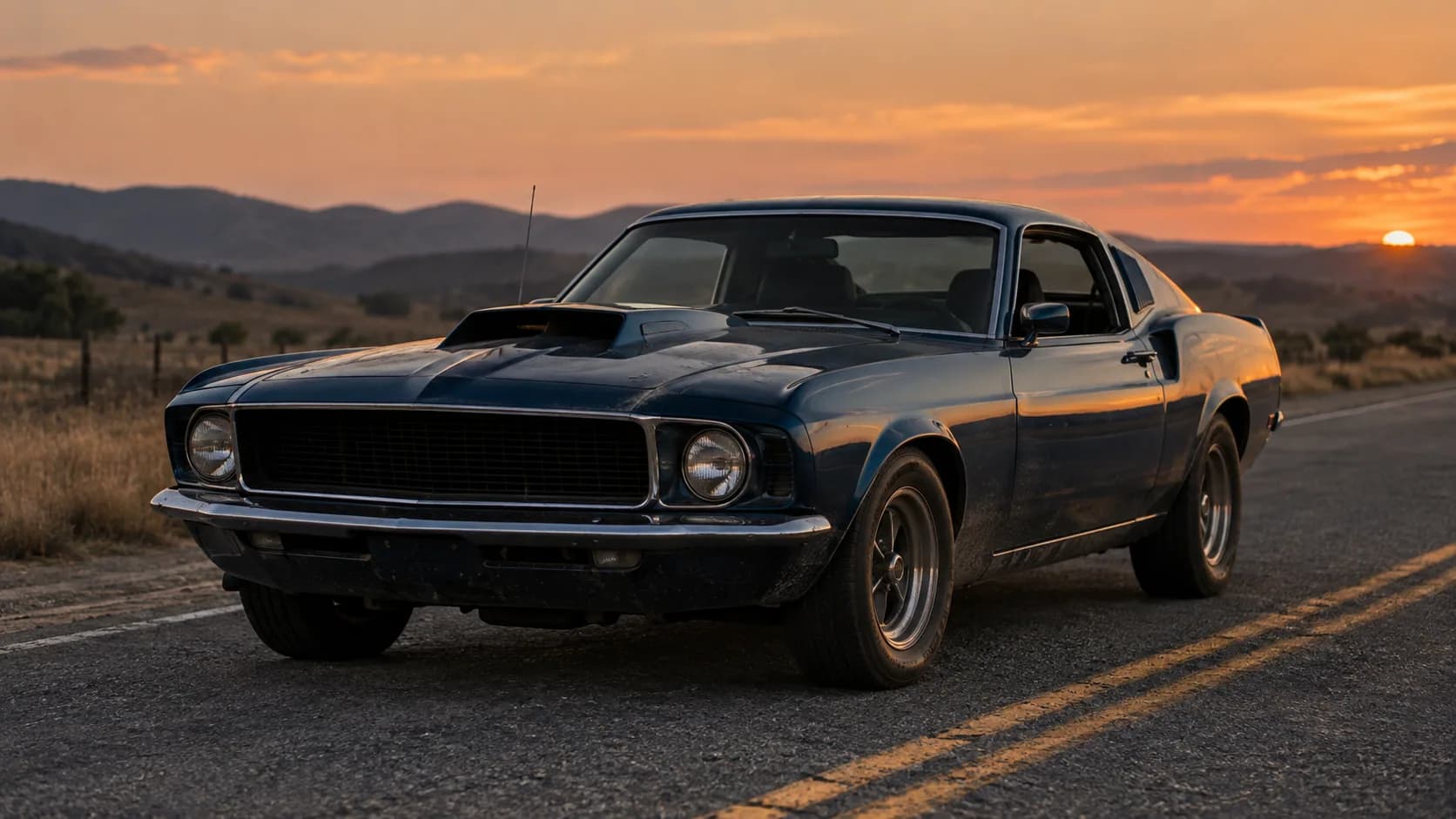
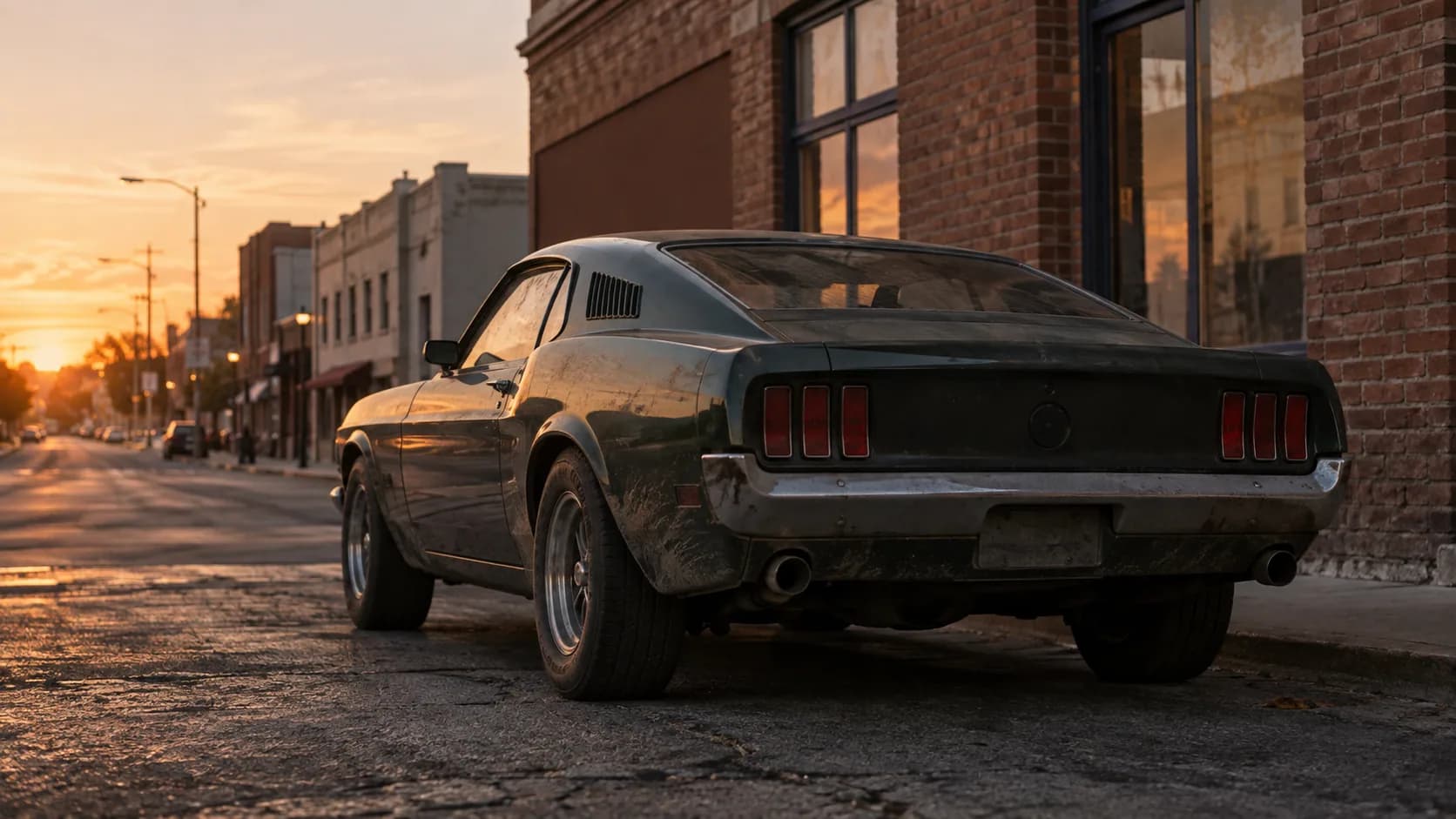
Ford never really wanted to put its biggest race engine in a Mustang; it needed 500 street cars to make that engine legal on NASCAR ovals, and the Mustang got the job. The render above imagines a dark Boss 429 fastback at sunset with its huge hood scoop catching the last light, and like the other images on this page it is AI-generated, not a photo of a real car. The story behind it is real, and it is one of the strangest in muscle car history.
Why a Mustang Got a NASCAR Engine
In the late 1960s NASCAR required a manufacturer to sell at least 500 cars to the public with an engine before it could race that engine. Ford's new weapon was the 429 with semi-hemispherical heads, built to answer Chrysler's 426 Hemi. The Torino and Mercury Cyclone were the cars Ford actually raced, but the engine could be homologated in any car Ford sold, and Ford chose the Mustang. It also gave the small-block Boss 302 a big-block partner in showrooms.
The 429 was physically too wide for the Mustang's engine bay. That is where Kar Kraft came in.
The Kar Kraft Conversion
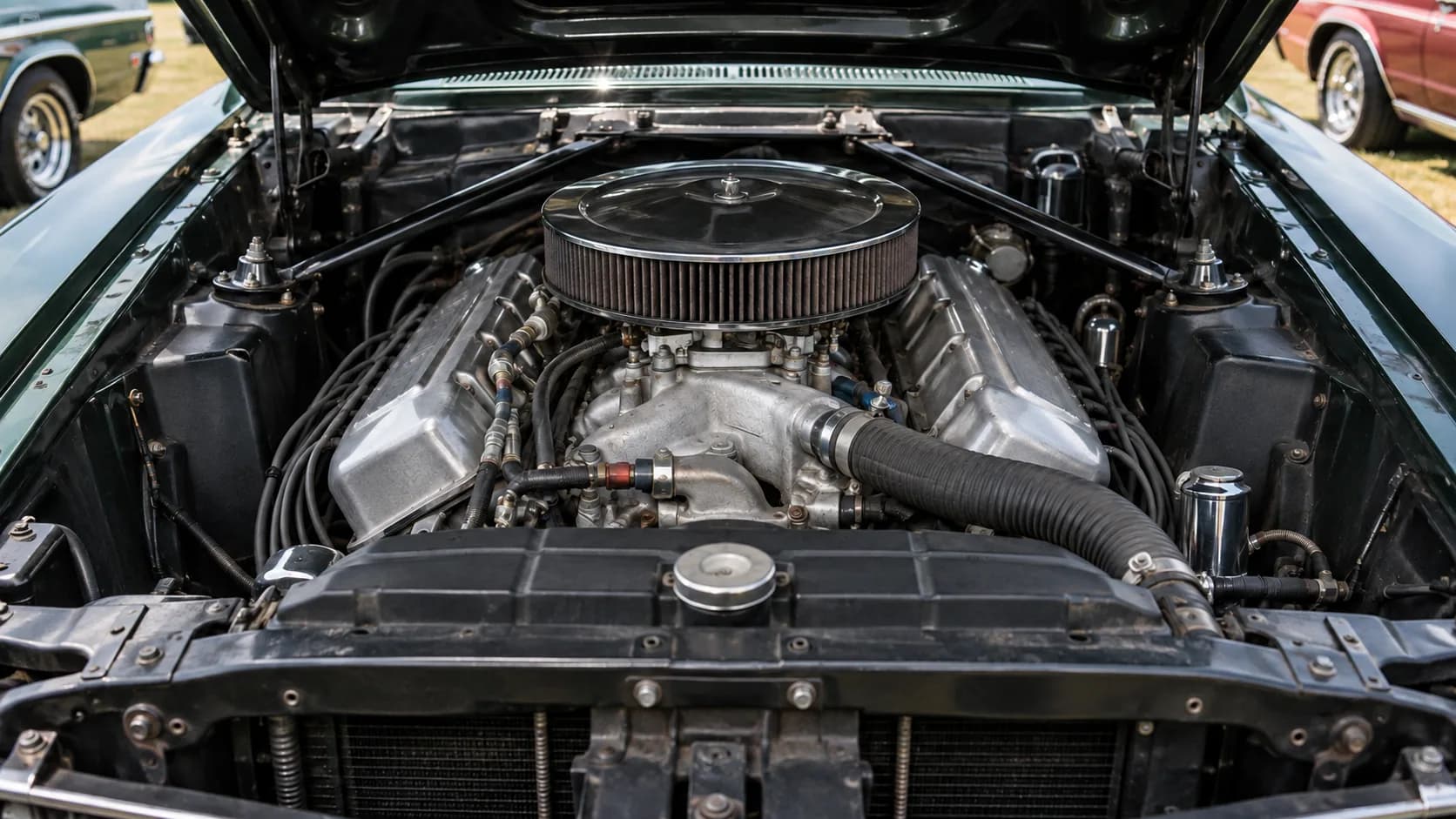
Kar Kraft was Ford's special-vehicle engineering contractor. Starting in January 1969, partly built SportsRoof Mustangs that had been earmarked for the 428 Super Cobra Jet left Ford's Dearborn plant and went to Kar Kraft's shop in Brighton, Michigan. There the front shock towers were reworked and moved outward to make room for the heads, and the front suspension was lowered and widened by about an inch with unique spindles and control arms.
The changes went further. The battery moved to the trunk to help balance the weight, an engine oil cooler was added, and the car got a 3/4-inch rear sway bar, described as the first ever fitted to a Mustang. Every car had a close-ratio four-speed manual and a 3.91 rear axle with Traction-Lok. Outside, the Boss 429 was quiet: a shallow front spoiler, Boss 429 decals on the front fenders, 15x7 Magnum 500 wheels, and a manually controlled hood scoop that Wikipedia calls the largest factory scoop ever put on a production Mustang. The 1969 scoop was body color; 1970 cars got a black one.
All that hand work was expensive. The car sold for close to $5,000 when new, about twice the price of a base six-cylinder Mustang, and Ford is reported to have lost money on each one.
The 429 Semi-Hemi: Engine and Specs
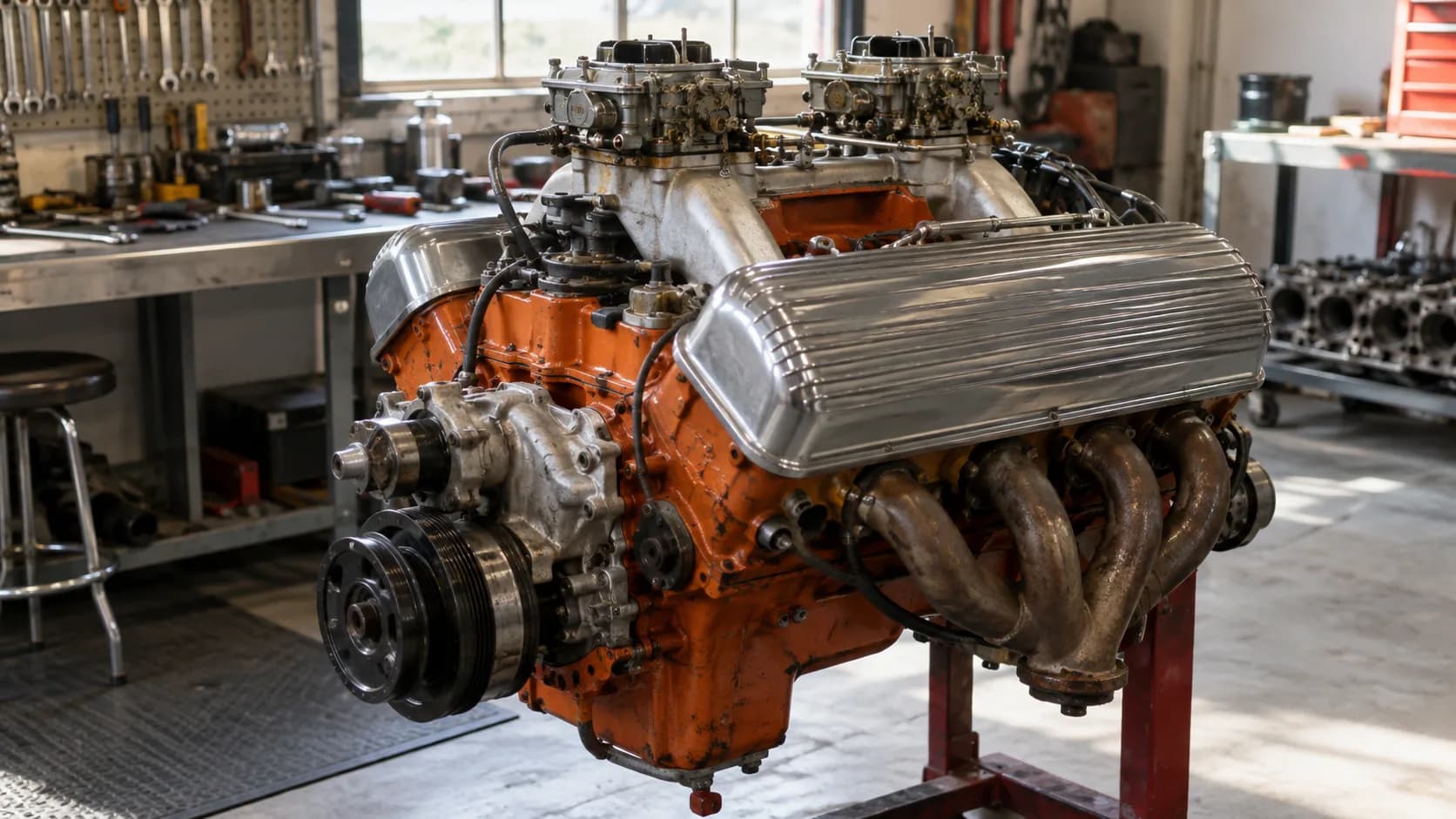
The Boss 429 engine was a special racing design. It used a strengthened block with four-bolt main caps, a forged steel crankshaft and forged connecting rods, and aluminum heads with a crescent-shaped, semi-hemispherical combustion chamber. It used a so-called dry-deck design, sealing each cylinder, oil passage and water passage with its own O-ring rather than relying on a conventional head gasket alone. A single 735 CFM Holley four-barrel sat on an aluminum intake manifold.
Ford rated it at 375 horsepower at 5,200 rpm and 450 lb-ft of torque at 3,400 rpm. Car Life's July 1969 test recorded 0 to 60 mph in 7.1 seconds and a 14.09-second quarter mile at 102.85 mph, roughly what a 428 Cobra Jet Mustang could do.
1969 cars used hydraulic lifters; 1970 cars switched to a mechanical-lifter camshaft. Early 1969 engines carry the S code, and later engines were coded T and A as Ford added emissions equipment and made running changes.
Production Numbers and Colors
Ford built Boss 429s for just two model years. Sources put 1969 production at 857 to 859 cars, partly because two Boss 429 Cougars were built for Lincoln-Mercury's racing program and are counted differently from source to source. For 1970 the figure is 499. That puts total production at roughly 1,356 to 1,359 cars.
The 1969 cars came in Raven Black, Wimbledon White, Royal Maroon, Candy Apple Red and Black Jade, all with black interiors. For 1970 the palette changed to Grabber Blue, Grabber Green, Grabber Orange, Calypso Coral and Pastel Blue. Sales fell, costs stayed high, and the program ended after 1970.
How to Identify a Real Boss 429
Because Boss 429s are worth so much, clones and rebodied cars exist, so identification matters. Start with the VIN: a 1969 car should begin 9F02Z, meaning 1969, Dearborn, SportsRoof body and the Z engine code for the Boss 429. A 1970 car begins 0F02Z.
Then find the KK number. Kar Kraft gave each car its own production number, shown on a sticker inside the driver's door above the Ford warranty plate, reading something like "KK NASCAR" followed by four digits. The first car was KK 1201 and the last Boss 429 was KK 2558. A few cars reportedly have a small brass plate instead of the sticker.
Look under the hood and underneath as well. The relocated shock towers are hard to fake convincingly, and the block should have "HP429" cast into its front. The car's serial number was stamped on the engine block and transmission, so a matching-numbers car can be checked against its VIN. Finally, get a Marti Report, built from Ford's original production records, to confirm the car's original color, options and build data.
What a Boss 429 Is Worth Today
Values sit firmly in six figures. Wikipedia notes that an unrestored black 1969 car sold for $417,000 at Mecum's Kissimmee auction in 2013, and a restored black 1969 car brought $500,000 at Barrett-Jackson Palm Beach in 2016. In 2018 Hagerty put a concours-quality Boss 429 at around $434,000, according to New Zealand's Driven car guide. Price swings between cars are wide: original engines, documented KK numbers and a clean Marti Report move a car up, while a replacement engine or a weak paper trail can cost it tens of thousands of dollars.
The Boss 429 never raced as a Mustang in NASCAR, but its engine powered Ford's Torino Talladega and Mercury Cyclone Spoiler II and won races in 1969. The Mustang was only the paperwork, and that paperwork turned into one of the most valuable Mustangs ever built.
Specs
- Model years
- 1969-1970
- Production
- About 857-859 (1969) and 499 (1970)
- Engine
- 429 cu in V8, aluminum semi-hemispherical heads, 735 CFM Holley 4-barrel
- Rated output
- 375 hp at 5,200 rpm; 450 lb-ft at 3,400 rpm
- Transmission
- Close-ratio 4-speed manual
- Rear axle
- 3.91 with Traction-Lok
- Converted by
- Kar Kraft, Brighton, Michigan
- KK numbers
- KK 1201 (first) to KK 2558 (last)
FAQ
- How many Boss 429 Mustangs were made?
- About 1,356 to 1,359 in total. Sources give 857 to 859 for 1969 and 499 for 1970; the 1969 figure varies because two Boss 429 Cougars are counted differently.
- Why did Ford build the Boss 429 Mustang?
- To homologate its semi-hemispherical 429 V8 for NASCAR, which required at least 500 cars sold to the public. The engine raced in the Torino and Mercury Cyclone, not the Mustang.
- What is a KK number on a Boss 429?
- It is the Kar Kraft production number, shown on a tag inside the driver's door above the Ford warranty plate. The first car was KK 1201 and the last was KK 2558.
- How much is a Boss 429 Mustang worth?
- Well into six figures. Recorded sales include $417,000 at Mecum in 2013 and $500,000 at Barrett-Jackson in 2016, and originality and documentation drive big differences between cars.
Know someone who drove one? Share this guide
Get the Look
As an Amazon Associate we earn from qualifying purchases.
- 1969 Ford Mustang Boss 429 diecast model — The big-scoop fastback in 1:18 or 1:24 scale.
- Boss 429 Mustang history book — Background on Kar Kraft, the semi-hemi and the KK cars.
- Ford Mustang Boss metal garage sign — A wall piece for the shop or garage.
Sources
- en.wikipedia.org — Boss_429_Mustang
- theautochannel.com — 1241154-1969-70-boss-429-mustang-auto-channel-looks-back
- drivencarguide.co.nz — being-the-boss-pristine-ford-mustang-icon-up-for-sale
- revologycars.com — 1969-boss-429-mustang-worth-value-market-guide
- burnsandcoauctions.com.au — 1969-ford-mustang-boss-429-v8-manual-kk-code
- sportscarmarket.com — 1969-ford-mustang-boss-429s
- hotcars.com — 10-cool-facts-youve-forgotten-about-the-1969-ford-mustang-boss-429
- rmsothebys.com — r231-1969-ford-mustang-boss-429
- conceptcarz.com — supercars.aspx