Big-Block Chevy 396 vs 427 vs 454: Specs, Versions and ID
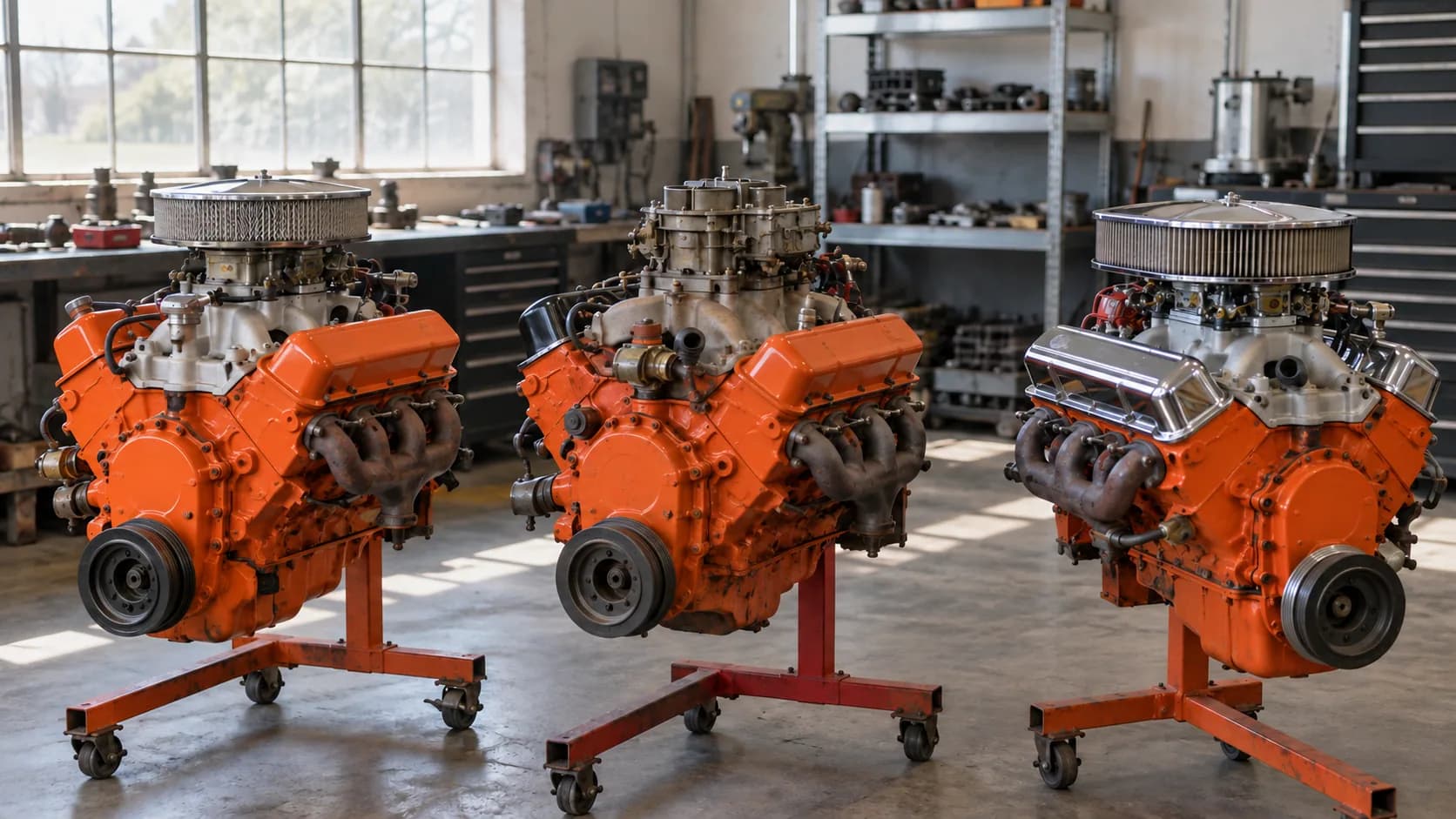
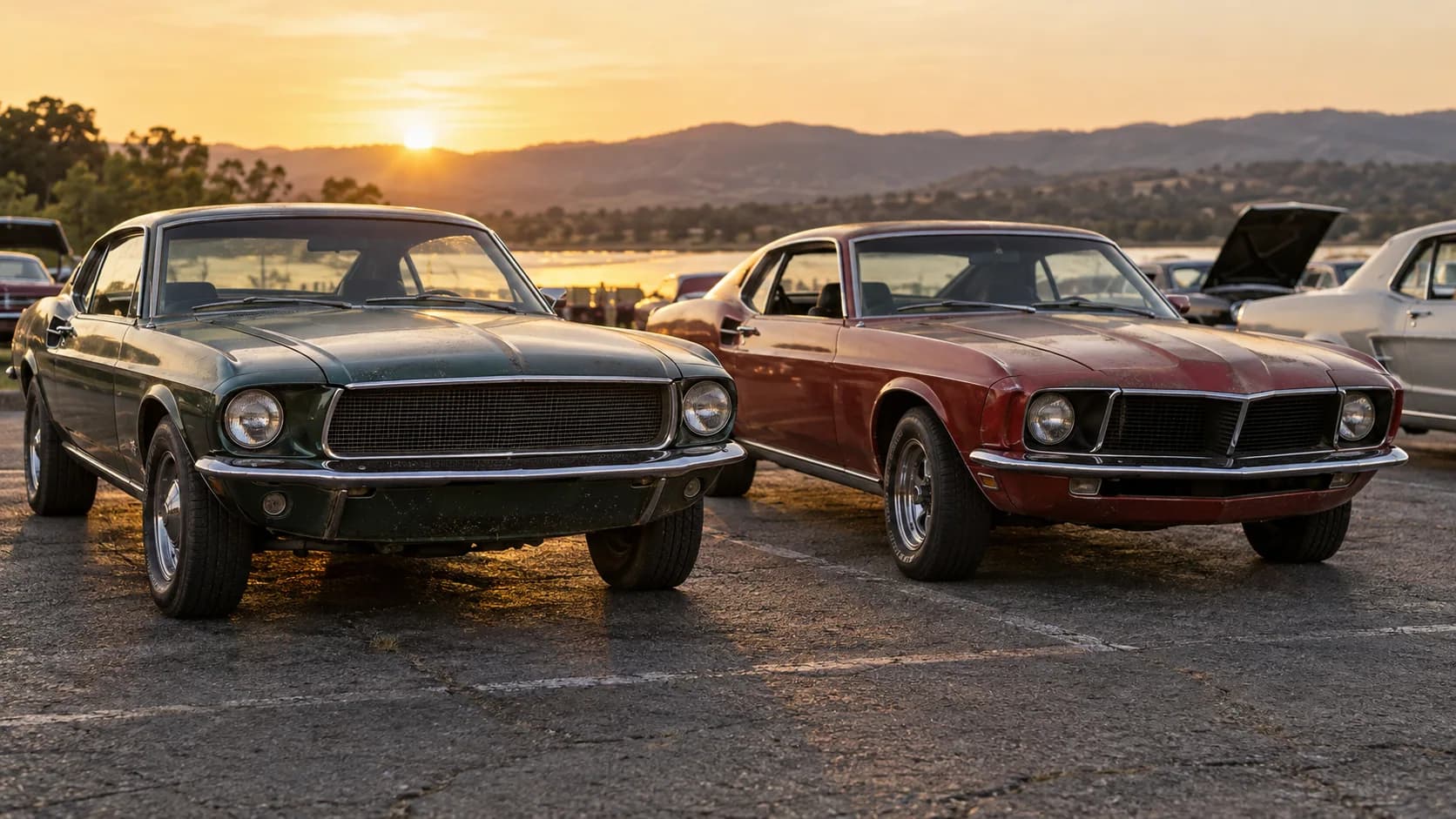
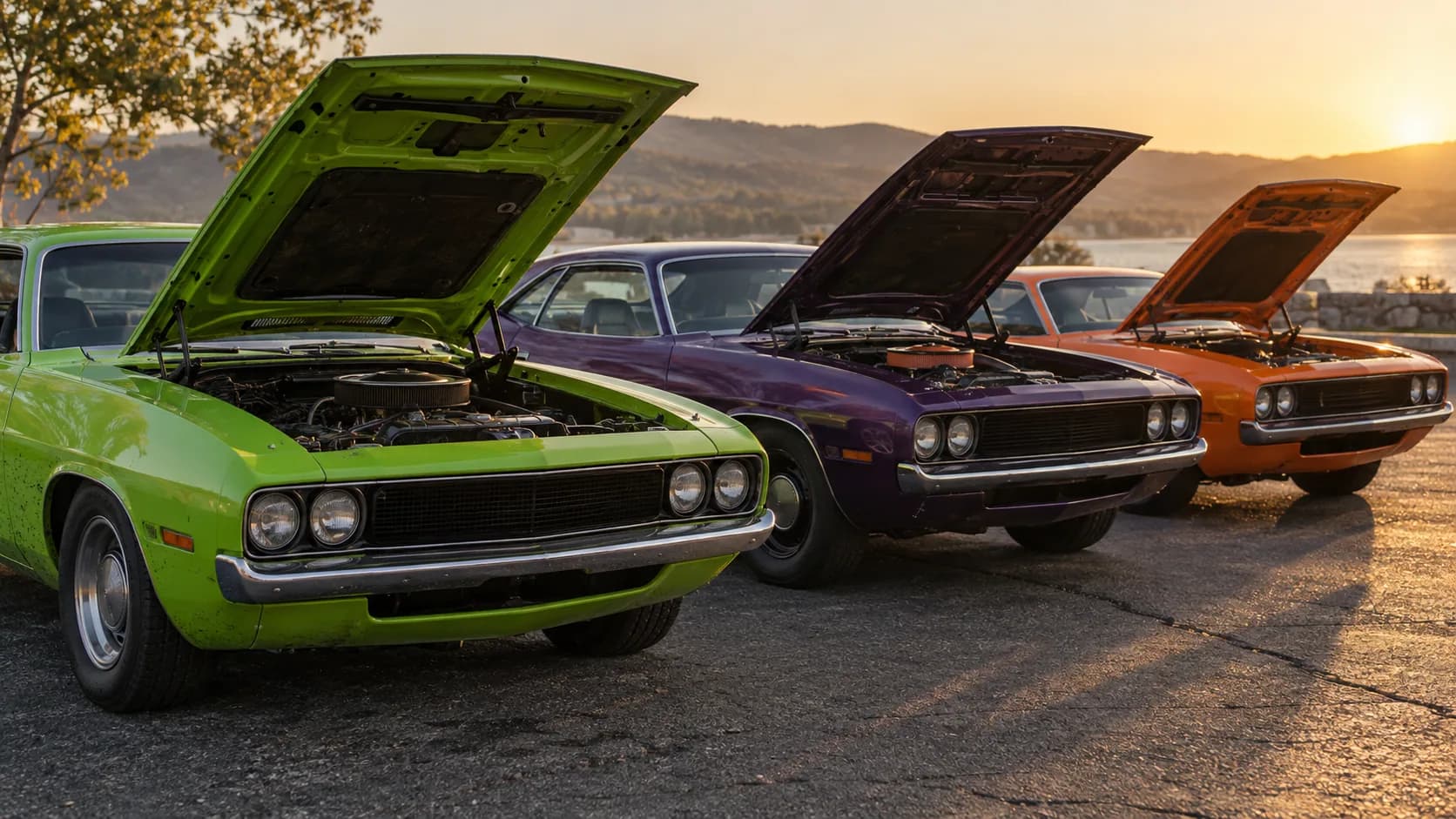
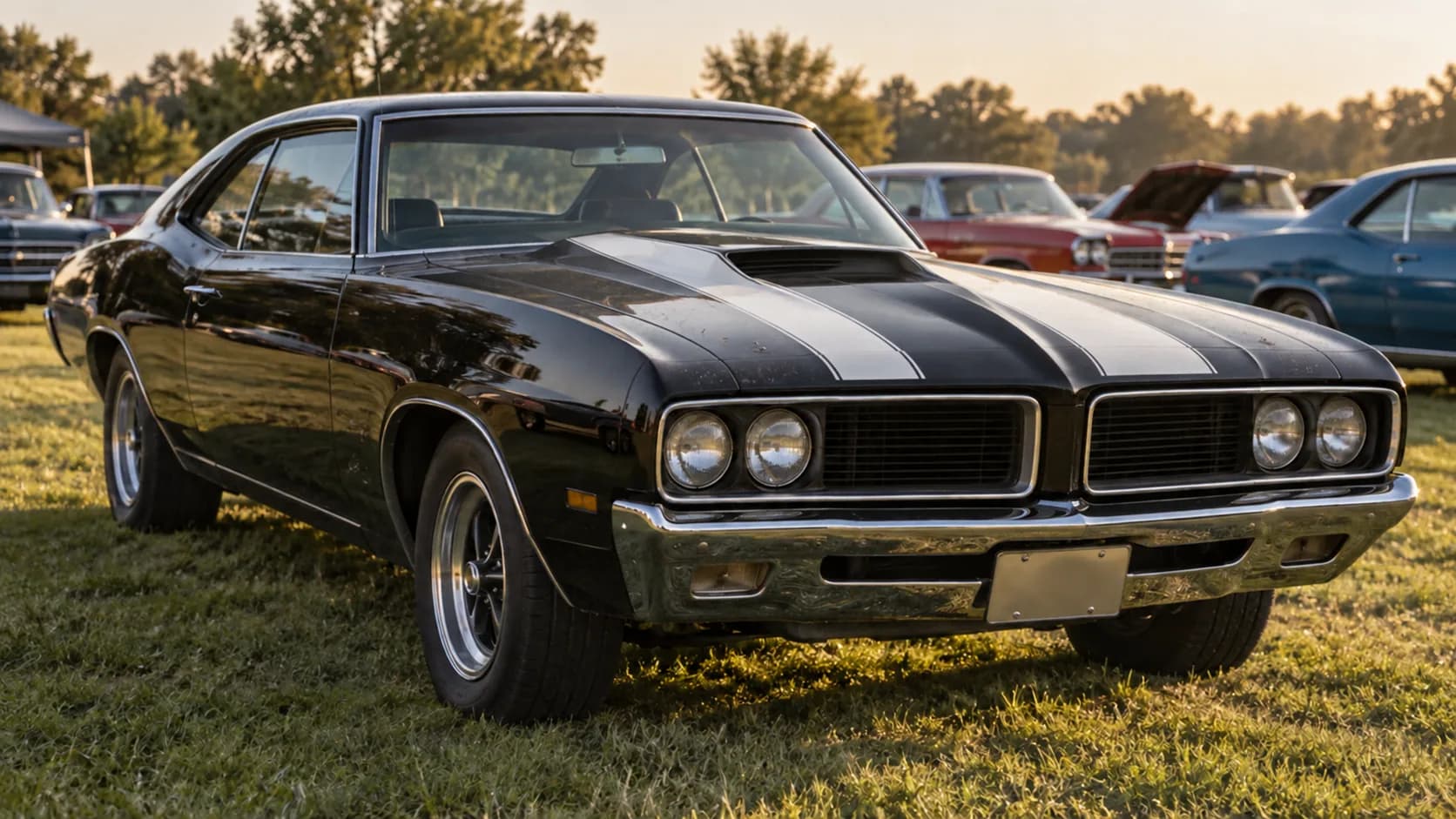
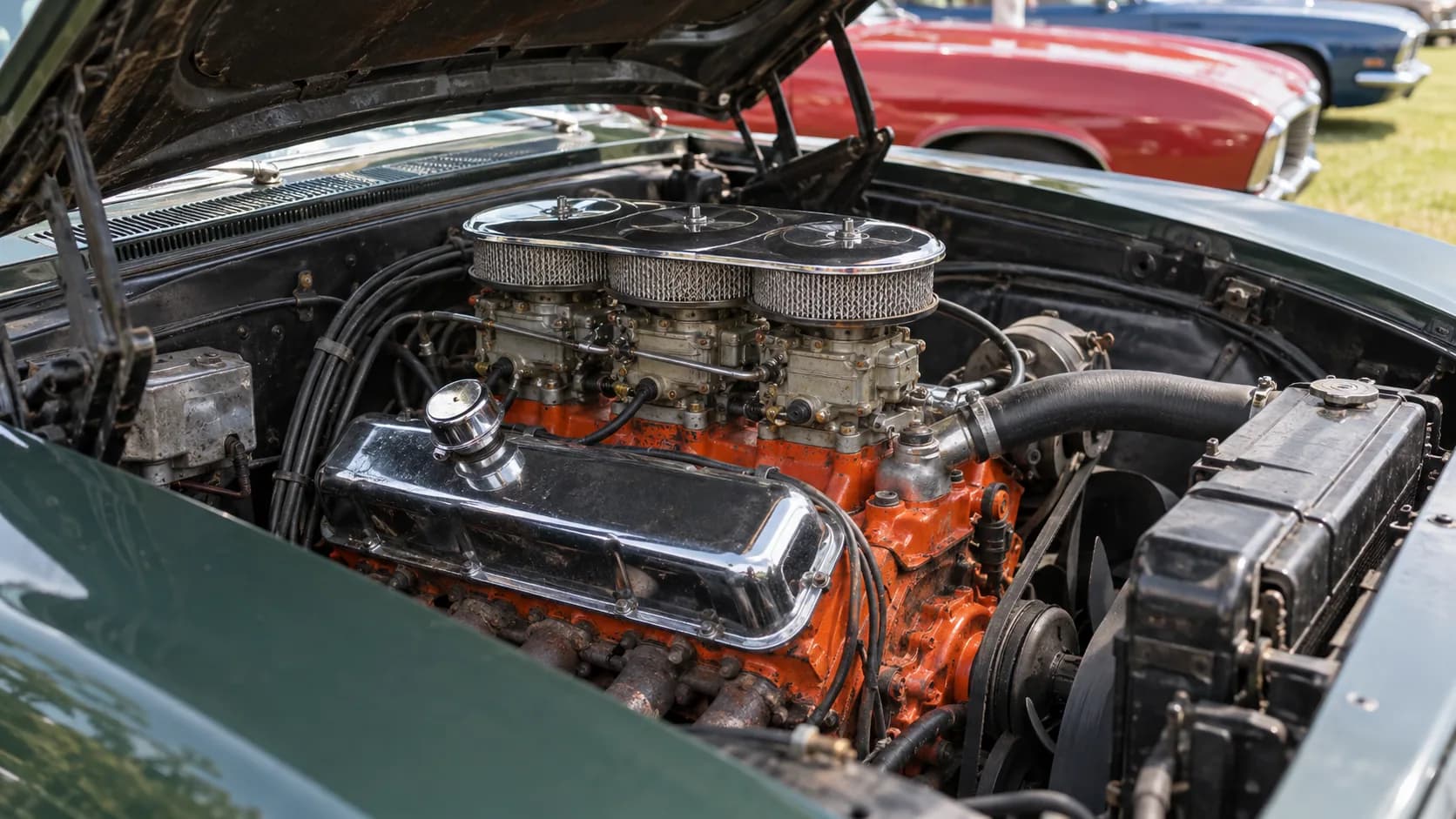
Three orange blocks on three engine stands can hide three very different stories, and the only number that matters is the one cast into the bottom of the bore. The renders above are AI images, not photos of real engines, but they capture the family resemblance that makes the Chevrolet Mark IV big-block so hard to read at a glance. The 396, 427 and 454 share a basic architecture, and most of the confusion at swap meets comes from that. Here is how they differ, which versions became legends, and why a casting number alone will not settle the argument.
Where the Mark IV Came From
The big-block story starts with the 1963 "Mystery Motor," a race-only 427 (the Mark II) that debuted at Daytona that season. It never went into a showroom car, but its design led to the production Mark IV, which replaced the 409 in mid-1965. Its valves were inclined in different directions so they could open away from the combustion chamber walls, which earned the head layout the nickname "porcupine."
The first production version was the 396. The engine had room for more, but GM's internal rule against putting engines over 400 cubic inches in its intermediate and smaller cars set the ceiling. Chevrolet got there with a 4.094-inch bore and a 3.76-inch stroke. It first appeared as the L78 in the 1965 Corvette and as the L37 in the Z16 Chevelle, a rare, special-built SS.
Bore, Stroke and the 402 Twist
For 1966 Chevrolet opened the bore to 4.25 inches and kept the 3.76-inch stroke, which made 427 cubic inches. For 1970 it kept the 4.25-inch bore and lengthened the stroke to 4.00 inches, which made the 454. In short, the 396 and 427 share a stroke, and the 427 and 454 share a bore.
The odd one out is the 402. Also introduced in 1970, it was a 396 bored out by 0.030 inch, adding 6 cubic inches. Chevrolet kept selling it under the popular "396" name in its smaller cars and called it the "Turbo-Jet 400" in full-size models. That means a 1970-or-later car with "396" badges usually has a 402 under the hood, which is fine as long as nobody is selling it as something rarer.
The Famous Versions
Ratings from this era are SAE gross, which overstates what an engine made installed in a car, so compare them with care.
**L78 396:** solid lifters, 11:1 compression and a big Holley four-barrel. It was rated 375 hp in mid-size cars such as the Chevelle and 425 hp in the 1965 Corvette.
**L72 427:** the street brawler, rated 425 hp with a single four-barrel and solid lifters. It went into the Corvette and full-size Biscayne, Impala and Caprice models, and later into 1969 COPO Camaros and Chevelles ordered through the Central Office Production Order system.
**L88 427:** a near-race engine with very high compression and aluminum heads, rated at 430 hp at 5,200 rpm. The rating was widely seen as understated. Most sources count 216 L88 Corvettes built from 1967 to 1969.
**ZL1 427:** an all-aluminum block and heads, developed mainly for Can-Am racing. In 1969, 69 Camaros got it through COPO 9560, and only two Corvettes did. In the Corvette the ZL1 package added about $4,718, close to the $4,781 base price of a 1969 Corvette coupe.
**LS5 454:** the standard 454 for 1970, rated 360 hp in the Chevelle SS 454 and 390 hp in the Corvette. Its rating fell in later years as compression dropped and the industry moved to net figures.
**LS6 454:** the peak. In the 1970 Chevelle SS 454 it was rated 450 hp at 5,600 rpm and 500 lb-ft of torque. For 1971 it moved to the Corvette with lower compression and a 425 hp rating.
Which Cars Got Which Engine
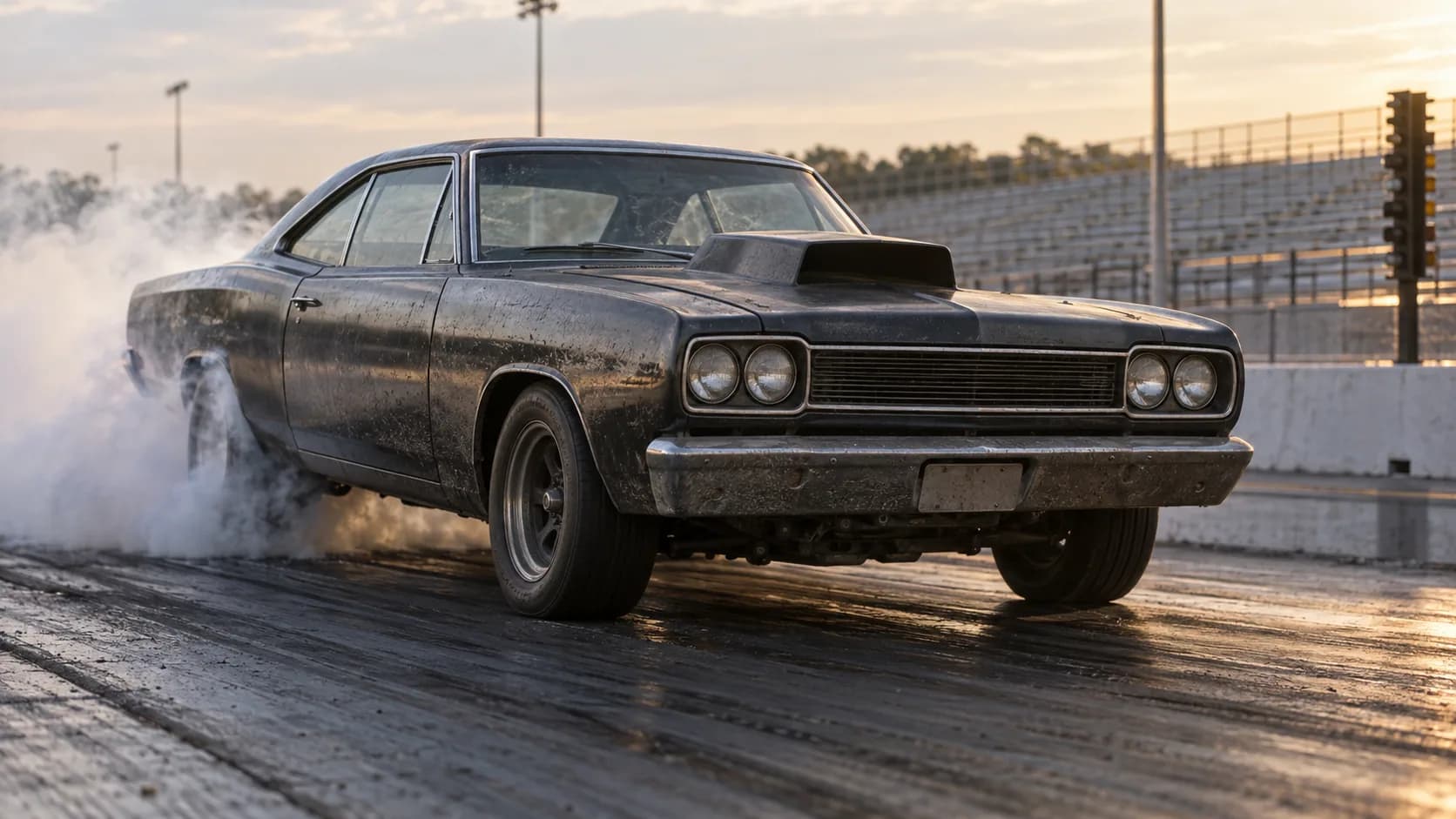
The 396 was the widest-spread of the three. It went into the Chevelle and El Camino, the Camaro, the Nova from 1968 to 1970, the Corvette, and full-size Impala, Biscayne, Bel Air and Caprice models. The factory 427 was a Corvette and full-size engine; 427 Camaros were mostly dealer conversions from 1967 to 1969, with the COPO cars as the factory exception. The 454 covered the Corvette from 1970 to 1974, the Chevelle, El Camino and Monte Carlo from 1970 to 1975, and the full-size Caprice through 1976. The Camaro and Nova never got a factory 454.
How to Identify One
Start with the block casting number on the rear of the block, usually on the driver's side. It narrows things down, but it does not prove displacement. The well-known 3963512 casting, for example, was used for both 427 and 454 engines. Cast dates also run days to weeks ahead of assembly, so they will not match the car's build date exactly.
Next, read the stamped pad in front of the passenger-side cylinder head. It carries a plant code, an assembly date and a suffix that Chevrolet used to code the engine, transmission and vehicle. Many stamps also include a partial VIN. Treat every stamp with suspicion: restamped pads are common in the classic-car market, and replacement engines marked "CE" were installed under warranty or sold over the counter, so they are not original to any car. Suffix codes sometimes repeated between years as well.
The only sure answer comes from measuring. A 4.25-inch bore says 427 or 454; the stroke tells you which. A 4.094- or roughly 4.125-inch bore points to a 396 or a 402. For a matching-numbers claim on a high-dollar car, check the casting, date, suffix and VIN stamp together, and lean on judging groups such as the NCRS for Corvettes.
Legacy
The Mark IV line set the template for every Chevrolet big-block that followed. The Gen V version arrived for 1991 with a revised block and a one-piece rear main seal, and the Vortec 7400 replaced it in 1996, followed by the Vortec 8100 in 2001. For collectors, though, the 1965 to 1971 window is still the one that matters: the L78, L88, ZL1 and LS6 are the codes that move prices, and they are exactly the ones worth checking twice.
Specs
- Family
- Chevrolet Mark IV big-block V8, introduced mid-1965
- 396
- 4.094 in. bore x 3.76 in. stroke
- 427
- 4.25 in. bore x 3.76 in. stroke (from 1966)
- 454
- 4.25 in. bore x 4.00 in. stroke (from 1970)
- 402
- 396 bored 0.030 in.; sold as "396" or "Turbo-Jet 400" (from 1970)
- Top ratings (gross)
- L78 375-425 hp; L72 425 hp; L88 430 hp; LS6 450 hp (1970)
- ZL1 production
- 69 Camaros (COPO 9560) and 2 Corvettes, 1969
- L88 Corvettes
- 216 built, 1967-1969 (most sources)
FAQ
- What is the difference between a 396, 427 and 454 big-block?
- All three are Mark IV big-blocks. The 396 has a 4.094-inch bore and 3.76-inch stroke, the 427 opens the bore to 4.25 inches with the same stroke, and the 454 keeps the 4.25-inch bore with a 4.00-inch stroke.
- Is a 402 the same as a 396?
- Nearly. The 402, introduced in 1970, is a 396 bored 0.030 inch larger. Chevrolet still badged it "396" in smaller cars and called it the Turbo-Jet 400 in full-size models.
- How do I tell if my big-block is a 427 or a 454?
- The casting number is not enough, since some blocks such as 3963512 were used for both. Check the stamped suffix code, and for certainty measure the stroke: 3.76 inches for a 427, 4.00 inches for a 454.
- How much horsepower did the LS6 454 make?
- Chevrolet rated the 1970 Chevelle LS6 at 450 hp gross at 5,600 rpm and 500 lb-ft of torque. The 1971 Corvette version was rated 425 hp.
Know someone who drove one? Share this guide
Get the Look
As an Amazon Associate we earn from qualifying purchases.
- Big-block Chevy engine book — History, numbers and build guides for the Mark IV family.
- Chevy orange engine enamel — The classic block color for a restoration.
- Chevelle SS 454 diecast model — The LS6 car in 1:24 scale for the shelf.
Sources
- en.wikipedia.org — Chevrolet_big-block_engine
- motortopia.com — unleashing-big-block-power-exploring-the-legendary-lineup-of-chevrolets-mark-iv-big-block-engines
- carguychronicles.com — 1966-chevy-396-427-mark-iv-bigger-is-better
- musclecarclub.com — chevy-427-big-block-guide
- vette-vues.com
- corvetteforum.com
- chevyhardcore.com
- chevellestuff.net — engine_stamp_numbers
- enginelabs.com
- forums.ncrs.org — 16393-big-block-ident
- rmsothebys.com — 1317662
- jalopnik.com — one-off-1969-zl-1-corvette-could-bring-3-million-at-au-1849944599