International Transtar 4070 (1968-1981): History and Specs
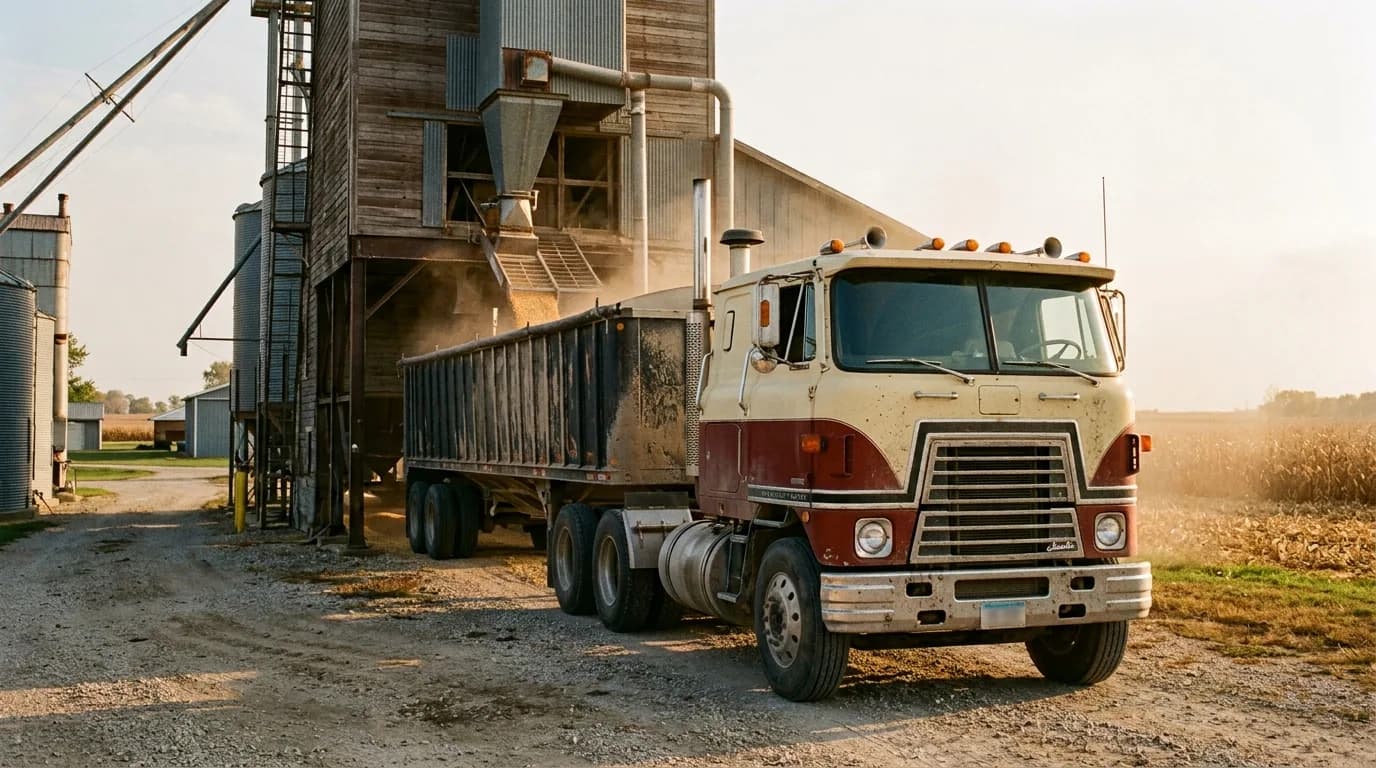
One collector who restored a 1976 Transtar says people at shows keep walking up to tell him their father had one. The AI-generated image above shows a cream and maroon cabover standing beside a weathered wooden grain elevator at harvest, dust in the air and a chrome bumper catching the low sun. It suits the International Transtar, a cabover from a company that grew out of Cyrus McCormick's reaper business and built its first truck in 1907, and by the 1970s it was one of the most recognizable cabovers on American highways.
From Emeryville to the CO-4000
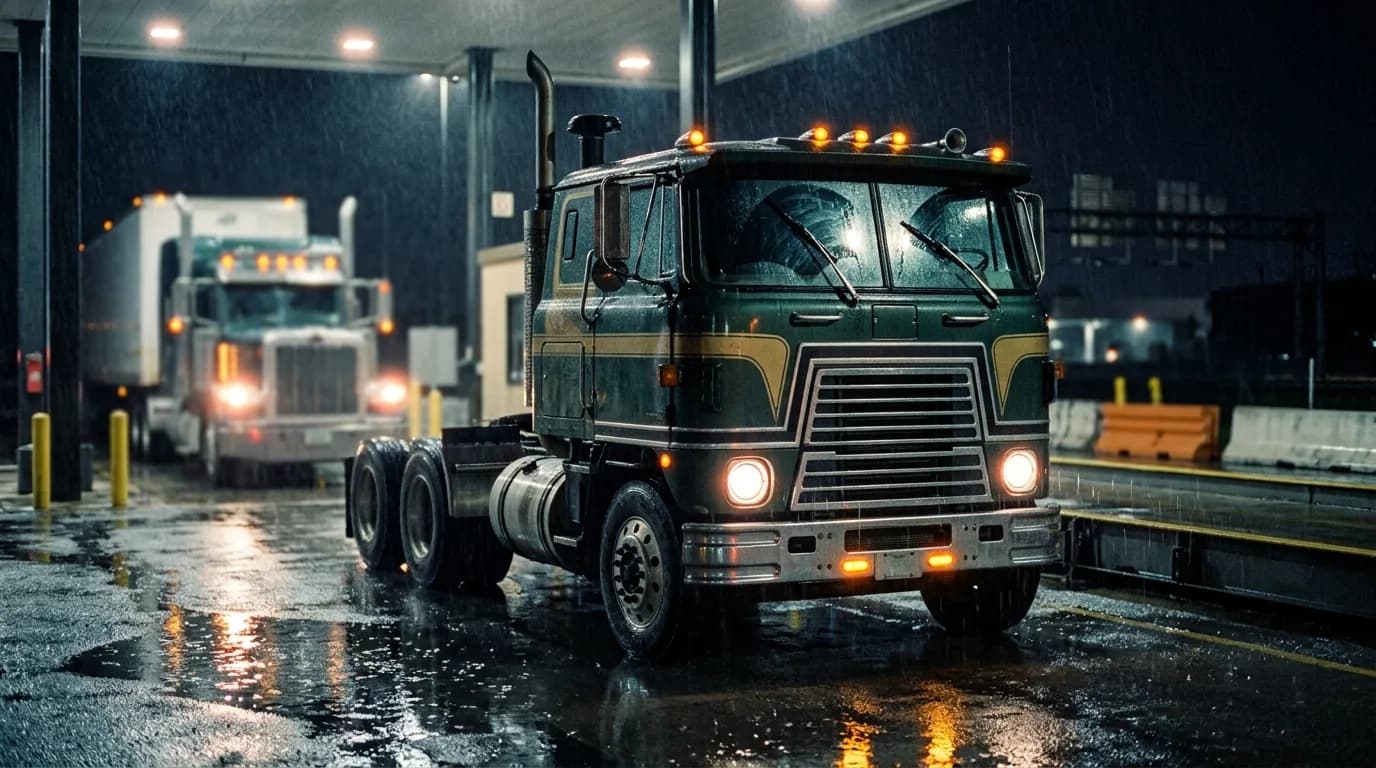
As the 1960s began, International Harvester's heavy-truck division sat near the top of the American market. Heavy Duty Trucking says its Emeryville cabover, the DCOF-405, was the top-selling American heavy truck for four years running in the early 1960s. In 1965 International followed it with the CO-4000, which Wikipedia describes as the first heavy-duty cabover the company designed entirely on its own. The Emeryville's cab is said to have come from Diamond T. The new truck had a larger, wider and taller cab with rounder edges, and a large trapezoidal grille that International would keep on its cabovers into the 1990s.
One Name, Two Body Styles
The Transtar name first appeared on the cabover in 1968, when the CO-4000 was updated. Internally it was the CO/COF-4070A, and the raised-cab version was the COF-4090A. Heavy Duty Trucking lists International's own turbocharged DVT573 V8 as the standard engine that year, with Cummins and Detroit Diesel engines optional. It describes the driving experience this way: a rubber-block suspension with no air ride yet, a cab that got chilly in winter, and plenty of engine noise at higher rpm. It also notes that the truck earned high marks for its looks, turning radius and interior amenities.
The name was never limited to cabovers. In 1969 International introduced the Transtar 400 conventional, which used the Emeryville cab. In 1971 it was replaced by the Transtar 4270 (short hood) and 4370 (long hood), with a much larger new cab. So a Transtar can be a cabover or a conventional. The conventional kept the name until 1985, when the 4370 became the International 9370.
Bigger Engines: Super Transtar to Transtar II
In 1970 International added two models. The Super Transtar carried a Detroit Diesel 12V71 V12 and could handle loads of up to 144,000 pounds. The Unistar was an all-wheel-drive version with a freewheeling front axle that engaged when the rear wheels lost traction, and it was sold through 1972.
The bigger change came in 1974 with the Transtar II, the CO/COF-4070B. Visually little changed. Most of the work was under the cab, where a larger engine compartment made room for the trend toward big-displacement power. The lineup included International's own V800 turbocharged V8, replacing the DVT573, along with Detroit Diesel's 8V92 V8, replacing the 12V71, and the Caterpillar 3406 six. Cummins offered several engines, including the 1,150-cubic-inch KT-450 six, which Heavy Duty Trucking calls one of the largest diesel engines ever fitted to a production commercial vehicle. Wikipedia's article on International Harvester also lists a Caterpillar 3408 V8 of 1,099 cubic inches.
Telling a 4070A From a 4070B
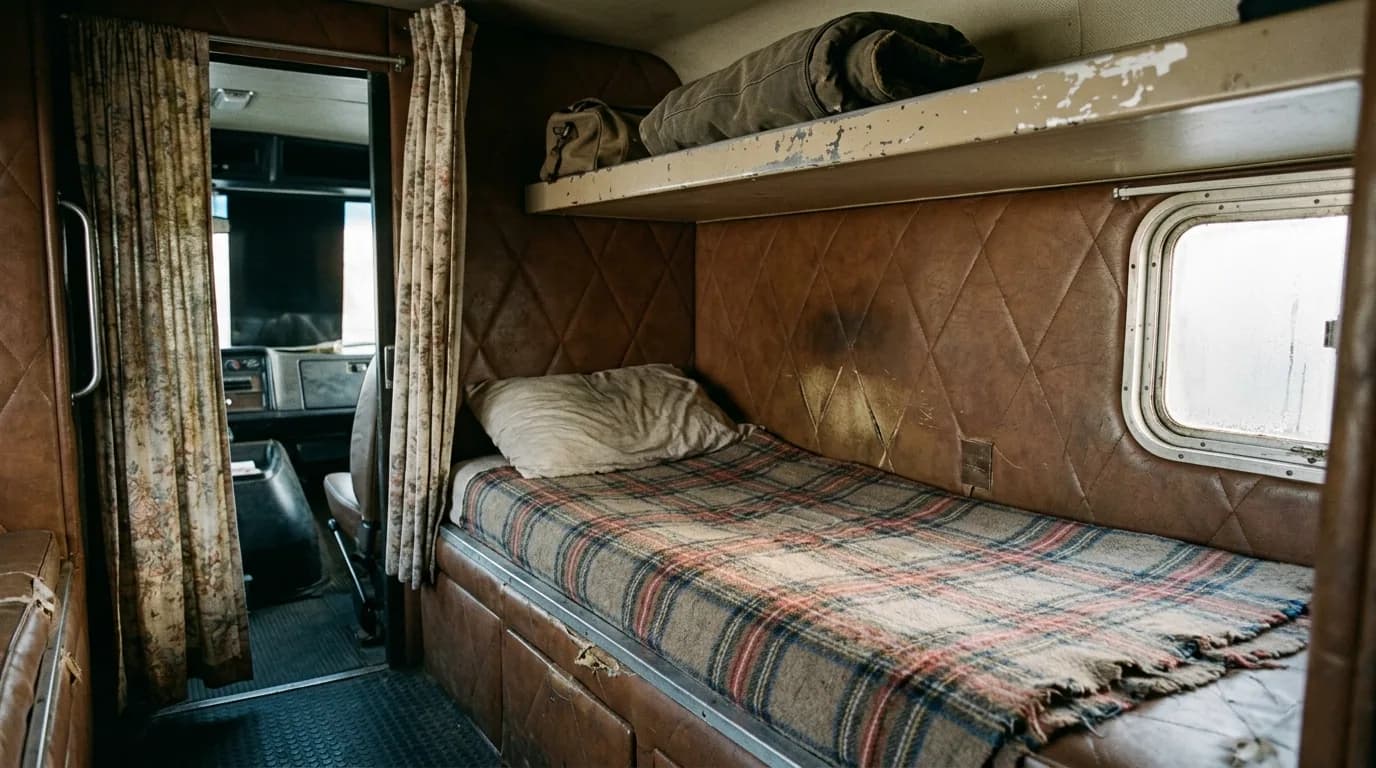
The quickest check is the wipers. A Transtar II has its windshield wipers mounted at the top of the cab, and Wikipedia adds that the Transtar II made the raised cab standard. Otherwise the two look very much alike.
Then there is the Eagle. For 1976 International launched an "Eagle" flagship brand that stayed in use into the 2010s, and AMT's 1/25 "Transtar II Eagle" model kit was first issued the same year. A parts supplier's paint chart lists 33 Eagle paint schemes, made up of 17 colors in three styles, as of September 1979.
Why the Cabover Faded
Heavy Duty Trucking dates the start of the end for the Class 8 cabover to changes in tractor-trailer length laws in 1976. Conventionals offered more room and a smoother ride, and it says their sales climbed. Other histories put the tipping point later, at the federal length rules of 1982. The Transtar II ceased production in 1981, replaced by the CO-9670, the first of International's Newport series. Its cab had a flat floor with no engine or transmission intrusion, and it shared its doors with the Transtar 4300 conventional. A Cummins N-series 855-cubic-inch engine in twin-turbo form produced 475 horsepower.
International stayed in the cabover business with the Newport series for years afterward, and the last one built for North America came in the late 1990s; Wikipedia dates it to 1998. Tooling for the line then went to Brazil, where the cabover was built for export markets. Transtar collector Mike Britton, who restored a 1976 model, told Heavy Duty Trucking that at shows people keep walking up to say their father had one.
Specs
- Lineage
- CO-4000 (1965), successor to the DCO-400 Emeryville
- Transtar name first used
- 1968 (CO/COF-4070A; COF-4090A with raised cab)
- Transtar II (CO/COF-4070B)
- 1974 to 1981; wipers mounted at the top of the cab
- Engines, 1968
- International DVT573 turbocharged V8 listed as standard; Cummins and Detroit Diesel optional
- Super Transtar, 1970
- Detroit Diesel 12V71 V12; loads up to 144,000 lb
- Transtar II engines
- International V800 V8, Detroit Diesel 8V92, Caterpillar 3406, Cummins including the 1,150 cu in KT-450
- Replaced by
- CO-9670, first of the Newport series, in 1981
FAQ
- What years was the International Transtar cabover made?
- The Transtar name first appeared on International's cabover in 1968 (CO/COF-4070A). The Transtar II (CO/COF-4070B) arrived in 1974 and ceased production in 1981.
- What is the difference between the Transtar 4070A and 4070B?
- The 4070B is the 1974 Transtar II. It looks much like the 4070A but has windshield wipers mounted at the top of the cab, and it came with a revised engine lineup that included the V800, 8V92, 3406 and KT-450.
- What engines did the International Transtar cabover have?
- In 1968 Heavy Duty Trucking lists International's DVT573 turbocharged V8 as the standard engine, with Cummins and Detroit Diesel options. The Transtar II offered the V800 V8, Detroit Diesel 8V92, Caterpillar 3406 and several Cummins engines.
- What replaced the International Transtar cabover?
- The CO-9670, the first of the Newport-series cabovers, replaced the Transtar II in 1981. The last Newport-series cabover for North America was built in the late 1990s.
Know someone who drove one? Share this guide
Get the Look
As an Amazon Associate we earn from qualifying purchases.
- International Transtar 1:25 scale model truck kit — A cabover model to build and put on the shelf.
- International Harvester trucks history book — Background on the company behind the Transtar.
- CB radio for trucks — The classic cab accessory that goes with any cabover build.
Sources
- en.wikipedia.org — International_Transtar
- en.wikipedia.org — International_Harvester
- en.wikipedia.org — International_9000_(COE)
- en.wikipedia.org — International_9000
- truckinginfo.com — great-american-trucks-the-international-transtar-cabover-tractor
- dailydieseldose.com — international-transtar-ii-cocof-4070b
- oldinternationaltrucks.com — transtar-ii-4070b-cabover-paint-scheme-poster
- modelroundup.com — amt-6183
- curbsideclassic.com — curbside-classic-1973ish-international-transtar-the-star-atop-a-busy-week-of-fun-with-cars
- curbsideclassic.com — truck-history-1973-freightliner-powerliner-its-giant-1150-cubic-inch-19l-600-hp-cummins-kta-600-was-the-largest-diesel-in-production-highway-trucks
- en.wikipedia.org — Surface_Transportation_Assistance_Act_of_1982
- expeditersonline.com — a-look-back-at-cabovers-5739