Kenworth K100: History, the Aerodyne Sleeper, and Its Legacy
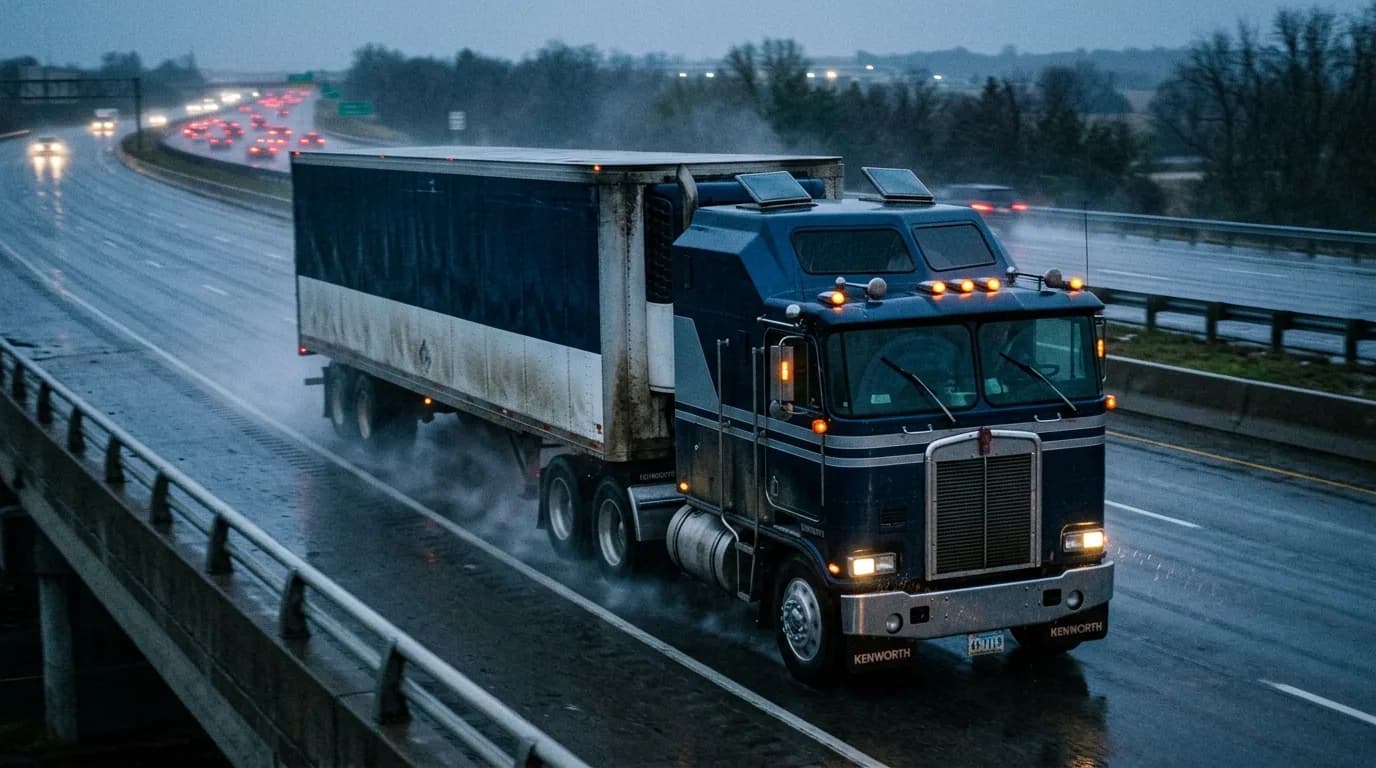
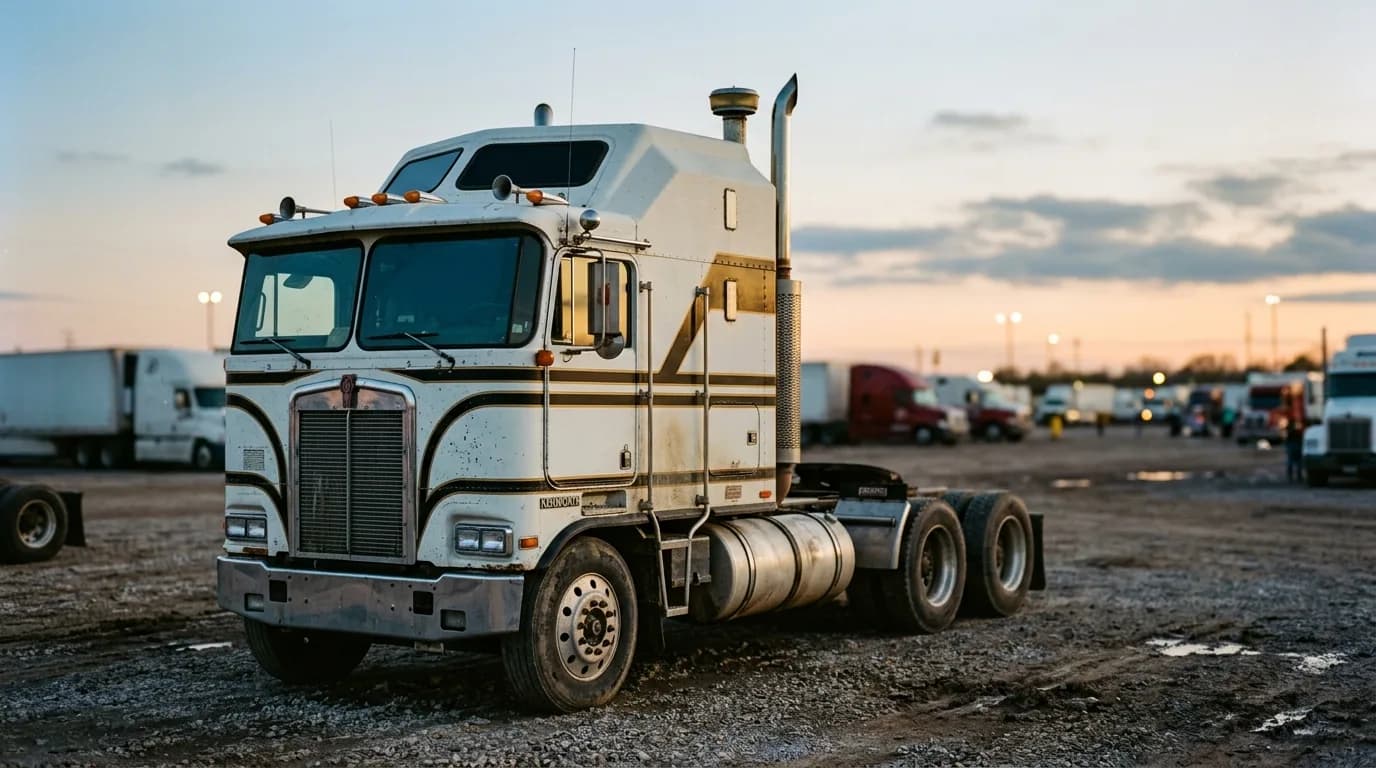
Length laws, not styling, are why the Kenworth K100 has no hood. The scene above is an AI render of a K100 Aerodyne working a wet night run, wipers going, trailer kicking up spray behind it, a fitting way to picture a classic cabover that spent its career on unglamorous long-haul work, all flat nose and stacked headlights, built around trucking regulations that don't exist anymore.
Why Kenworth Built a Truck With No Hood
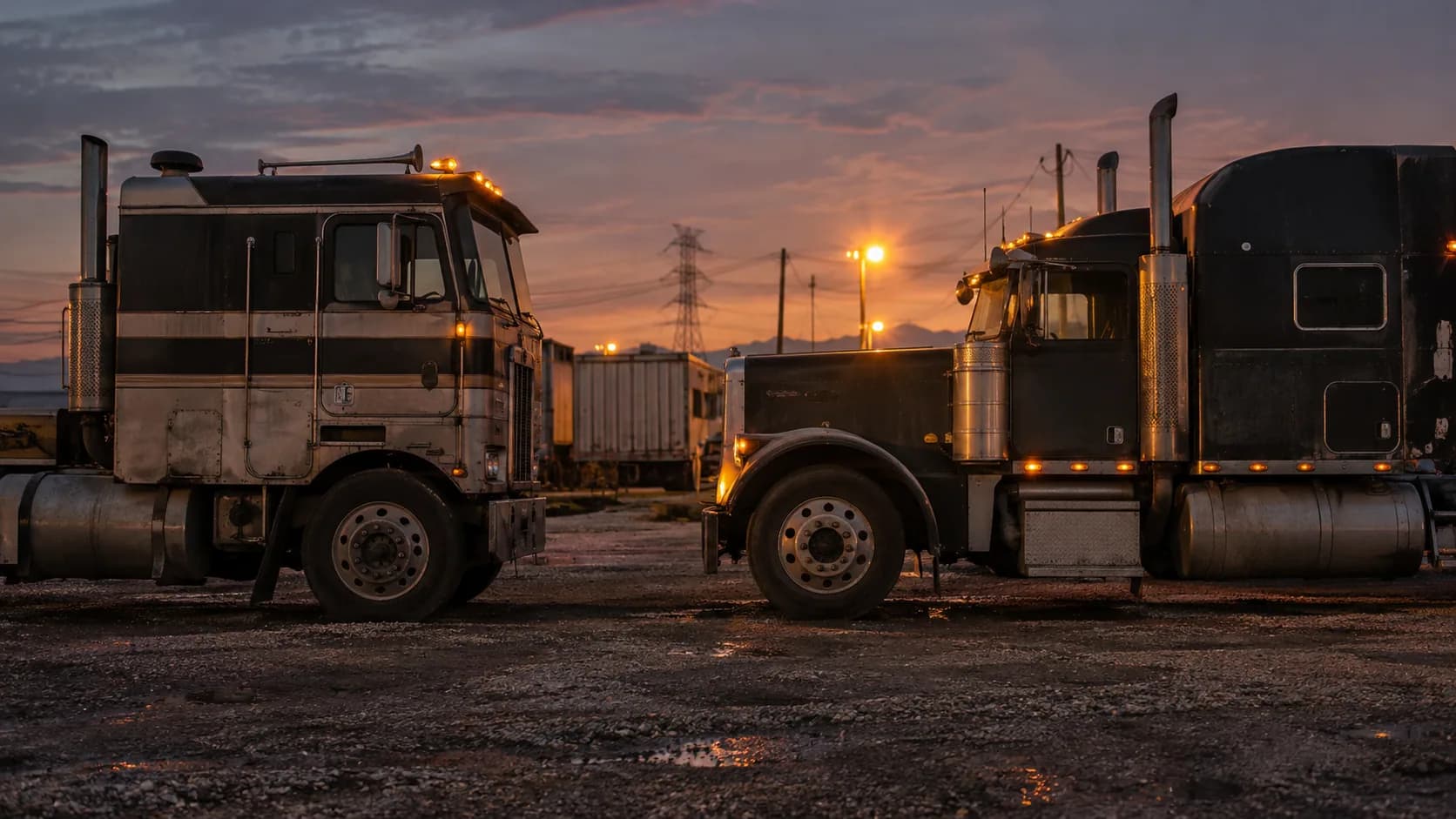
Kenworth had been building cab-over trucks since the mid-1950s, but the direct ancestor of the K100 was the K-series COE that arrived in 1956, replacing an earlier engine-surrounding cab design that didn't tilt at all. In 1963, that lineage was renamed the K900 and then, the same year, the K100 — introduced alongside its conventional sibling, the W900. The reasoning was almost entirely regulatory: through the 1970s, many states capped the combined length of a tractor and trailer anywhere from about 55 to 65 feet depending on the state, and every foot a truck saved on the cab was a foot it could add to the box behind it. Moving the driver on top of the engine instead of behind it let Kenworth build a shorter tractor without giving up trailer space, and for owner-operators trying to maximize a legal load, that made the cabover the only sensible choice.
The Aerodyne Raised the Roof
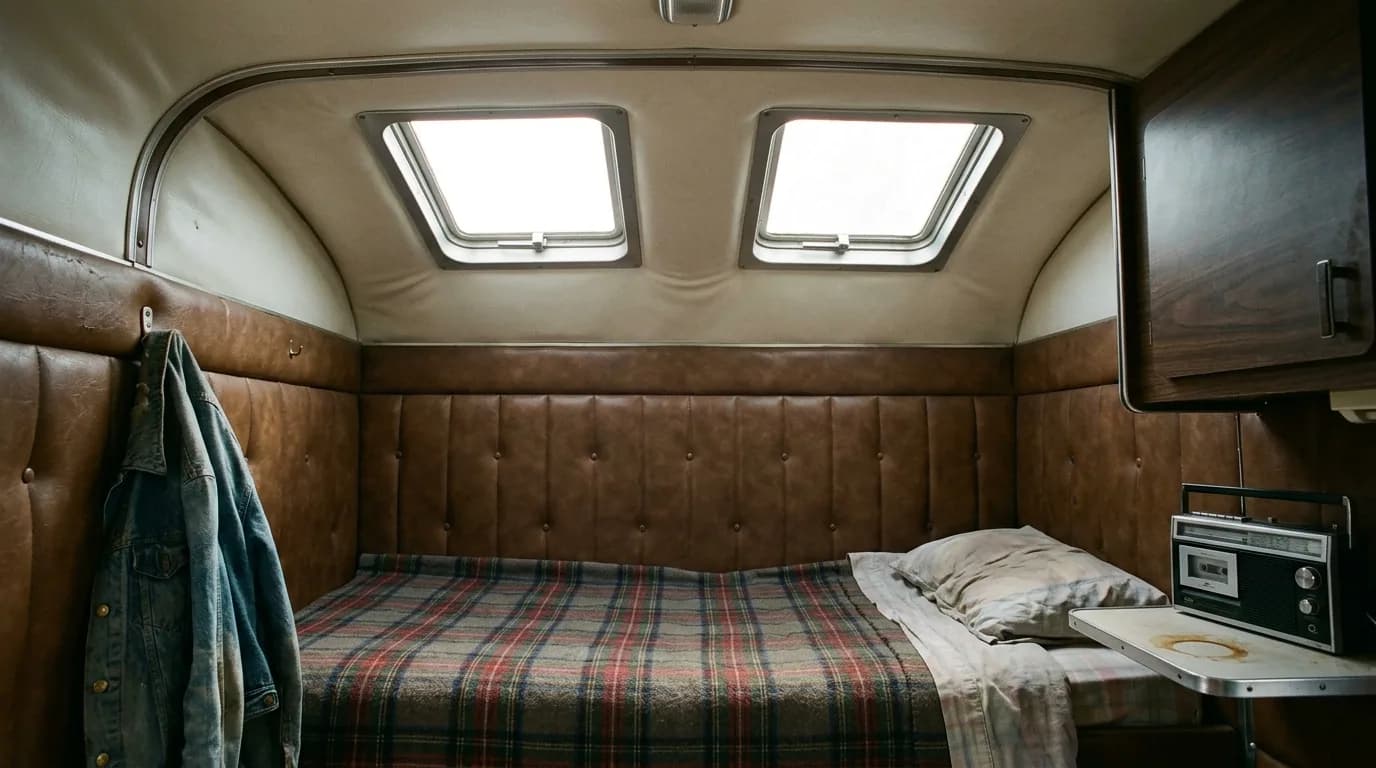
In 1976, Kenworth gave the K100, and the W900, the Aerodyne: a raised-roof sleeper with twin skylight windows and, according to Kenworth, the first seven feet of stand-up headroom ever built into a factory sleeper cab. For a design that had always traded comfort for legal length, it was a real shift. Drivers could now stand up, change clothes, and stretch out in the back of a cabover without ducking under a low ceiling. Kenworth marked the U.S. bicentennial that same year with a run of red-white-and-blue "Very Important Trucker" Aerodyne editions, and the raised roof and skylights became the K100's signature feature for the rest of its production run.
Detroit Two-Strokes and a Tilting Nose
Engines varied by decade and buyer, but the K100 Aerodyne is most associated with Detroit Diesel's smoky, distinctive two-stroke line, the 6-71 Turbo and the larger 8V92, alongside Caterpillar's 3406 and Cummins' Big Cam 350 and 400. Whatever sat under the cab, reaching it meant the same procedure every time: release the latches, and the entire cab tilts forward on a hydraulic jack, swinging the whole front end up and out of the way. It's a more involved job than popping a conventional's hood, but it puts the whole engine and transmission out in the open, with no fender or hood side panel to reach around. That tilting nose, along with the flat face and stacked round headlights, is still the fastest way to pick a K100 out of a lineup at any truck show.
B.J. and the Bear Made It a Household Truck
The K100 Aerodyne's biggest brush with fame came from television. When B.J. and the Bear premiered on NBC in February 1979, star Greg Evigan's character drove a red-and-white Kenworth K100 Aerodyne cabover for all three seasons, and Kenworth leaned into the exposure as free advertising for the sleeper it had introduced just three years earlier. The show's original truck disappeared for years, turning up in an overgrown Georgia field decades later, before a father-and-son team from Wisconsin bought it in 2007 and restored it to its original on-screen specs. It still makes the occasional truck-show appearance today, badge and all.
Why the Cabover Disappeared
The same length laws that created the K100 eventually killed it. States began relaxing their combined-length caps through the early 1980s, and once a conventional truck like the W900 could legally pull as much trailer as a cabover, most buyers picked the conventional anyway, for the easier engine access, the smoother ride, and a hood between them and whatever they hit. Kenworth kept building K100 cabovers for a shrinking market long after most competitors quit, finally phasing out the K100E in North America after 2002, though the related K200 cabover has stayed in production for the Australian market ever since. What's left in the U.S. mostly lives at truck shows now, restored Aerodynes standing in for a shape that used to be everywhere on the interstate.
Specs
- Predecessor
- Kenworth's K-series COE, introduced 1956
- Introduced
- 1963, alongside the W900 (initially named the K900)
- Aerodyne raised-roof sleeper
- 1976; first factory sleeper with 7 ft of stand-up headroom (shared with the W900)
- Common engines
- Detroit Diesel 6-71 Turbo, 8V92; Caterpillar 3406; Cummins Big Cam 350/400
- Common transmissions
- Eaton-Fuller Roadranger 9-, 10-, and 13-speed manuals
- Cab access
- Hydraulic tilt-forward cab for engine and transmission access
- North American production ended
- 2002 (K100E phased out; Kenworth Australia's K200 continues)
Get the Look
As an Amazon Associate we earn from qualifying purchases.
The flat-nose cabover shape for a shelf, in pocket-size or display scale.
Check price at AmazonBackground reading on the era that made trucks like the K100 the norm.
Check price at AmazonThe classic cab accessory no big rig look is complete without.
Check price at AmazonFor keeping stacks and grille chrome show-lot bright.
Check price at AmazonGarage or man-cave decor for a classic-Kenworth fan.
Check price at AmazonFAQ
- Why did Kenworth build the K100 as a cabover instead of a conventional?
- To save length. Many states capped combined tractor-trailer length anywhere from about 55 to 65 feet through the 1970s, and putting the cab over the engine let Kenworth build a shorter tractor, leaving more legal length for the trailer.
- What was special about the Aerodyne sleeper?
- Introduced in 1976 for the K100 and W900, it was the first factory-built sleeper with 7 feet of stand-up headroom, using a raised roof and twin skylight windows.
- What truck did B.J. drive in B.J. and the Bear?
- A red-and-white Kenworth K100 Aerodyne cabover, which Greg Evigan's character drove throughout the show's 1979–1981 run on NBC.
- Is the Kenworth K100 still made?
- Not in North America. Kenworth phased out the K100E there after 2002, though the related K200 cabover has remained in production for the Australian market.