Cummins Big Cam Engine: History, Specs and Ratings (855)
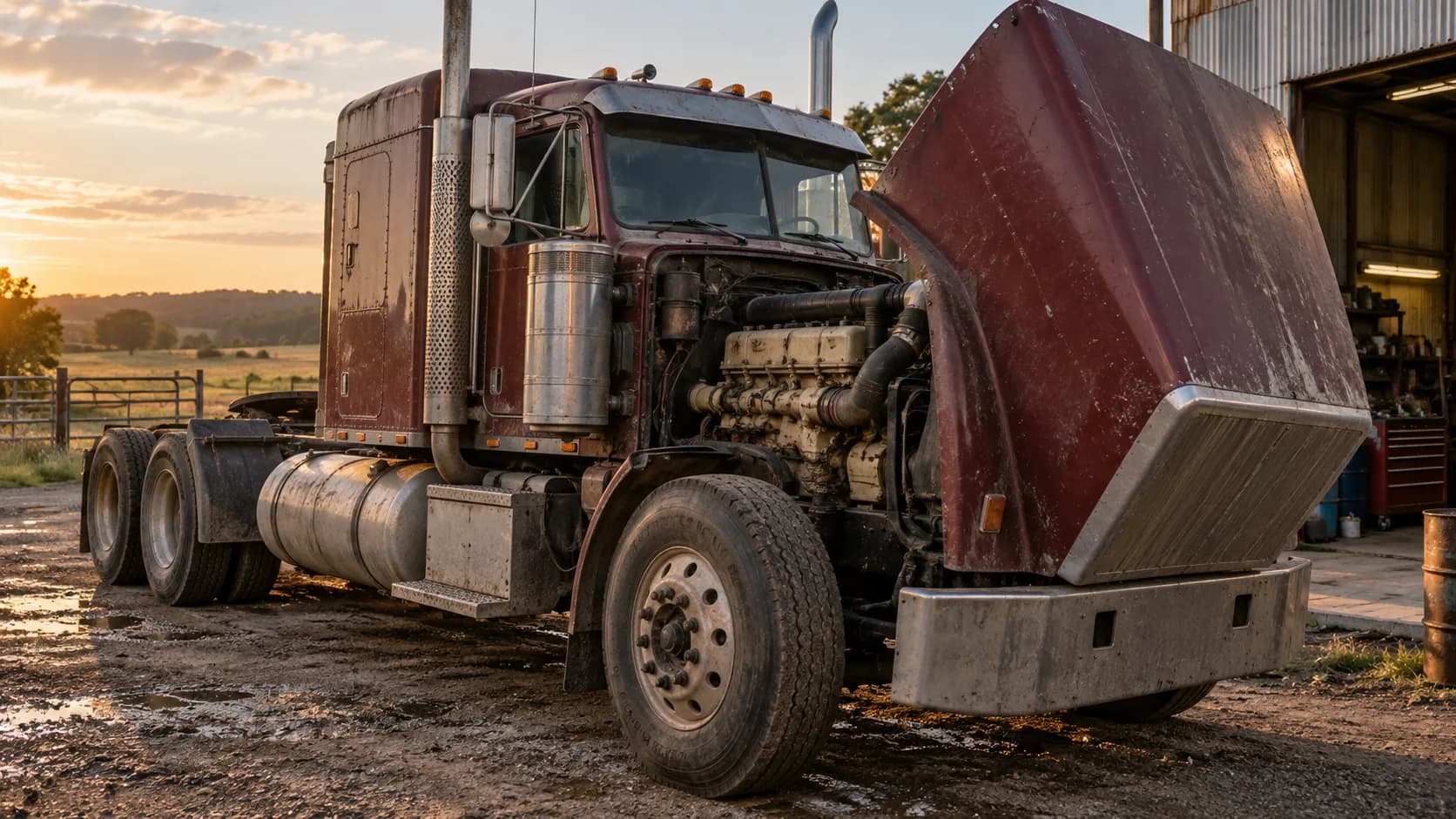
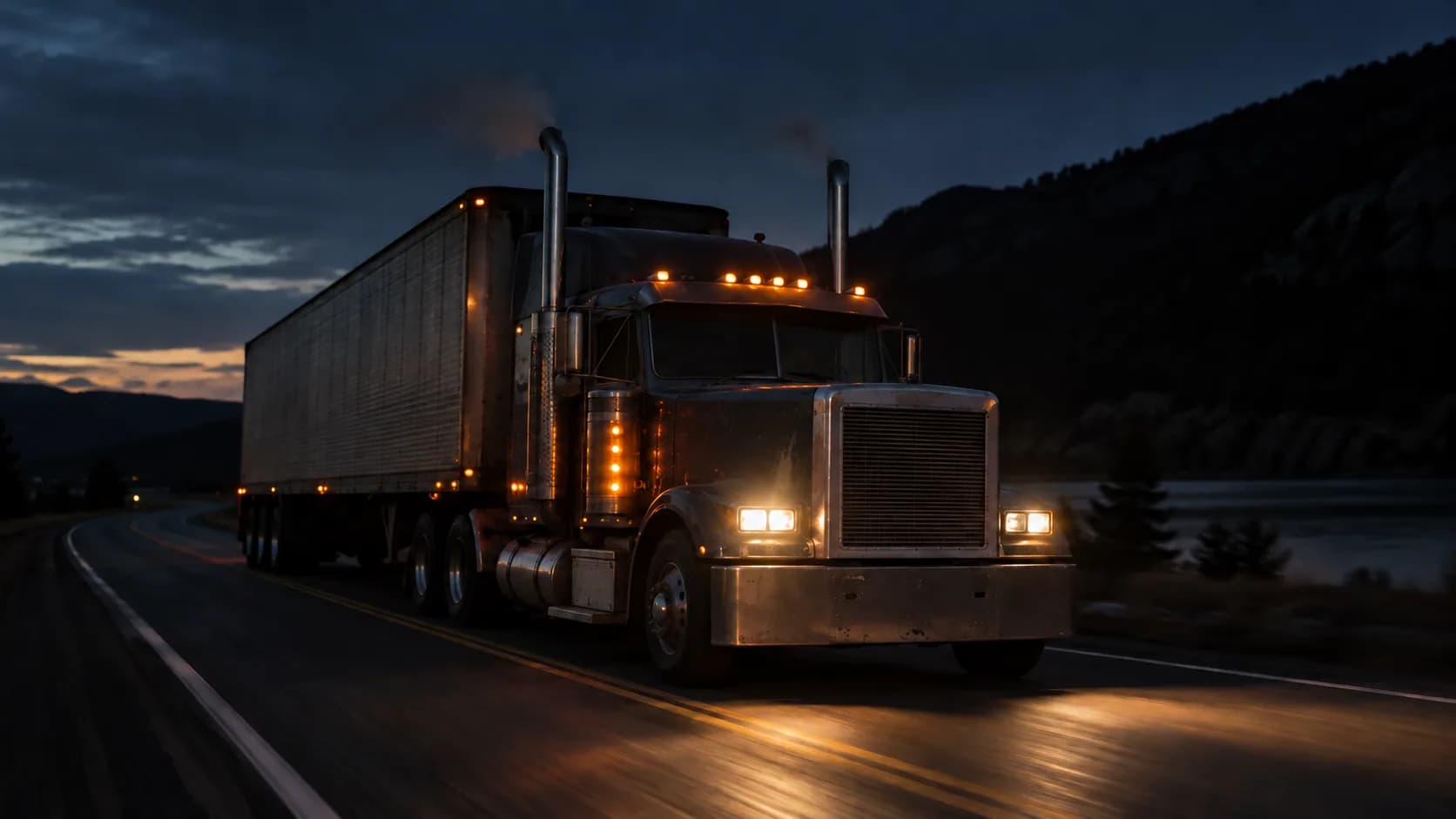
Half an inch of camshaft does not sound like much, but it gave a whole generation of American big rigs their name for an engine. The render above imagines that era: a weathered maroon long hood at sunset, hood tipped forward and a cream-painted inline six showing in the frame. It is an AI-generated image, not a photo of a real truck or engine, but the Cummins Big Cam it stands for is real, and owners still go looking for one.
What "Big Cam" Actually Means
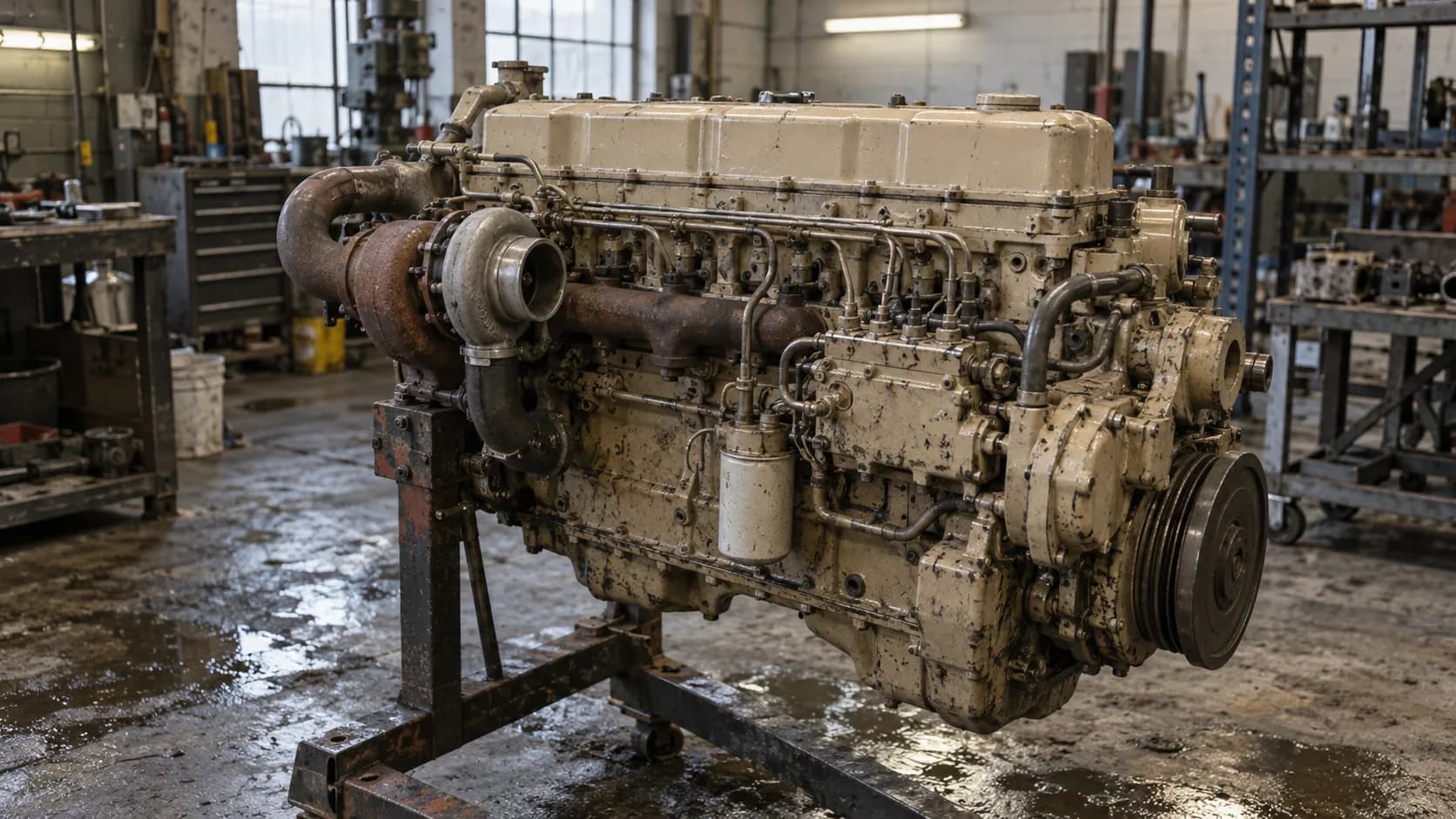
The Big Cam was the 855 cubic inch Cummins, the same 14.0-liter inline six family as the NT855, with a 5.5-inch bore and a 6.0-inch stroke. The name came from one change: the camshaft journal diameter grew from 2 inches to 2.5 inches. The engines it replaced are known as Small Cam 855s.
That bigger cam was not just for show. On the Cummins system, the camshaft drives the injectors, and the larger cam let Cummins raise injection pressure from roughly 11,000 psi to about 14,000 psi, so fuel went in faster and over a shorter period. The result, reported in engine histories, was about a 6 percent fuel economy gain over the small-cam version, along with less smoke, noise and emissions.
Big Cam I Through IV: The Timeline
Dates vary a little from source to source, so treat these as approximate.
A 1980 technical paper by C. W. Hoefflin of Cummins traces the NT-855 from a pre-1975 Small Cam rated at 2,100 rpm, to the 1975 Formula rating at 1,900 rpm with the same power, to the Big Cam Formula in 1976 and the Big Cam II Formula in 1979 at 1,800 rpm. The same paper reports a 15 percent fuel economy improvement between 1975 and 1980 and lists a Big Cam III as a planned development for 1982.
Popular histories put the Big Cam I at 1977, the Big Cam II at 1979, the Big Cam III at 1982 and the Big Cam IV at 1984. Each step worked on the fuel system and air handling and cut the power the engine spent driving its own internals. The theme across all of it was the same: run slower, burn less fuel, keep the pulling power.
Ratings: NTC 350, NTC 400 and Friends
Big Cams were sold under ratings rather than one fixed number, and the rating usually sits in the model name. Engine listings describe an NTC-350 at 350 hp and 1,800 rpm, and an NTC-400 at 400 hp, both on the 855 cubic inch, 14.0-liter block. Owners and dealers often just say "350 Big Cam" or "400 Big Cam."
Be careful with the badges, though. Cummins naming was not always consistent, and enthusiasts point out cases where the marketing number on an engine did not match its spec sheet rating. If the exact rating matters, the CPL number and serial number on the engine data plate are what to check.
The Trucks That Ran Them
The Big Cam was a mainstream Class 8 engine of its day, and it turned up in the long-hood conventionals that classic-truck fans chase now. Overdrive magazine's reader-rig features show how common the pairing was: a 1976 Kenworth W900 Bicentennial with a 350 Big Cam and a 13-speed, a 1979 Kenworth W900A with a 400 Big Cam III and a 13-speed, and a 1983 Kenworth K100 cabover with a 350 Big Cam III and a 9-speed. Older trucks have been repowered with them too, including a 1966 Kenworth W925 that now runs a 400 Big Cam.
The 13-speed shows up often in builds like these. For more on that side of the drivetrain, see our Eaton Fuller 13-speed vs 18-speed guide, and for the Big Cam's era rivalry with Caterpillar, our Cat vs Cummins comparison.
Reputation, Weak Spots and Rebuilds
The Big Cam's reputation rests on three things: it ran at low engine speeds, it made strong low-end torque, and it lasted. Engine histories describe it as one of Cummins' most respected truck engines, largely because of its long service life.
It was not flawless. As Cummins kept raising injection pressure to meet tougher emissions rules, the fuel system was asked to do more, and the late Big Cam IV engines with reduced drain flow injectors are linked to injector reliability problems. An early Big Cam and a late one are not the same engine to live with.
What keeps them alive is rebuildability. The 855 uses wet cylinder liners and a mechanical pressure-time (PT) fuel system, and complete overhaul kits for the NT855 are still sold. A mechanical engine with no computer is also one a lot of owners can still work on themselves.
From Big Cam to N14, and Why Owners Still Want One
The 855 Big Cam was followed by the N14. Sources date the N14 from 1987, with full production around 1990 to 1991, and it kept the 855 cubic inch displacement and the same bore and stroke. The big changes were air-to-air aftercooling and, from 1990, the electronic Celect version. Our Cummins N14 guide covers that engine in detail.
That electronic shift is exactly why the Big Cam still has a following. It belongs to the purely mechanical era of Cummins heavy-duty engines, simple enough to understand, sturdy enough to rebuild and period-correct for a 1970s or 1980s long hood. For anyone restoring a classic Kenworth or Peterbilt, a Big Cam under the hood is often part of the point.
Specs
- Engine
- Cummins 855 (NT855 family), inline six, turbocharged diesel
- Displacement
- 855 cu in (14.0 L)
- Bore x stroke
- 5.5 in. x 6.0 in.
- Camshaft journal
- 2.5 in. (up from 2 in. on the Small Cam)
- Injection pressure
- About 14,000 psi (up from about 11,000 psi)
- Versions
- Big Cam I (1977), II (1979), III (1982), IV (1984); dates approximate
- Common ratings
- NTC-350 (350 hp at 1,800 rpm), NTC-400 (400 hp)
- Successor
- Cummins N14 (from 1987)
FAQ
- What does Big Cam mean on a Cummins?
- It refers to the larger camshaft on the Cummins 855: the journal diameter grew from 2 inches to 2.5 inches. That let Cummins raise injection pressure and improve fuel economy over the earlier Small Cam engines.
- What years were Cummins Big Cam engines made?
- Cummins introduced the Big Cam in 1976, and popular histories date the Big Cam I to 1977, the II to 1979, the III to 1982 and the IV to 1984. The N14 followed from 1987.
- How much horsepower does a 400 Big Cam have?
- The NTC-400 is rated at 400 hp, and the NTC-350 at 350 hp at 1,800 rpm. Check the CPL number on the data plate to confirm a specific engine's rating.
- What is the difference between a Big Cam and an N14?
- Both displace 855 cubic inches with the same bore and stroke. The N14 added air-to-air aftercooling and, from 1990, Celect electronic controls, while the Big Cam is fully mechanical.
Know someone who drove one? Share this guide
Get the Look
As an Amazon Associate we earn from qualifying purchases.
- Cummins NT855 engine overhaul kit — Liners, pistons and gaskets for a Big Cam rebuild.
- Cummins engine history book — Background on the company behind the 855.
- Kenworth W900 diecast model truck — A long hood from the Big Cam era for the shelf.
Sources
- slashgear.com — cummins-diesel-engine-big-cam-what-made-it-special
- trid.trb.org — 184831
- incal.cummins.com — NT855-G4.pdf
- rvuniverse.com — 1985-cummins-nt855-big-cam-engine
- rvuniverse.com — 1989-cummins-nt855-big-cam-engine
- capitalremanexchange.com — cummins-n14-specs-history-problems
- dieselhub.com — cummins-n14
- overdriveonline.com — reader-rigs
- overdriveonline.com — reader-rigs
- overdriveonline.com — metzger-truckings-2018-kenworth-w900l-and-1976-w9-bicentennial
- static.dieselpro.com — engine-overhaul-repair-kit