1970 Dodge Challenger R/T: History, Specs, and High-Impact Colors
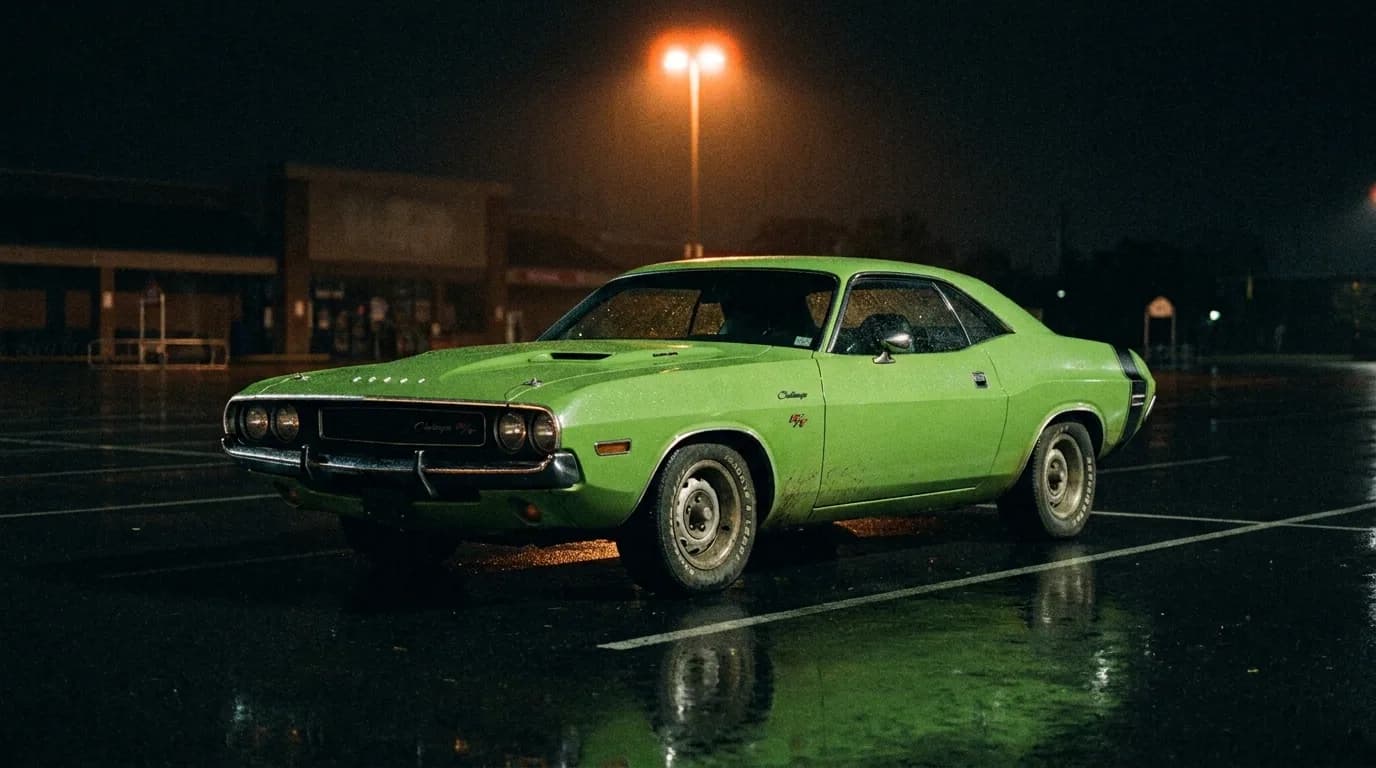
Dodge showed up late to the pony car fight that Mustang and Camaro had been running for years, then made the delay count: a bigger, more athletic body, an engine lineup that topped out with the 426 Hemi, and paint colors loud enough to argue the wait was worth it. The render above is AI-generated, but the mood is the one the 1970 Challenger R/T was built to earn: wet asphalt, one sodium streetlight, a Sublime-green R/T sitting low in an empty lot.
Dodge's Answer to the Pony Car Wars
Dodge had watched Plymouth's Barracuda and Ford's Mustang duke it out through the 1960s without a true pony car of its own, so for 1970 Chrysler built the E-body platform specifically to fix that — sharing its basic architecture with the redesigned Barracuda but stretching the Challenger's wheelbase to 110 inches, two inches longer than its Plymouth sibling. That extra length, along with standard quad headlights and a plusher available interior, was a deliberate move upmarket, chasing the same plusher pony-car buyer the Mercury Cougar had already proven was out there. The Barracuda, by contrast, kept its two-headlight face for every year but 1971. The Challenger launched in hardtop and convertible body styles, with the R/T performance package sitting at the top of the range — Dodge moved 76,935 Challengers in the model's debut year, and the R/T accounted for roughly one in four of them.
What Made It an R/T
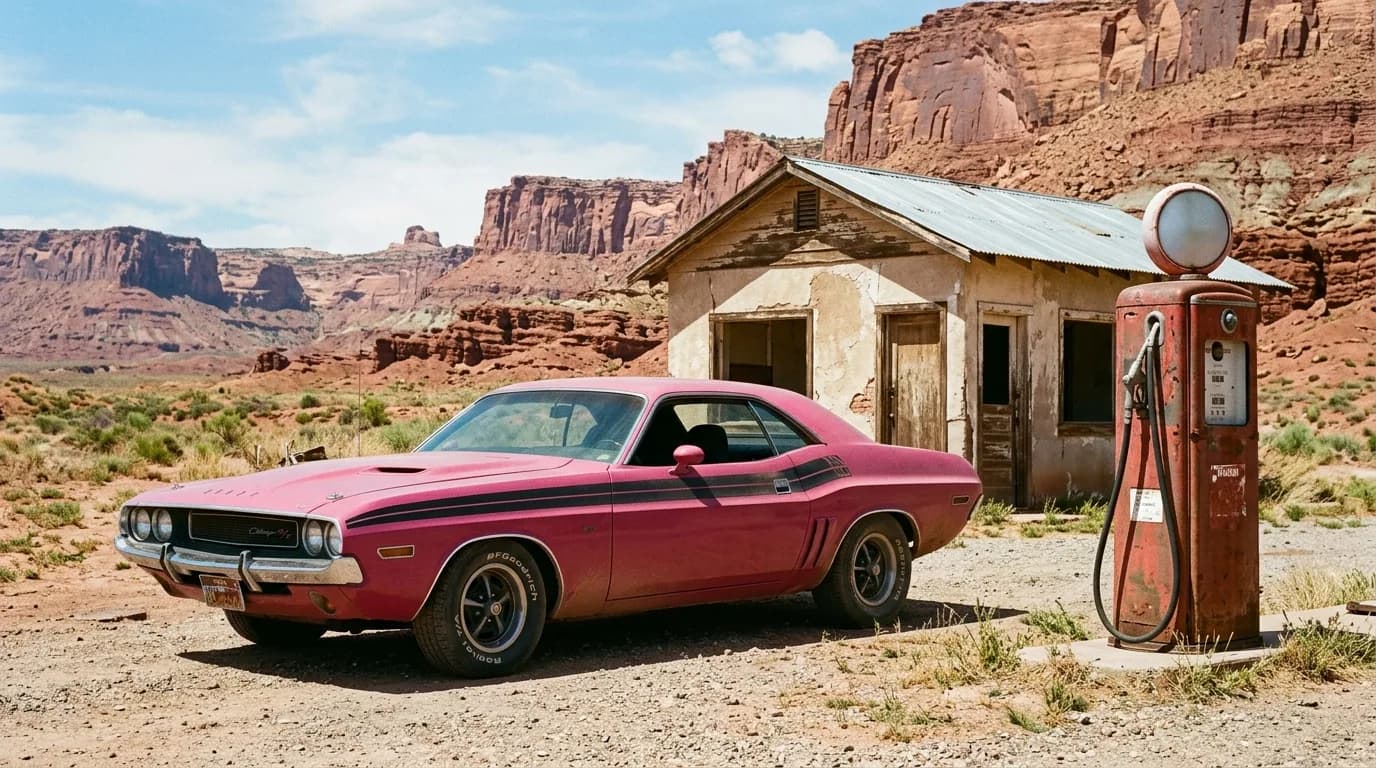
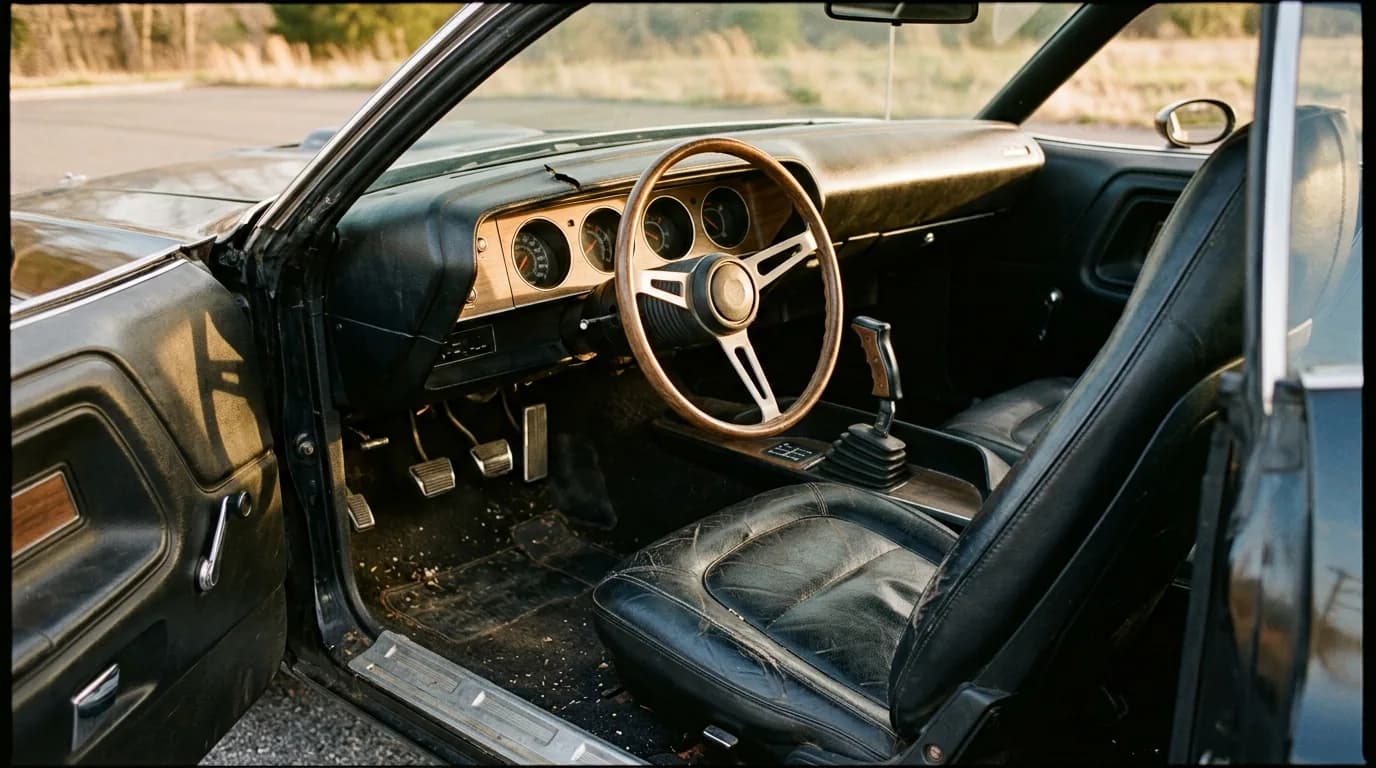
Order the R/T and the Challenger came standard with a 383 cu in Magnum V8, a Rallye instrument cluster with a 150-mph speedometer and 8,000-rpm tachometer, Rallye suspension with a beefed-up sway bar, and heavy-duty drum brakes to help rein in the extra power. A low-profile, non-functional twin-scoop hood was standard, while the theatrical Shaker scoop — poking through the hood and moving with the engine — was a $97 option paired with the 440 and Hemi engines. Dual exhaust and R/T badging, including the bumblebee-style tail stripe, rounded out the package. Buyers could step up to the dressier R/T SE, with its smaller rear window and vinyl roof, or go the other direction entirely with the convertible, of which Dodge built just 963 for the year — making the drop-top R/T the rarest body style regardless of engine.
Four Engines, One Big Decision
The standard 383 Magnum made 335 hp, plenty for a car that already looked the part. From there, Dodge offered the 375-hp 440 Magnum, the 390-hp 440 Six Pack with its triple two-barrel carburetors, and finally the 425-hp, 490 lb-ft 426 Hemi — the same engine terrorizing NASCAR ovals that same season. The Hemi was a rare order in a Challenger: Dodge built only 356 of them for 1970, split between 287 hardtops, 60 R/T SEs, and just nine convertibles, the rarest combination in the entire 1970 Challenger lineup.
Screaming Colors and a Hollywood Chase
For $15, Dodge would paint an R/T in one of its High Impact colors — Sublime green, Plum Crazy purple, Go Mango orange, and the spring-only Panther Pink, worn by only about 340 Challengers that year. They weren't subtle, and that was the point: a High Impact Challenger wasn't a car you drove to blend in. The model got a very different kind of visibility a year later in Vanishing Point (1971), where a white 440 Magnum R/T carries car-delivery driver Kowalski across the Southwest in one of the era's defining car-chase films — by most accounts five Alpine White Challengers were used during filming, four of them running the 440 with a 4-speed manual.
Finding One Today
A 383 or 440 Challenger R/T is a genuinely attainable classic, but Hemi cars are a different world entirely — with so few built, documentation matters more than almost anything else on the car. Ask for the fender tag and broadcast sheet before anything else, especially on a car advertised as a Hemi or wearing a High Impact color, since both are among the most commonly faked details in the Mopar hobby. Beyond paperwork, the usual E-body checkpoints apply: inspect the torsion bar crossmember and trunk floor for rust, and confirm the partial VIN stamped on the engine block and the fender tag actually match the engine sitting under that shaker hood before the color and the badge do the rest of the talking.
Specs
- Wheelbase
- 110 in (2 in longer than the Barracuda)
- R/T production (1970)
- 18,512 units — hardtop, SE, and convertible
- Standard engine
- 383 cu in Magnum V8 — 335 hp
- Optional engines
- 440 Magnum (375 hp), 440 Six Pack (390 hp), 426 Hemi (425 hp / 490 lb-ft)
- 426 Hemi production (1970)
- 356 total — 287 hardtop, 60 R/T SE, 9 convertible
- High Impact color option
- $15; Sublime, Plum Crazy, Go Mango, Panther Pink (about 340 cars)
- Transmission
- 3-speed manual standard; 4-speed manual or 3-speed automatic optional
- Movie fame
- White 440 Magnum R/T driven by Kowalski in Vanishing Point (1971)
Get the Look
As an Amazon Associate we earn from qualifying purchases.
A shelf-scale stand-in for studying the E-body's proportions and stripe graphics.
Check price at AmazonBackground reading on the E-body's short but intense run against the Mustang and Camaro.
Check price at AmazonRetro wall art for a Mopar corner of the garage.
Check price at AmazonBasic dust protection for a garage-kept classic between drives.
Check price at AmazonSuited to keeping original bucket seats and dash vinyl from cracking further.
Check price at AmazonFAQ
- What engines were available in the 1970 Dodge Challenger R/T?
- The R/T came standard with a 335-hp 383 Magnum V8, with the 375-hp 440 Magnum, 390-hp 440 Six Pack, and 425-hp 426 Hemi available as options.
- What is the difference between a 1970 Dodge Challenger and a Plymouth 'Cuda?
- Both share Chrysler's E-body platform, but the Challenger rides a 110-inch wheelbase versus the Barracuda/'Cuda's 108 inches, has standard quad headlights, and was positioned as the more upscale of the two — aimed at buyers the Mercury Cougar was drawing away from Ford.
- How many 1970 Challenger R/Ts had the 426 Hemi?
- Dodge built only 356 Hemi Challengers for 1970 across all R/T body styles — 287 hardtops, 60 R/T SEs, and just 9 convertibles, making the convertible the rarest of the bunch.
- What movie made the 1970 Dodge Challenger R/T famous?
- Vanishing Point (1971) starred a white 440 Magnum-powered Challenger R/T driven across the American Southwest by the character Kowalski, cementing the car's outlaw reputation.