1970 Chevelle SS 454 vs. Plymouth Road Runner: Two Ideas of Cheap Speed
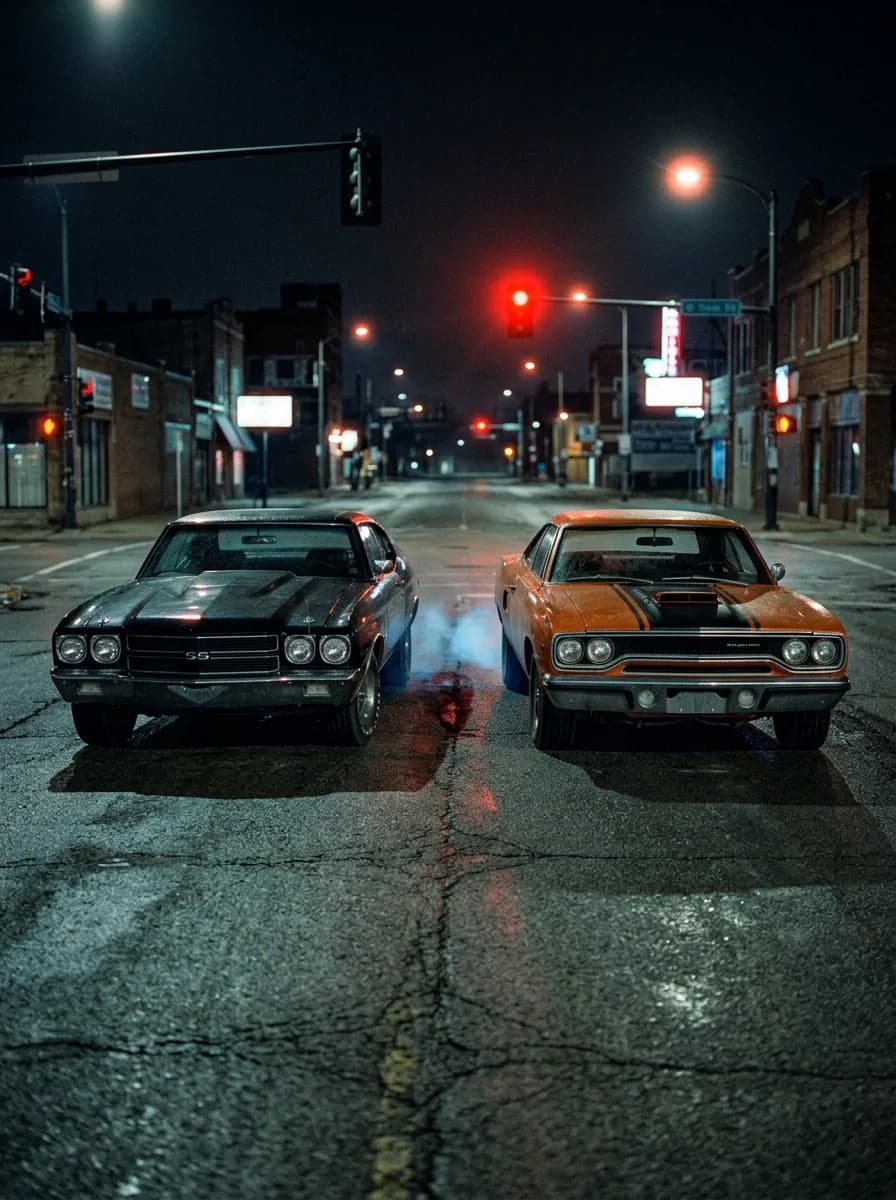
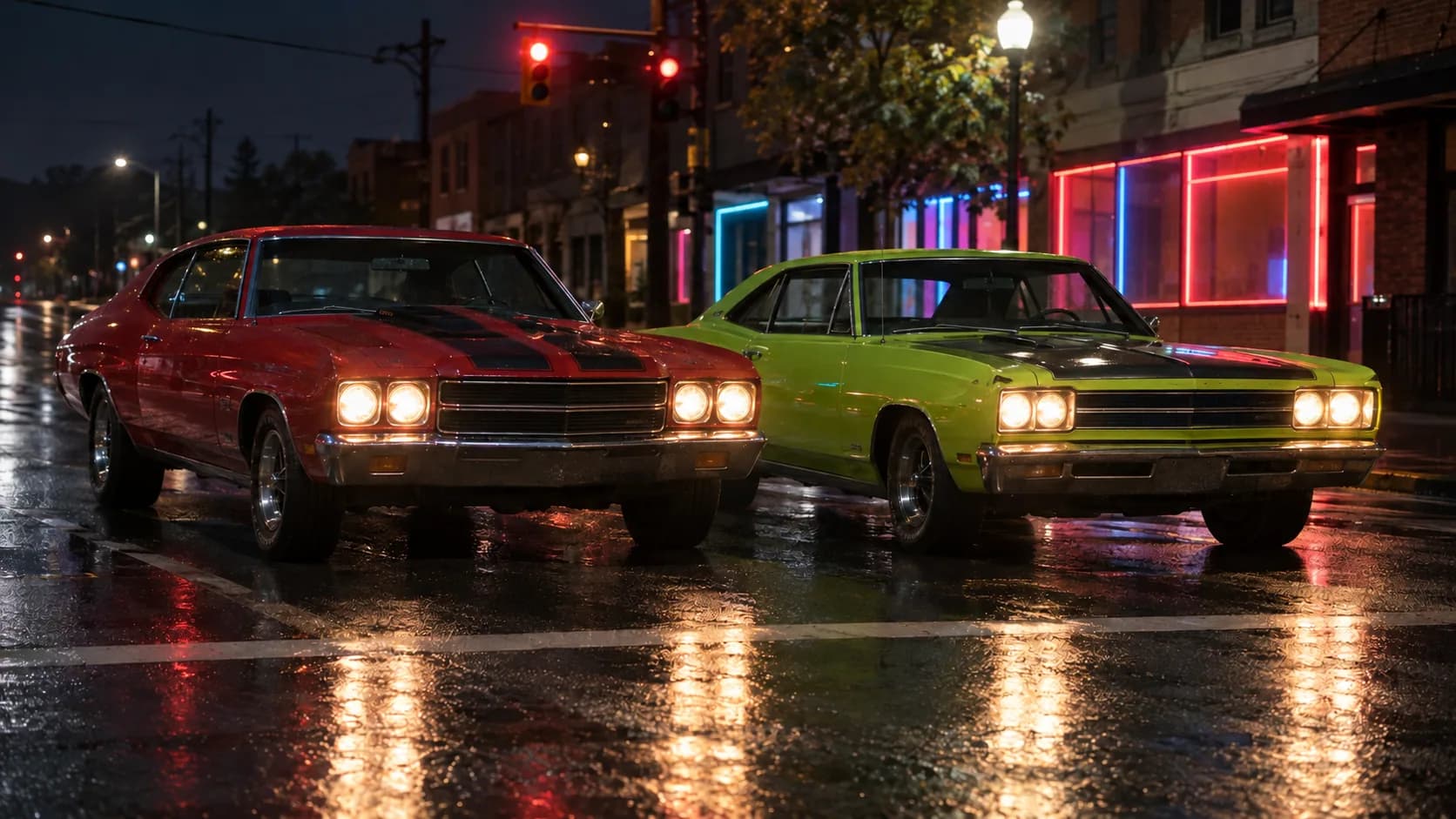
Which was the better deal in 1970: a $3,034 Road Runner, or a Chevelle SS 454 that cost a good deal more? Both were built to go fast for a reasonable price, but "reasonable" meant something different at Chevrolet than it did at Plymouth. The AI render above squares the two off at a stoplight, engines lit, exactly the kind of matchup that played out for real on American streets that year.
Two Different Ideas About Cheap Speed
Plymouth built the Road Runner around a simple premise: strip out the chrome and the comfort options, keep the big engine, and sell a genuine muscle car for less than almost anything else with a big-block under the hood. The interior showed it — a basic bench seat, rubber floor mats instead of carpet in the cheapest versions, no console even with the four-speed manual, and none of the power accessories buyers could pile onto pricier Mopars. The 1970 Road Runner started at $3,034. Chevrolet's approach with the Chevelle SS ran the other direction — the SS package was built on the better-trimmed Malibu body, with carpeting, upgraded upholstery, and a longer options list as the starting point, and the 454-cubic-inch SS 454 option (RPO Z15) added roughly $503 on top of that. By the time a buyer optioned an LS6-powered Chevelle with a four-speed manual, the total could push toward $5,000 — real money for a mid-size car in 1970.
A Cartoon Licensing Deal That Became a Legend
Plymouth paid Warner Bros. roughly $50,000 to license the name and likeness of the Road Runner cartoon character, plus a per-car royalty on top of that. The payoff was the horn: a novelty "beep beep" unit, developed at a reported cost of $10,000, tuned deliberately away from the cartoon's actual "meep meep" call to sidestep a dispute over the character's protected voice. It became the car's signature feature — a $50,000 joke that Plymouth buyers loved enough to help move roughly 41,500 Road Runners in 1970 alone.
Engines: Six-Pack and Hemi vs. LS5 and LS6
Road Runner buyers started with a 383 cubic-inch V8 rated at 335 horsepower, stepped up to the 440 Six Barrel (three two-barrel carburetors) at 390 horsepower, or went all the way to the 426 Hemi at 425 horsepower. On the Chevelle side, the SS package could still be had with the 396-badged big block (actually bored to 402 cubic inches by 1970) making 350 horsepower, or stepped up into 454 territory with the LS5 at 360 horsepower and 500 lb-ft of torque, or the top-shelf LS6 at 450 horsepower and 500 lb-ft — widely considered the most powerful engine GM put in a production car during the muscle car era.
Cold Air, Two Different Ways
Both cars offered factory cold-air induction, and both leaned into showmanship while doing it. The Road Runner's "Air Grabber" scoop, redesigned for 1970 with vacuum operation, let the driver push a button under the dash to snap open a flap on the hood and expose a scoop feeding cold air straight to the carburetor — complete with cartoonish shark-teeth decals on the scoop opening when it was up. The Chevelle countered with the $147 Cowl Induction hood (RPO ZL2), available on both the 396 and 454 cars, which used a flapper at the base of the windshield that opened under full throttle to pull cooler, denser air off the cowl; it came bundled with bold dorsal hood stripes, though buyers could delete them if they wanted the sleeper look.
Who Each Car Was Really For
The Road Runner was aimed at a buyer who wanted the quickest car available for the least money and didn't mind vinyl seats and minimal sound-deadening — often a younger buyer, cross-shopping against the pricier GTX from the same Plymouth showroom. The Chevelle SS 454 targeted someone willing to pay for a more finished car — better trim, a wider options list, the Malibu's more composed ride — who still wanted the biggest engine Chevrolet built. Neither buyer was wrong; they were shopping for different things that happened to both be very fast.
Owning One Today
The gap in original pricing has flipped into a gap in collector value. A numbers-matching 1970 LS6 Chevelle in top condition is valued at roughly $263,000 in Hagerty's price guide, and documented convertibles have sold at auction for $600,000 or more (Mecum), putting either well out of reach for most enthusiasts — and it's genuinely rare, with only about 4,475 LS6 engines built for the model year across Chevelles and El Caminos combined, and roughly 300 surviving examples of all body styles tracked by the LS6 registry today. The 426 Hemi Road Runner is similarly rarefied — Plymouth built only 152 of them across hardtop, pillared coupe, and convertible body styles that year. A base 383 Road Runner or an LS5-powered Chevelle SS 454, by contrast, remain far more attainable entry points into either car's history — much the same role the cheaper versions of both cars played when they were new.
Specs
- 1970 Road Runner base price
- $3,034
- Road Runner engines
- 383 (335 hp) · 440 Six Barrel (390 hp) · 426 Hemi (425 hp)
- 1970 Hemi Road Runners built
- 152 (75 hardtop, 74 coupe, 3 convertible)
- Chevelle SS 454 option (RPO Z15)
- about +$503 over Malibu SS price
- Chevelle SS 454 engines
- LS5 (360 hp / 500 lb-ft) · LS6 (450 hp / 500 lb-ft)
- Chevelle SS 396/402 engine
- L34, 350 hp
- 1970 Road Runner production
- about 41,500 units
FAQ
- Which was cheaper, the 1970 Road Runner or the Chevelle SS 454?
- The Road Runner, by a wide margin. It started at $3,034, while the Chevelle SS 454 package added roughly $503 on top of a better-trimmed Malibu body, pushing the total well past the Road Runner's base price.
- Which had the more powerful engine, the LS5 or LS6 Chevelle SS 454?
- The LS6, rated at 450 horsepower and 500 lb-ft of torque, versus the standard LS5's 360 horsepower at the same 500 lb-ft.
- Why does the Road Runner have a 'beep beep' horn?
- Plymouth licensed the Road Runner name and likeness from Warner Bros. for around $50,000, and built a novelty horn tuned to echo the cartoon character's call as part of the deal.
- How rare is a 1970 426 Hemi Road Runner?
- Very. Plymouth built only 152 of them for 1970 across hardtop, pillared coupe, and convertible body styles combined.
Know someone who drove one? Share this guide
Get the Look
As an Amazon Associate we earn from qualifying purchases.
- 1970 Plymouth Road Runner 1:24 Diecast Model Car — The budget-muscle side of the matchup, at shelf scale.
- 1970 Chevelle SS 454 1:24 Diecast Model Car — The better-trimmed answer to the Road Runner.
- Muscle Car Era History Book (Mopar vs. GM) — Background on the Mopar-vs-GM rivalry of the early '70s.
Sources
- hagerty.com — budget-muscle-the-plymouth-road-runner-started-a-trend
- hotcars.com — how-plymouth-road-runner-pack-beep-beep-horn-works
- hotcars.com — 50000-secret-hidden-road-runners-horn
- ultimatemusclecar.com — 1970-plymouth-road-runner-engine-options-and-specifications
- conceptcarz.com — plymouth-road-runner.aspx
- musclecarfan.com — plymouth-built-just-152-hemi-road-runners-in-1970-only-16-skipped-the-clutch-pedal
- heacockclassic.com — the-best-muscle-car-1970-ls6-chevelle
- sportscarmarket.com — 1970-chevrolet-chevelle-ss-454-ls6
- hagerty.com — 1970-chevrolet-chevelle-ss_454
- autoevolution.com — 1970-chevrolet-chevelle-ls6-sells-for-396000-fails-to-set-new-record-240894
- over-drive-magazine.com — 1970-chevrolet-mid-size-cars-fact-sheet
- ls6registry.com — models_sold
- chevellestuff.net — options_by_cost
- moparconnectionmagazine.com — the-ultimate-stoplight-intimidator-air-grabber-fresh-air-induction