Mack Superliner (1977-1993): E9 V8, Specs and History
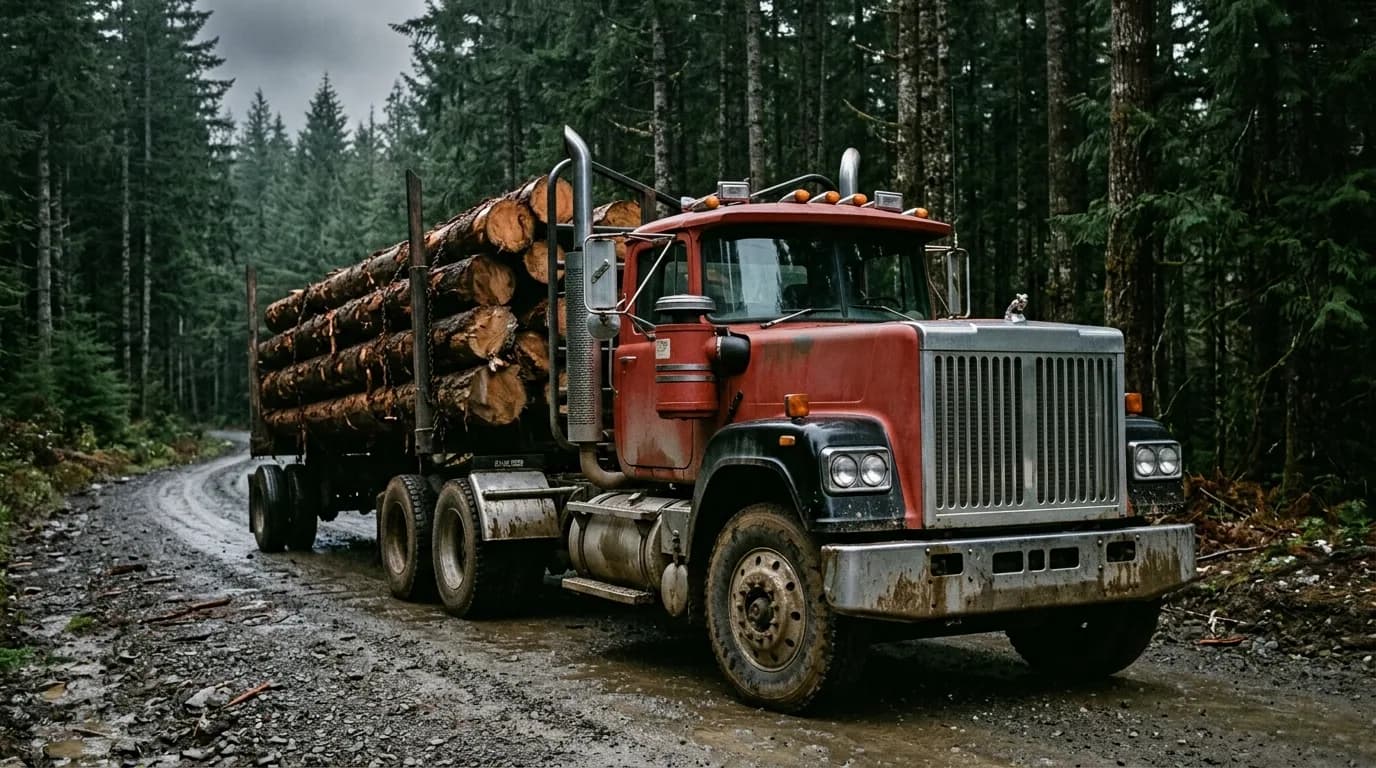
Mack's own spelling has the hyphen, but when fans say Super-Liner they usually mean the E9: a turbocharged V8 of 998 cubic inches under a long hood. The AI render above has a red Mack hauling a trailer of logs down a wet gravel road, mud on the bumper, tall stacks rising behind the cab, dark firs crowding both sides. It is a fair picture of the truck Mack built for owners who wanted a lot of engine, the company's flagship conventional in North America from 1977 to 1993.
A Bigger Hood on the R-Series Cab
The Super-Liner started with a simple idea: a bigger hood. Wikipedia traces its development to the early 1970s at Brockway, a Mack subsidiary, around a squared-off hood that could fit a larger radiator and engine, though Tenfour Magazine calls the Brockway link a debate among Mack and Brockway fans. Brockway closed in 1977, and Mack carried on with a set-forward-axle version that entered production by the end of 1977 as the RW700, the W standing for Western.
The cab came straight from the R series, the model Mack brought out in the mid-1960s to replace the B series we cover in our Mack B-61 guide, and the chassis used the frame of the WR Cruise-Liner cab-over. That R-series cab was already modern for its day, with an air-ride mounting and an almost vertical windshield, so the Super-Liner was really an R cab behind a bigger, squarer hood with more horsepower on the order sheet.
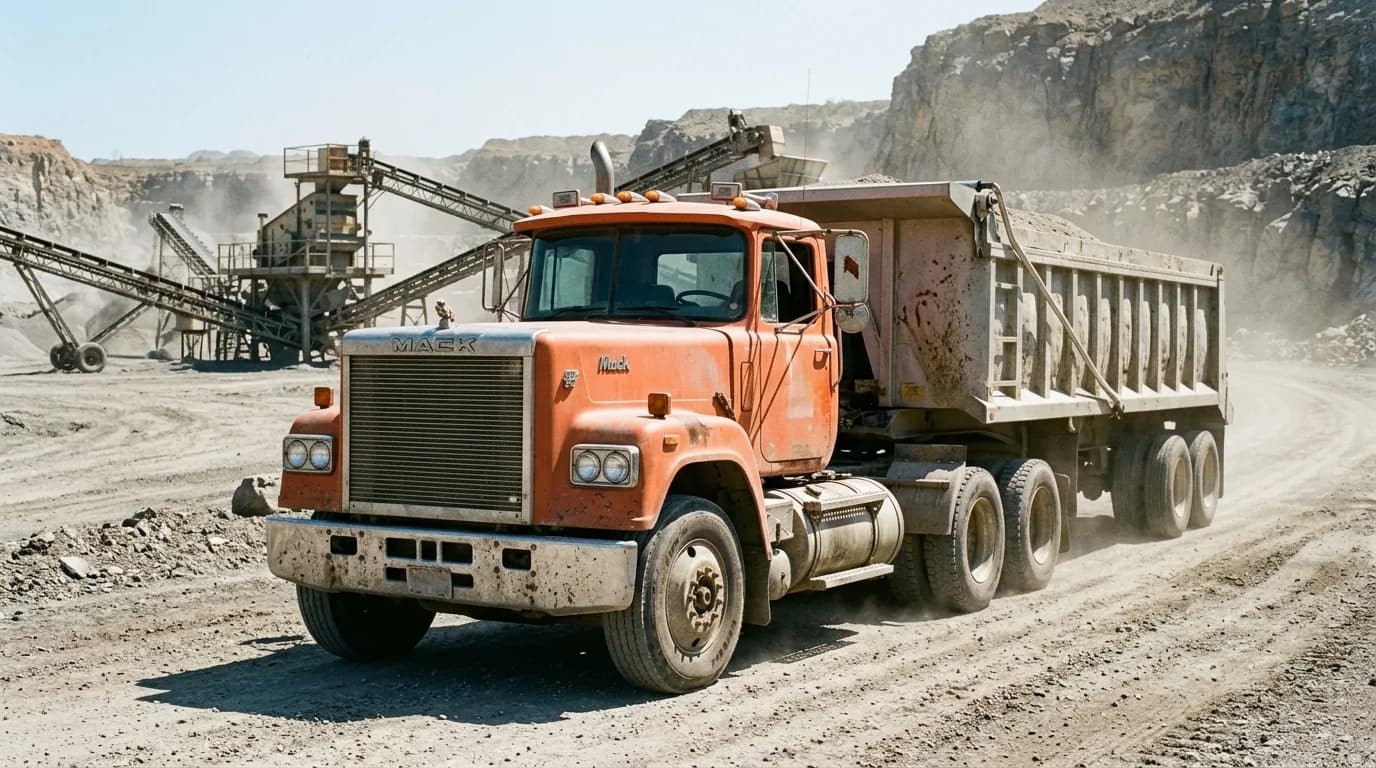
Engines: Maxidyne Sixes and the E9 V8
Mack did not lock Super-Liner buyers into one engine. Tenfour Magazine lists the E6 Maxidyne and Econodyne inline-sixes as the most common choices, plus aftermarket power such as Cummins, the Mack E7 later on, and Mack's own E9 V8.
The Maxidyne is the Mack engine to know after the Thermodyne of the B-61 era. It arrived in 1966 with the R series, and the original 11-liter inline-six, the ENDT 675, is listed at 237 hp and 906 lb-ft of torque, with peak torque arriving at a very low 1,000 to 1,200 rpm depending on the source. Jalopnik puts its torque rise at about 52 percent, against 15 to 20 percent for typical engines of the day, which let a heavy truck get by with a simple five-speed Maxitorque transmission instead of ten or more gears.
The V8 is what most fans mean when they say Super-Liner. Mack had built V8 diesels before: Wikipedia's Mack F series engine table lists a V8 Maxidyne 865 that actually displaced 866 cubic inches (14.2 liters) and made 322 hp. The E9 went much bigger, a turbocharged V8 of 998 cubic inches (16.4 liters). Trucksales says the fourth Australian-built Super-Liner, built in July 1979 for Bromage Tankers, was the first to carry Mack's own V8, an engine that would evolve into the E9, and by the 1985 Magnum edition the E9 was offered at 400, 450 or 500 horsepower.
Super-Liner II and the Magnum
Mack reworked the truck for the mid-1980s. Wikipedia dates the Super-Liner II to 1985, while Tenfour Magazine says 1984, so call it a 1984-85 changeover. The round headlights gave way to four square lights, the frame switched to the full-length rails of the MH Ultra-Liner cab-over, and the three-spoke steering wheel gave way to a smaller two-spoke.
To launch the new truck, Mack built a Magnum special edition for 1985: 250 in total, 186 of them Super-Liner IIs and 64 Ultra-Liner cab-overs. Magnums wore black paint with red and orange striping and a red interior, and came with the E9 V8 and a nine-speed Mack T2090 transmission. Mack offered the Magnum Super-Liner with a 36-inch or a 60-inch flat-top sleeper built by Able-Body.
How to Tell One Apart
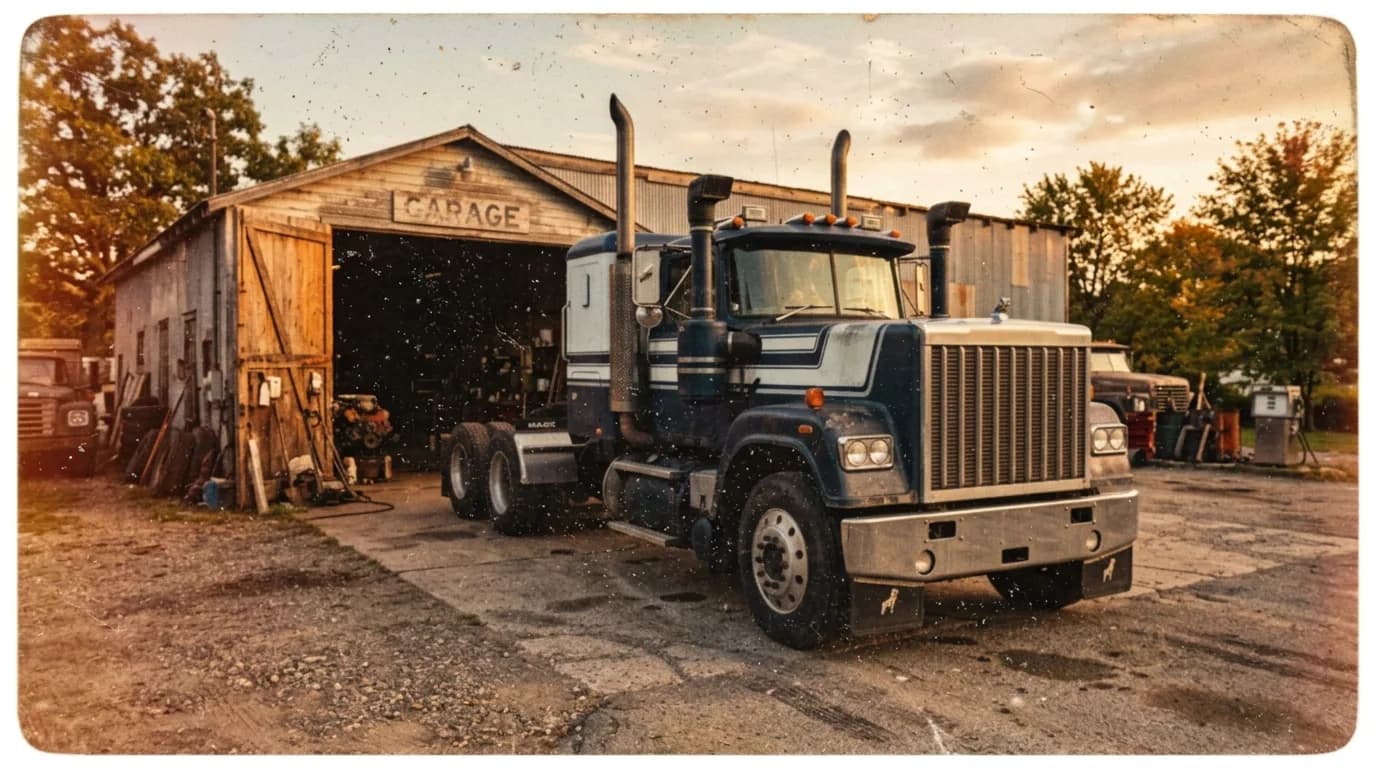
Start with the face. A first-generation truck, 1977 to about 1984, has four round headlights in rectangular housings, which is how the renders here draw it. A Super-Liner II has four square headlights. After that, look for the R cab's upright windshield behind a bigger, squarer hood than the R model's, and check whether the truck is a day cab or carries a sleeper. A black truck with red striping and an E9 under the hood is a Magnum, one of only 186 Super-Liner IIs built that way.
After 1993: The Name Lives On in Australia
North American production ended in 1993, and the CL700 replaced the Super-Liner. In Australia the story kept going. Mack Trucks Australia dates the Australian release to 1980, though Trucksales says the first Australian-built truck, an RW700RSX, was delivered to Cleary Bros at Port Kembla in 1979, and about 370 Super-Liners had been delivered by 1986. Trucksales dates the Australian Super-Liner II to 1986, with a 500 hp E9 V8 as standard, and in 1988 Mack released just 16 Bicentennial Super-Liner IIs painted in brown, green and gold.
Trucksales also reports that the nameplate was retired around 1991, that Mack's CLR replacement was less loved by Mack fans, and that Mack revived the Super-Liner in 1993, with Titan and Trident versions following in 1995 and 1998. Under Volvo ownership in 2008 the truck gained the 16-liter MP10 at 685 hp, and Trucksales says it is now offered with a 17-liter MP11 rated at 780 hp. In 2025 the magazine counted a 45-year life, and counting.
Specs
- North American production
- 1977–1993
- Origin
- RW700: R-series cab on a set-forward-axle chassis; development reportedly began at Brockway
- First generation
- 1977 to about 1984; four round headlights in rectangular housings
- Super-Liner II
- Introduced 1984–85 (sources differ); four square headlights, MH Ultra-Liner frame rails
- Engines offered
- Mack E6 Maxidyne and Econodyne inline-sixes, later E7, Cummins and other aftermarket diesels, and the E9 V8
- E9 V8
- 998 cu in (16.4 L) turbocharged V8; 400, 450 or 500 hp in the 1985 Magnum
- Magnum special edition
- 1985; 250 built (186 Super-Liner II, 64 Ultra-Liner)
- Afterlife
- CL700 replaced it in North America after 1993; the Super-Liner name continues in Australia
FAQ
- What years was the Mack Superliner made?
- The Mack Super-Liner was built in North America from 1977 to 1993. Mack Trucks Australia dates the Australian release to 1980 (the first truck was delivered in 1979), and the name is still in use there today.
- What engine does a Mack Superliner have?
- Buyers could choose Mack's E6 Maxidyne or Econodyne inline-six, later the E7, aftermarket diesels such as Cummins, or the E9 V8, a 998-cubic-inch (16.4-liter) turbocharged engine rated 400 to 500 hp in the 1985 Magnum.
- What is the difference between a Super-Liner and a Super-Liner II?
- The Super-Liner II arrived in the mid-1980s (1984 or 1985, depending on the source) with four square headlights in place of the original four round ones, the full-length frame rails of the MH Ultra-Liner cab-over, and a smaller two-spoke steering wheel.
- Is the Mack Superliner still made?
- Not in North America, where the CL700 replaced it after 1993. Trucksales reported the Super-Liner still in production in Australia in 2025.
Know someone who drove one? Share this guide
Get the Look
As an Amazon Associate we earn from qualifying purchases.
- Mack Super-Liner 1:50 or 1:43 scale die-cast truck — A shelf-size version of Mack's long-hood flagship.
- Mack Trucks history book — For the story of the bulldog brand behind the Super-Liner.
- 1:32 scale logging truck model — For the log-hauling scene in the render above.
Sources
- en.wikipedia.org — Mack_Super-Liner
- en.wikipedia.org — Mack_R_series
- en.wikipedia.org — Mack_F_series
- en.wikipedia.org — Mack_Trucks
- tenfourmagazine.com — a-terrific-trio
- trucksales.com.au — mack-super-liner-spotlight-australias-outback-icon-150218
- jalopnik.com — diesel-mack-maxidyne-1966-constant-horsepower-trucks
- macktrucks.com.au — 1980-1989
- tradetrucks.com.au — why-the-mack-super-liner-has-one-of-the-biggest-names-in-trucking
- hcvc.com.au — 3211-mack-engines