Mack V8 Diesel: E9, Maxidyne and Specs
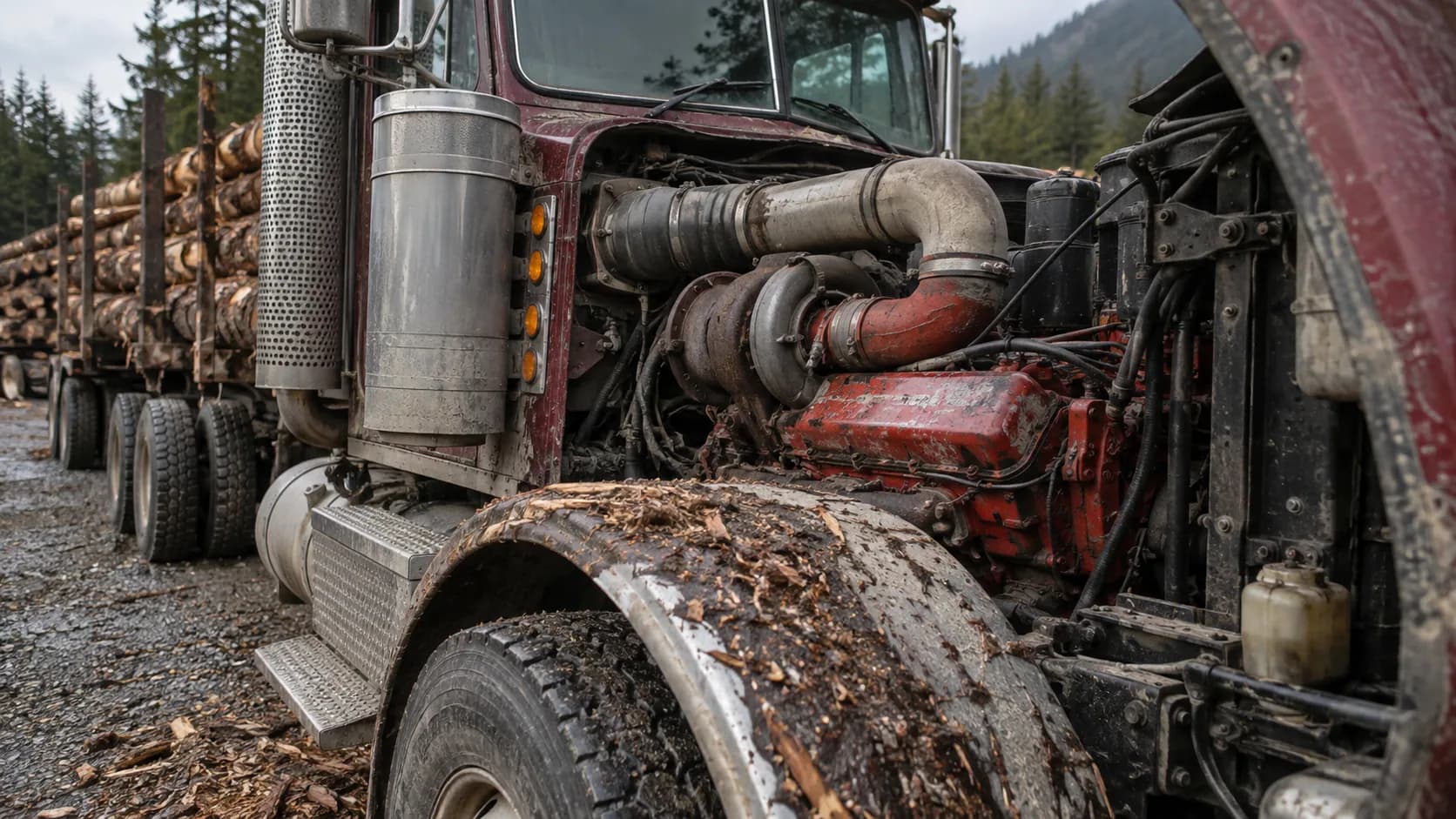
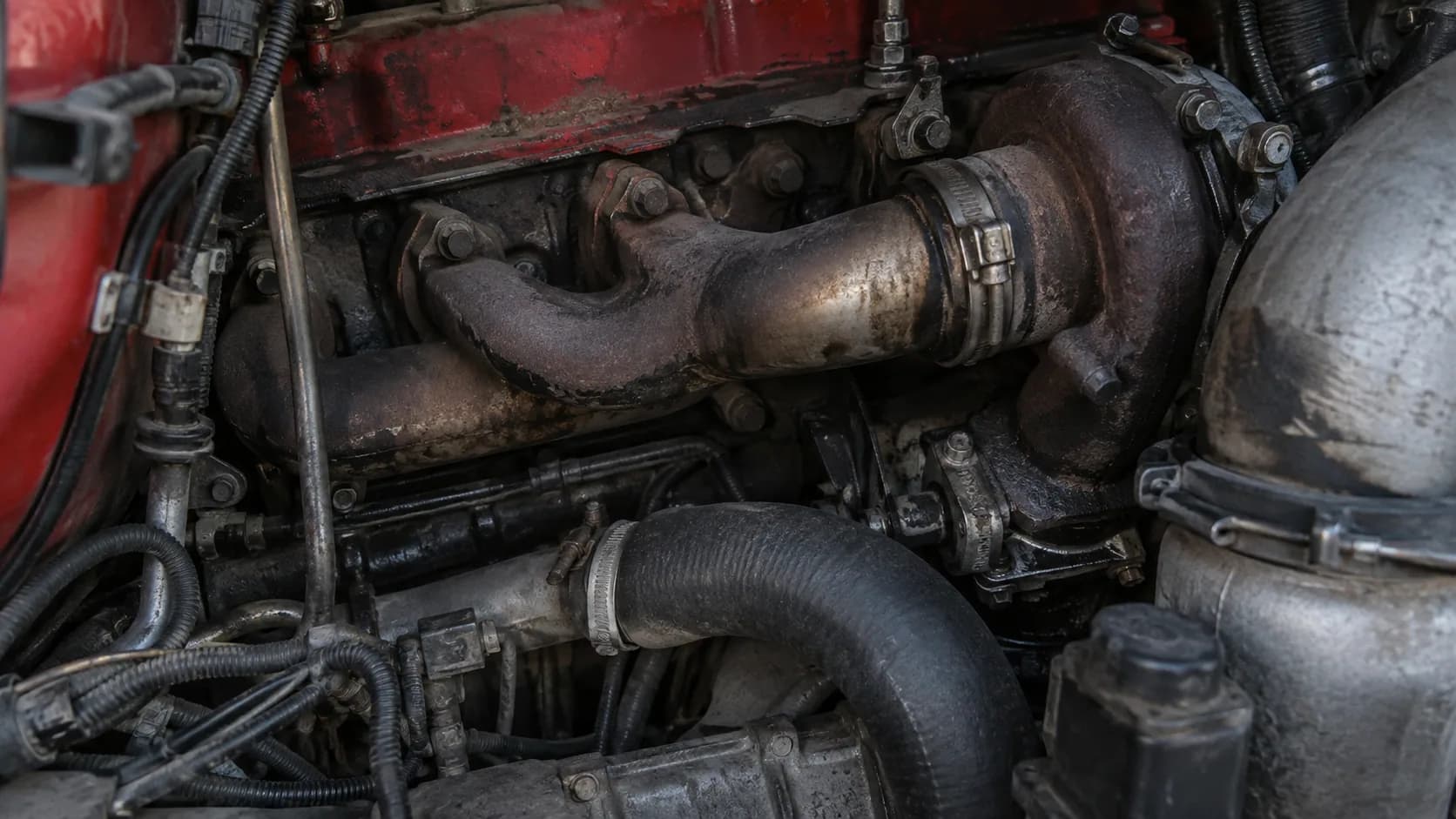
Open the hood on a big Mack and every so often you find a V8 where other brands put six cylinders in a row. The AI render above imagines exactly that: a mud-streaked dark red long-hood parked beside a stack of logs, the engine bay open on a red V8 with a fat turbocharger and a silver pipe arching across the top. It is not a real truck, but it is a fair picture of what people mean when they search for the Mack V8, a family of big diesels that grew from 864 cubic inches in the early 1960s to the 998 cubic inch E9 that became the best known of them.
The First Mack V8: 1962
According to Curbside Classic's history of the engine, Mack introduced its first V8 diesel, the END 864, in 1962, and discussions on the BigMackTrucks forum give the same year. It displaced 864 cubic inches, about 14.2 liters. A Mack manual dated August 1969, quoted on that forum, lists the END 864 at 255 hp at 2,300 rpm, the END 864B at 270 hp and the turbocharged ENDT 864 at 300 hp. Ratings shifted over the years and other figures circulate for the turbo engine, so treat any single number as a snapshot rather than a final word. The ENDT 864 was the predecessor of the ENDT 865 and ENDT 866 V8s.
The Maxidyne V8: ENDT 865
Wikipedia's Mack history says Mack introduced its innovative Maxidyne inline-six in 1966, followed by a V8 version in 1970. The Maxidyne idea was a wide, flat power band: it let a heavy Class 8 truck work with a five-speed Maxitorque transmission instead of a long gearbox. Wikipedia's Mack F series table lists the Maxidyne 865 at 866 cubic inches (14.2 liters) and 322 hp at 2,100 rpm.
An SAE paper presented in Montreal in June 1971 describes the ENDT 865 as the V8 follow-up to the ENDT 675 six. It covers a new injection pump, a simplified oil system, a single turbocharger and an essentially constant horsepower characteristic, and its second part is devoted to the built-in Mack Dynatard engine brake.
From the ENDT 1000 to the E9
The V8 got a lot bigger in the late 1970s. The ENDT 1000 displaced 998 cubic inches (16.4 liters). Forum discussions on BigMackTrucks describe it as field-tested in the early 1970s and in production by the late 1970s, but the dates vary by variant, and no single first-build year is well documented. When Mack simplified its engine names, the 998 became the E9. Wikipedia's R series article says the numbering had changed by 1988, with the "9" standing for the 998 cubic inch (16.4 L) V8.
In the United States the E9 was offered in a range of about 400 to 500 hp. Wikipedia's Super-Liner entry gives that range for the 1985 Magnum special edition, and a TenFour Magazine feature on Magnum trucks mentions 400, 450 and 500 hp ratings.
Which Trucks Carried It
The E9 was never a mass-market engine, so spotting one in the wild is part of the fun. Its best-known home was the Super-Liner, and the R series list of engine codes includes the V8 as well. If you want the older Mack background before any of this, our Mack B-61 guide covers the Thermodyne diesel era that came before the R series. For the truck most owners associate with the E9, read our Mack Superliner guide, which covers the 1977 to 1993 long-hood, its Magnum edition and the Australian afterlife.
Australia: Where the E9 Kept Growing
In Australia the engine became the electronic EA9, the "A" marking an Australian engine, according to Roadtrains.com.au. The same site says the mid-1990s EA9 made over 600 horsepower with 2,050 lb-ft of torque, at a time when most truck makers could supply only up to 550 hp. Trucksales.com.au describes a Super-Liner Titan with a 575 hp EA9 and 1,925 lb-ft, and a 610 hp version that it says did not always match the longevity of the older engines. Wikipedia's Mack Titan entry says the 16.4-liter V8 was offered at 610 hp (455 kW) and 2,050 lb-ft (2,780 N-m) until about 2000 or 2001.
When Did It End?
Curbside Classic dates the Mack V8 line from 1962 to 2003 and says Mack gave up on the big V8 in 2003. Other sources point earlier: Wikipedia's Titan entry has the top Australian rating ending around 2000 or 2001, and TenFour Magazine notes that the last Super-Liner left the line in 1993. No published source settles a single last-build date, so treat the end of the story as a range, with the early 2000s as Curbside Classic's answer. By that account the family ran about four decades, from an 864 cubic inch newcomer to a 998 cubic inch engine with a sound all its own.
Specs
- First Mack V8 diesel
- END 864, 1962; 864 cu in (about 14.2 L)
- END 864 / ENDT 864 output
- 255 hp (END 864); 300 hp (turbo ENDT 864), per a 1969 Mack manual quoted on a forum
- Maxidyne V8 (ENDT 865)
- Introduced 1970; 866 cu in (14.2 L), listed at 322 hp
- ENDT 1000 / E9
- 998 cu in (16.4 L) turbocharged V8; late 1970s production, E9 name by 1988
- E9 ratings, US
- About 400 to 500 hp
- EA9, Australia
- 575 hp (1,925 lb-ft) and 610 hp (2,050 lb-ft)
- Trucks
- F series (Maxidyne 865), R series, Super-Liner, Titan (Australia)
- End of the line
- Around 2003 per Curbside Classic; sources differ
FAQ
- When did Mack build its first V8 diesel?
- Mack introduced its first V8 diesel, the END 864, in 1962, according to Curbside Classic. It displaced 864 cubic inches and was followed by the Maxidyne ENDT 865 V8, which Wikipedia dates to 1970.
- How big is the Mack E9 engine?
- The Mack E9 is a turbocharged V8 of 998 cubic inches, or 16.4 liters. It grew out of the ENDT 1000, which had the same displacement.
- How much horsepower does a Mack E9 make?
- In the United States the E9 was offered at roughly 400 to 500 hp, according to Wikipedia. In Australia the electronic EA9 reached 610 hp (455 kW) with 2,050 lb-ft of torque.
- Does Mack still make a V8 diesel?
- Not in North America. Curbside Classic says Mack gave up on its big V8 in 2003, and Mack's recent engines such as the MP10 are inline-sixes.
Know someone who drove one? Share this guide
Get the Look
As an Amazon Associate we earn from qualifying purchases.
- Mack R-model or Super-Liner 1:64 die-cast truck — A shelf-size Mack long-hood.
- Mack Trucks history book — For the story of the bulldog brand and its engines.
- 1:32 scale logging truck model — For the log-yard scene in the cover render.
Sources
- curbsideclassic.com — the-legendary-mack-v8-diesel-engine-1962-2003-big-power-with-a-distinctive-sound-and-its-scania-v8-offspring-is-still-going-strong
- en.wikipedia.org — Mack_Trucks
- en.wikipedia.org — Mack_F_series
- en.wikipedia.org — Mack_R_series
- en.wikipedia.org — Mack_Super-Liner
- en.wikipedia.org — Mack_Titan
- saemobilus.sae.org — 710557
- bigmacktrucks.com — 42796-mack-v8s-before-the-e9
- bigmacktrucks.com — 37177-seeking-a-little-history-on-versions-of-e9
- bigmacktrucks.com — 46588-production-of-v-8-maxidyne-under-way-by-mack-trucks
- roadtrains.com.au — 2500-hp-v8-mack-drag-truck-remembered
- tenfourmagazine.com — content
- trucksales.com.au — buying-used-mack-titan-133378
- bigmacktrucks.com — 3857-horsepower-rating-for-turbo-charged-864-v8