Cabover vs Conventional Semi Trucks: Why Cabovers Faded

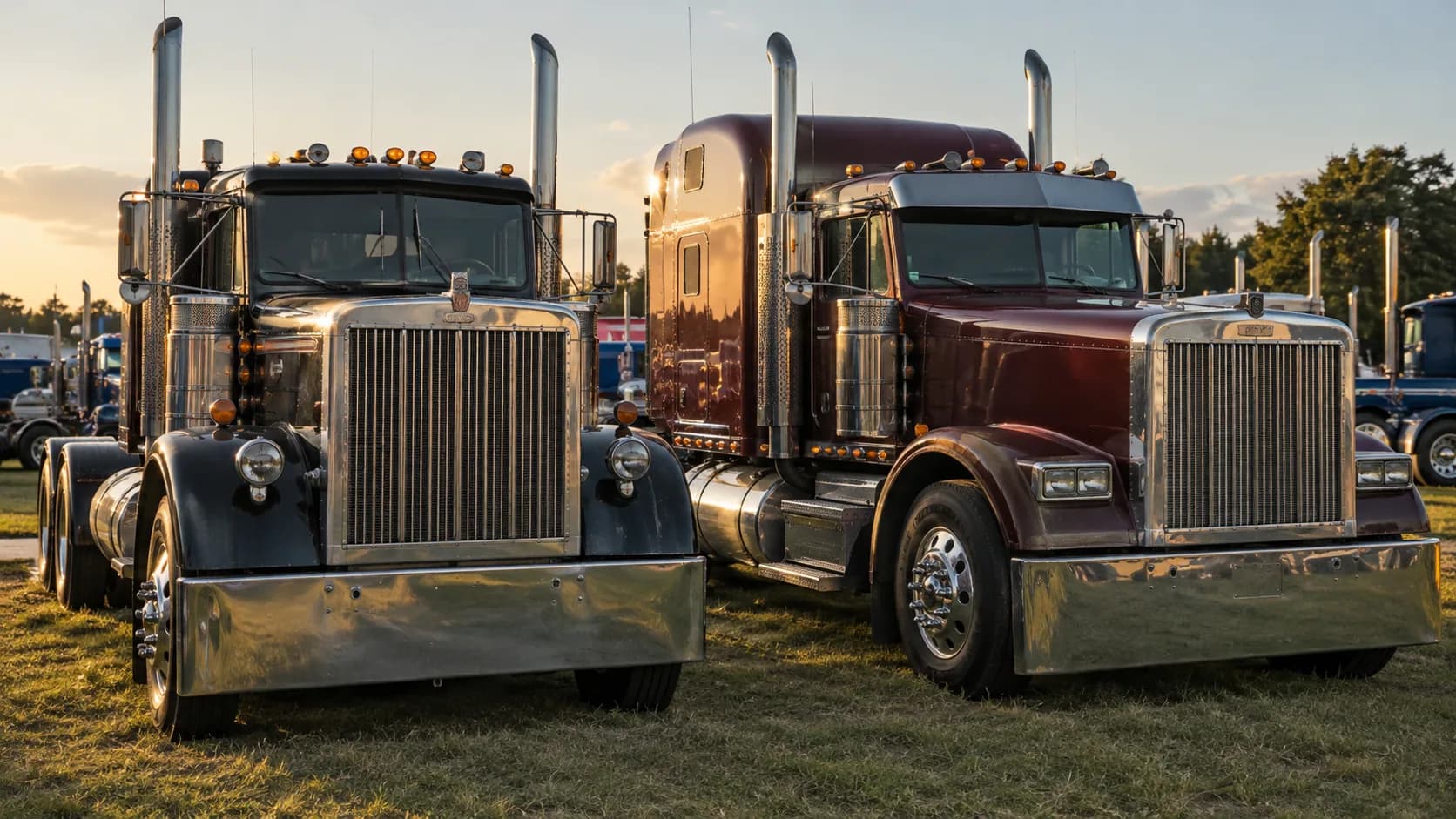
A tractor with no nose can pull a longer trailer, and for decades American law made that the whole point. The renders above imagine a flat-faced cabover and a long-hood conventional facing each other at dusk, and they are AI images, not photos of real trucks. The pairing is a fair summary of a trucking argument that the law settled, then settled again somewhere else. Our guides to the Peterbilt 352 Pacemaker, the Peterbilt 362, the Kenworth K100 and the White Freightliner cabover cover individual trucks. This one covers the why.
Why U.S. Fleets Ran Cabovers
The cabover began as a length-law workaround. Wikipedia says White Motor Company's 1932 cab-over truck, designed by Viktor Schreckengost and Ray Spiller and patented in 1934, put the cab over the engine and front axle to shorten the tractor, which allowed a longer trailer under a 42-foot highway limit. Expediters Online's history also points to 1930s laws that limited highway truck length to 42 feet.
Length rules kept the layout alive for decades. The Federal Highway Administration notes that there was no federal length standard before 1982 and that state rules varied. Expediters Online says the cabover was the most popular U.S. configuration until about 1986 because of overall length laws, and Wikipedia says cabovers were popular with heavy truckers in the 1970s for the same reason. Freight fleets bought them because every foot of tractor was a foot of cargo box they could not use.

The 1982 Law That Ended It
The Surface Transportation Assistance Act passed Congress in 1982, and President Reagan signed it on January 6, 1983. According to the FHWA, it set minimum trailer lengths of 48 feet for single-trailer combinations and 28 feet for doubles, and permitted no length restriction on the tractor or the overall configuration. The agency stresses these were minimums, not maximums. The act applied to the National Network, which the FHWA designated in June 1984, and it let states keep longer trailers already in lawful use on December 1, 1982. Alabama's grandfathered limit, for instance, is 53 feet 6 inches.
Once the tractor no longer counted against a length cap, the cabover's main advantage was gone. Jalopnik puts it that the cab-over's "greatest advantage evaporated," and conventionals offered roomier cabs and better sleepers. The decline was gradual. Peterbilt tried a streamlined cabover, the 372, in 1988, and drivers nicknamed it the football helmet. In November 1998 a Navistar executive said the heavy-truck cabover segment had declined about 90 percent since 1988, and Navistar said it would end 9800 production at its Springfield, Ohio plant on March 31, 1999. In August 1999 J.B. Hunt announced a plan to replace its cabover tractors with Freightliner conventionals, and the last Peterbilt 362 was built in 2005.
Ride, Comfort and Maintenance
The ride is the cabover's best-known complaint. Wikipedia says the shorter wheelbase and the driver's seat over the front axle give a rougher ride, and Expediters Online cites the harsh ride that comes from sitting there. Jalopnik adds that engine heat and noise reach a cabover cab more easily. Wikipedia also says early flat-faced cabovers had worse aerodynamics than conventionals, and that the U.S. Federal Bridge Formula discouraged the layout because tight axle spacing reduced allowable load.
The cabover wins on maneuverability. Jalopnik and Expediters Online both note a tighter turning radius, and Expediters adds the panoramic view from the seat, which suits dense streets, like the alley in the second render where a long trailer sits close to brick walls.
Engine access is a trade. A tilting cab opens up the engine, but Wikipedia warns that unsecured items in the cab and sleeper can fall onto the windshield or under the dash. Cost is murkier. A 2014 Work Truck Online article on medium-duty trucks (Class 4 to 7, not Class 8) quotes Gillies of GE Capital Fleet Services saying cabovers ran approximately 3 to 5 percent higher in price than comparable conventionals and cost more to maintain, citing higher parts costs and fewer shops. It is a medium-duty finding, so it may not carry over to long-haul tractors.

Why Cabovers Still Rule Elsewhere
Europe measures the whole vehicle. Volvo Trucks says European legislation limits overall vehicle length, including trailer and tractor, so short cabs leave more room for cargo, and Wikipedia says the layout is currently common among European and Asian truck makers. Wikipedia reports that Scania, the last European maker of conventional trucks, stopped production in 2005. Europe has begun to loosen the rule: Volvo says changes introduced in 2020 allow slightly longer noses where the cab delivers improved aerodynamic performance, energy efficiency and safety performance.
Asia shows the same logic in small trucks. Wikipedia says Japan's kei trucks are capped at 3.4 meters in length, and most current ones use the cab-over layout to maximize load-carrying ability. In Australia, Jalopnik says Kenworth's K200 and K220 cabovers are popular, though they are not sold in the U.S.
Where the Cabover Survives in America
Class 8 cabovers are mostly history, but the layout never left the work truck world. Wikipedia says cabovers are widely used in the United States for refuse collection, terminal tractors and other jobs that need a tight turning radius or frequent entry and exit. Wikipedia's Peterbilt article lists Peterbilt's 210 and 220 cabovers returning in 2011.
The bigger lesson is that the shape followed the rule. When American law stopped counting the tractor, the hood returned. When European law kept counting it, the hood never came.
Specs
- Early U.S. length cap
- 42 ft for highway trucks in the 1930s
- Cabover peak (U.S.)
- Most popular configuration until about 1986
- STAA signed
- January 6, 1983 (passed Congress in 1982)
- STAA minimums
- 48 ft single semitrailer; 28 ft each trailer in doubles; no tractor length limit on the National Network
- Cabover segment, 1988-1998
- Down about 90 percent, per a Navistar executive (Nov. 1998)
- Last Peterbilt cabover (362)
- 2005
- Cabover ride
- Driver sits over the front axle; harsher ride
- Europe
- Length limit covers the whole vehicle, tractor included
Get the Look
As an Amazon Associate we earn from qualifying purchases.
FAQ
- Why did cabover trucks go away in the US?
- Length laws made them popular, and the 1982 Surface Transportation Assistance Act stopped limiting tractor length on the National Network. Once a conventional could pull the same trailer, buyers chose its roomier cab and smoother ride.
- Why are European trucks cabovers?
- European legislation limits the overall vehicle length, including trailer and tractor, so a short cab leaves more room for cargo. A 2020 amendment allows slightly longer noses for aerodynamic cabs.
- Is a cabover or conventional truck more comfortable?
- Sources favor the conventional for long-haul comfort: the cabover driver sits over the front axle, with a harsher ride and more engine heat and noise reaching the cab. The cabover turns tighter.
- Are cabover semi trucks still made in the US?
- The last Peterbilt 362, a Class 8 cabover, was built in 2005. Cabovers remain in refuse collection and other vocational work, and Peterbilt's medium-duty 210 and 220 returned in 2011.