Cat 3406E vs Cummins N14: Which Big Rig Engine Won?
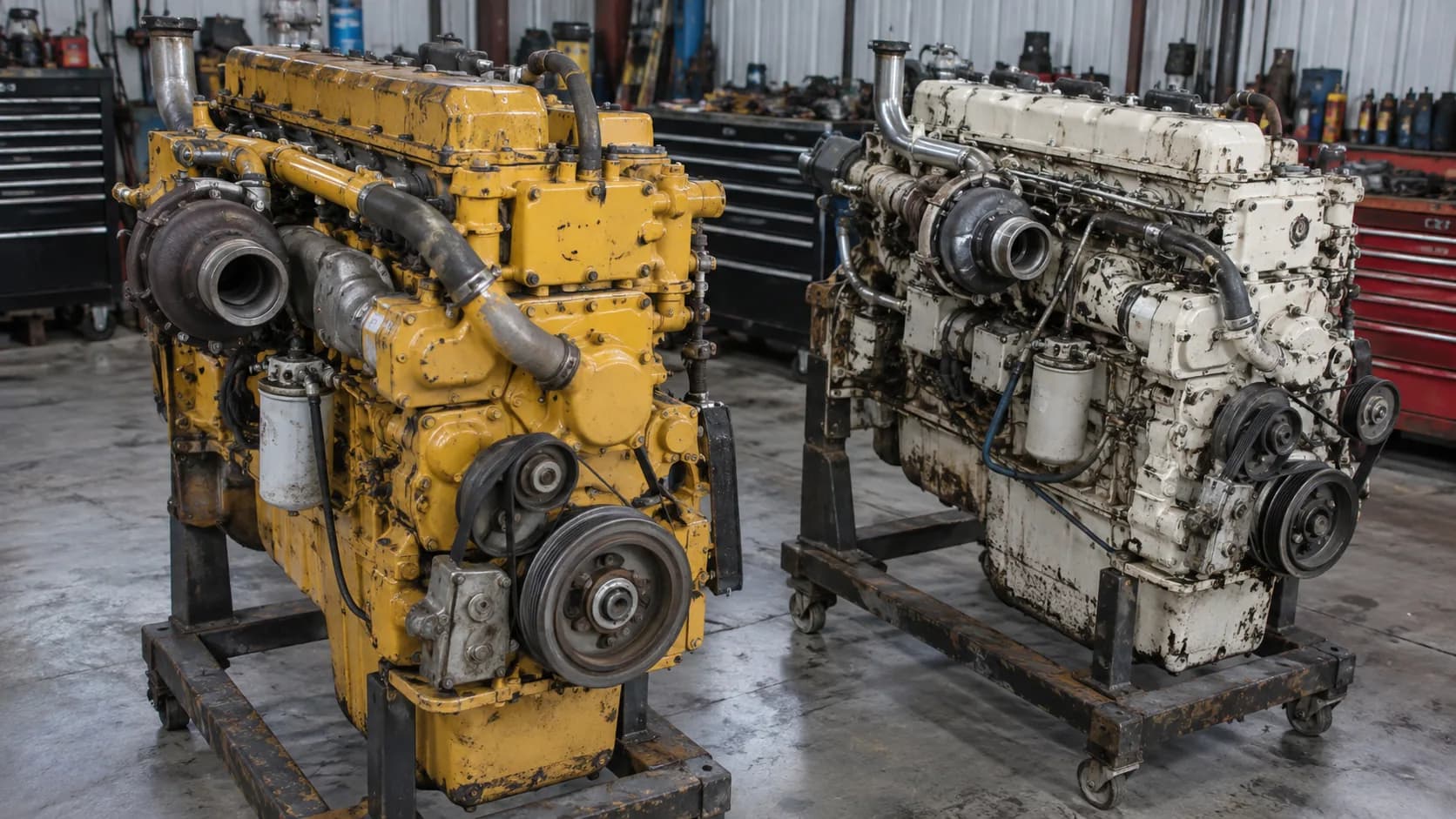
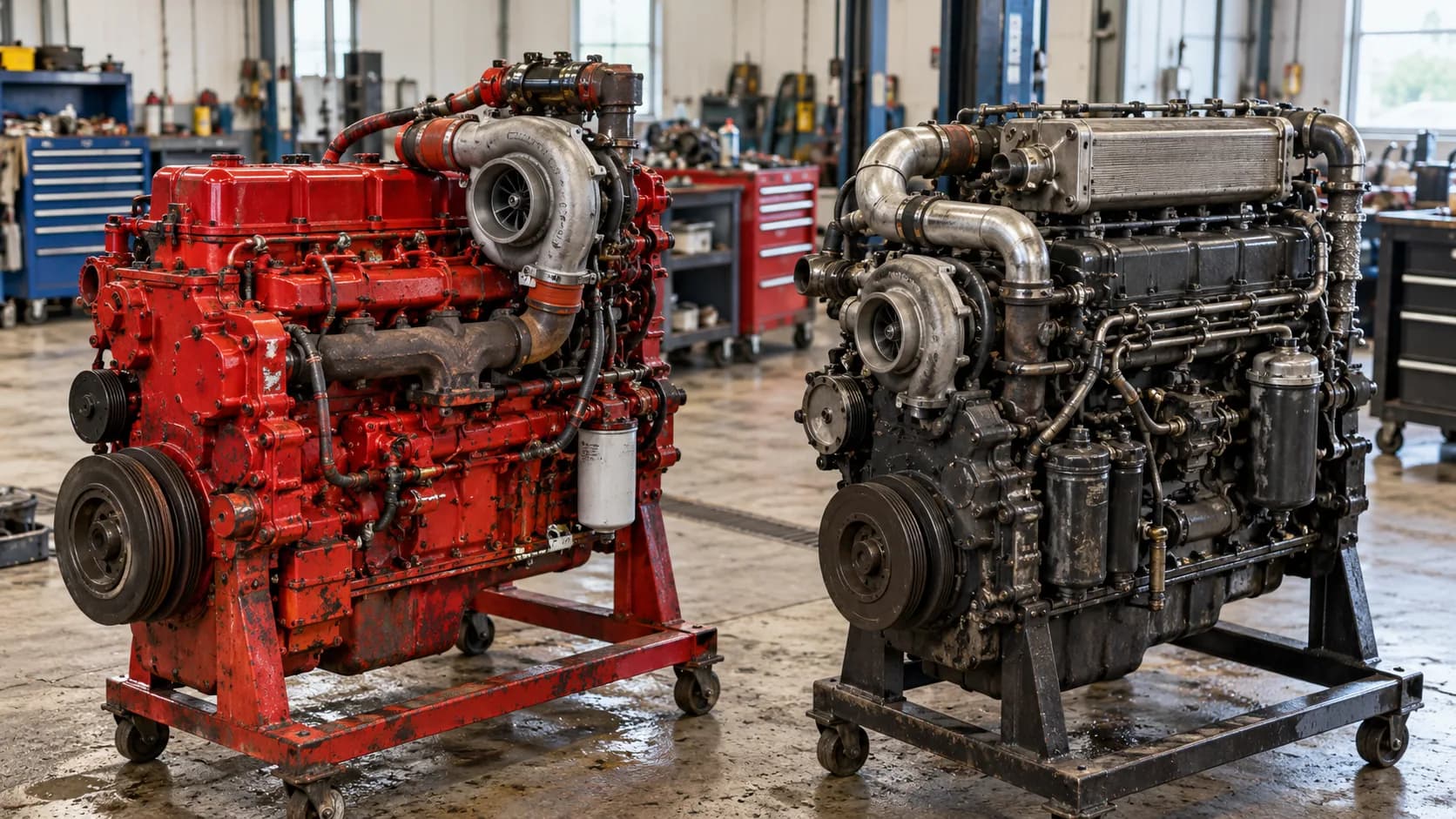
Ask a room of truckers whether they would rather have a Cat or a Cummins under the hood and you can start an argument that lasts until closing time. The AI render above captures the shape of it: two heavy diesels on stands side by side in a shop, one painted yellow and one cream, both with a turbocharger bolted to the side and the same tired, oil-stained look. They are not real engines, but the rivalry behind them is real, and it was one of the biggest in American big rigs.
The Contenders
The Caterpillar 3406 was built from 1973 to 2007 and displaces 893 cubic inches (14.6 liters), per engine histories from IPD and 4BT Engines. The Cummins N14 displaces 855 cubic inches (14.0 liters) and replaced the 855 Big Cam. Sources date the N14 from 1987 and end it in 2001 or 2002, though Capital Reman Exchange gives 1991 to 2001. The two were close enough in size that fleets and owner-operators could compare them on price, power and feel, and they often did.
Detroit Diesel entered the argument as the third option. Wikipedia's Series 60 entry says the engine arrived in 1987 as the first heavy-duty diesel with fully integrated electronic controls, and ran to 2011 in 11.1, 12.7 and 14.0-liter versions. Wikipedia adds that the 12.7 liter (775 cubic inch) was a preferred choice, particularly for motorcoaches.
Power and Torque on Paper
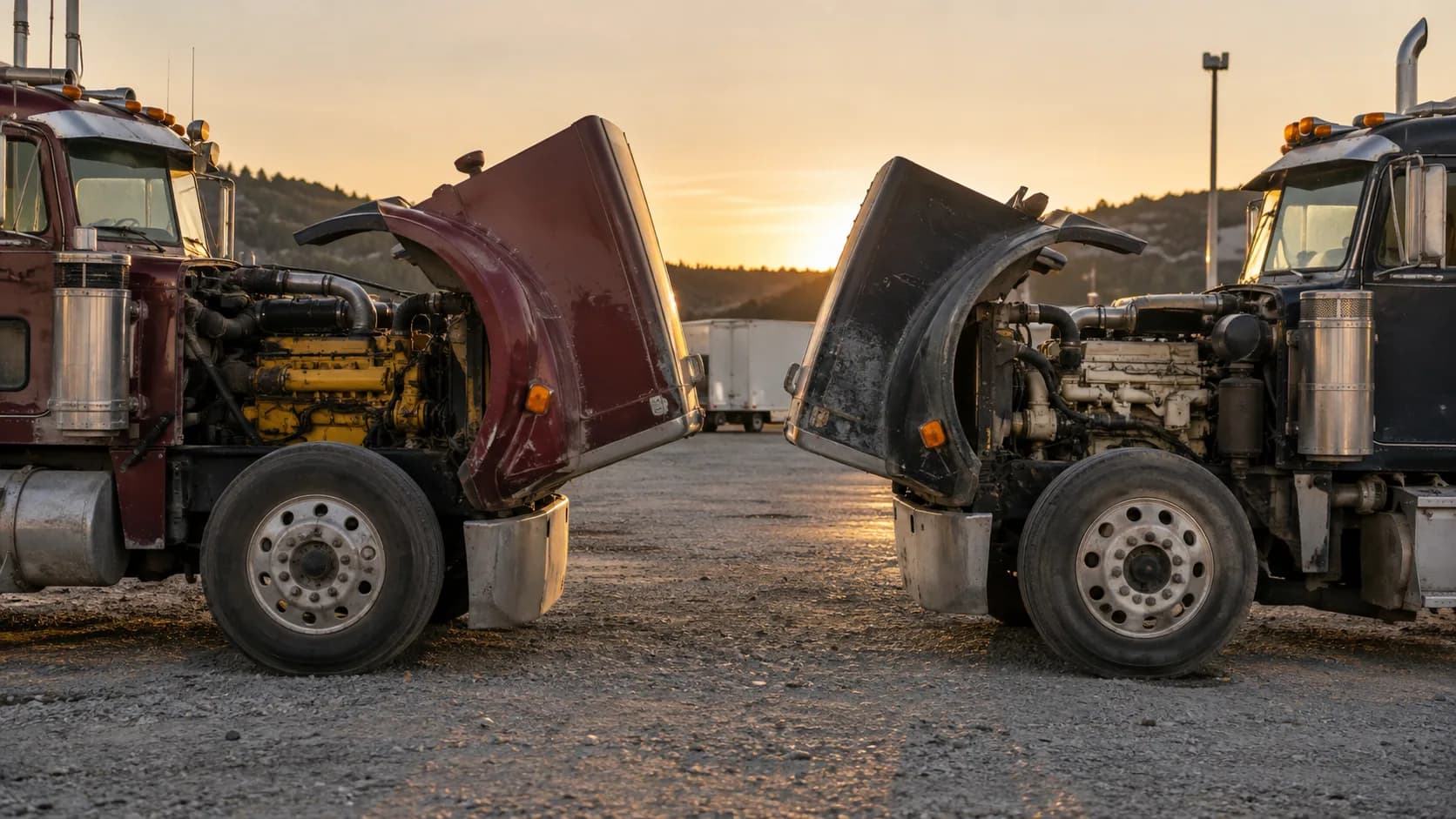
IPD's 3406 history lists the early mechanical 3406A at 310 to 425 hp and the 3406B at 350 to 525 hp with up to 1,750 lb-ft. The 3406C and 3406E reached higher, with IPD giving 365 to 625 hp for the C and 435 to 800 hp for the E, though 4BT Engines notes the 800 hp figure was a marine rating. The N14 ran 310 to 525 hp and 1,250 to 1,850 lb-ft of torque, according to 4BT Engines. The point is that the two families overlapped across most of the range a truck buyer cared about.
Mechanical vs Electronic
The split that shaped opinions was mechanical against electronic. DieselPro describes the 3406B as an all-mechanical engine and says the 3406C and 3406E later moved toward electronic control. IPD says the 3406E brought electronic unit injection and fully electronic management. Sources date the 3406E from November 1991 (4BT Engines) or 1993 (IPD).
Cummins moved the same way. 4BT Engines says early N14s were mechanical with a Pressure-Time injection system, and that from 1990 the Celect electronic system arrived. Detroit's Series 60 had electronics from the start.

What Owners Say
Opinions vary and should be read as opinions. DieselPro says many users prefer the 3406B for its simplicity and longevity, because no laptop is needed to diagnose it and most components can be reached with hand tools. For the Cat's later electronic 3406E, Highway and Heavy Parts lists injector problems, turbocharger wear, oil leaks and sensor or ECM problems among the recurring failure patterns, while stressing that reliability depends on oil system maintenance and proper diagnosis.
On the Cummins side, 4BT Engines says industry observers treat the N14 as highly durable, quoting the idea that the question is not whether it will reach a million miles but how far beyond. Capital Reman Exchange calls injectors the N14's Achilles heel and advises drivers to carry one or two spares. Jalopnik quotes a long-time owner recalling that few truck-stop arguments disputed that a Caterpillar pulled better. None of this is a reliability statistic, just how people describe their experience.
Why Cat Left the Highway
Caterpillar announced in June 2008 that it was leaving the North American on-highway truck engine business. Trucking News said the company cited problems with its 2007-compliant engines, which it said cost it market leadership to Cummins (Cummins held 30.9 percent of the market in 2007 to Cat's 25.7 percent, per that report), and a director's view that it would be increasingly difficult to participate as an independent engine maker. Truck News quoted Cat's on-highway director saying nothing would change through 2009, with the exit tied to the 2010 emissions rules. Jalopnik adds that its ACERT emissions system cost more than $500 million to develop and that on-highway engines were only about 8 percent of Caterpillar's engine production by 2008.
The Trucks They Lived In
Classic trucks give the rivalry its flavor. Our Peterbilt 379 guide notes that the long-hood's engine list included Cat's 3406 and later C-series engines, Cummins' N14 and ISX, and Detroit's Series 60. Our Kenworth W900 guide says Cat's 3406 was the engine most associated with the W900A's heyday, while Cummins and Detroit offered their own alternatives.
So which one won? On sales, Cummins had taken the lead by 2007, per Trucking News, and Cat soon left the field. In memory, the answer depends on which driver you ask.
Specs
- Cat 3406
- 1973-2007; 893 cu in (14.6 L) inline-six
- Cat 3406 versions
- 3406A and B mechanical; 3406C and E moved to electronic control; 3406E fully electronic
- Cummins N14
- From 1987 to about 2001-2002 (sources differ); 855 cu in (14.0 L) inline-six
- N14 power range
- 310-525 hp; 1,250-1,850 lb-ft
- N14 electronics
- Mechanical PT injection early; Celect electronics from 1990
- Detroit Series 60
- 1987-2011; 11.1, 12.7 and 14.0 L; electronic from the start
- Cat's exit
- Announced June 2008; engines offered through 2009, exit tied to 2010 emissions rules
FAQ
- Which is better, Cat 3406E or Cummins N14?
- There is no verdict both camps accept. Owner accounts differ: Jalopnik quotes an owner who says Cats pulled better, while 4BT Engines says veteran drivers rate the N14 as highly durable. Both engines had known weak points, and results depend on maintenance.
- What years was the Cat 3406 made?
- The Cat 3406 was built from 1973 to 2007, according to IPD and 4BT Engines. The fully electronic 3406E dates from 1991 (4BT Engines) or 1993 (IPD).
- Why did Caterpillar stop making truck engines?
- Caterpillar announced in June 2008 that it would leave the North American on-highway engine market. Trucking News cited problems with its 2007-compliant engines, lost market leadership to Cummins, and a market too small for several independent engine makers.
- Is the Cummins N14 a good engine?
- 4BT Engines says observers treat it as highly durable, with a reputation for going well past a million miles. Capital Reman Exchange lists injectors as its main weakness.
Know someone who drove one? Share this guide
Get the Look
As an Amazon Associate we earn from qualifying purchases.
- Kenworth W900 or Peterbilt 379 1:24 die-cast truck — Two long-hoods that carried these engines.
- 1:50 scale big rig die-cast set — For the shelf rivalry.
- CB radio for truck — Dash gear in the spirit of the cab render.
Sources
- ipdparts.com — history-of-the-caterpillar-3406-engine
- 4btengines.com — cat-3406-production-history-and-specs
- 4btengines.com — cummins-n14-production-history-and-specs
- trucksales.com.au — history-cummins-engines-down-under-118690
- capitalremanexchange.com — cummins-n14-specs-history-problems
- dieselpro.com — everything-you-need-to-know-about-the-caterpillar-3406b
- highwayandheavyparts.com — caterpillar-3406e-engine-spotlight
- en.wikipedia.org — Detroit_Diesel_Series_60
- ttnews.com — caterpillar-exits-us-truck-market
- jalopnik.com — why-caterpillar-stopped-making-truck-engines-reason-explained
- trucknews.com — cat-drops-a-bombshell
- dieselhub.com — cummins-n14